Spin-Orbit Coupling (LS Coupling) and the Fine Structure of Hydrogen
We flip to the electron's frame, crank through Biot-Savart and magnetic moments, and nail down the spin-orbit Hamiltonian correction behind hydrogen's fine structure.
Both the electron and the proton carry spin and therefore have magnetic moments. Because a spin magnetic moment scales inversely with the particle’s mass, the electron’s contribution is much larger than the proton’s. That makes the electron spin the natural place to focus when studying hydrogen’s spin–orbit interaction.
1. The electron’s frame and an effective magnetic field
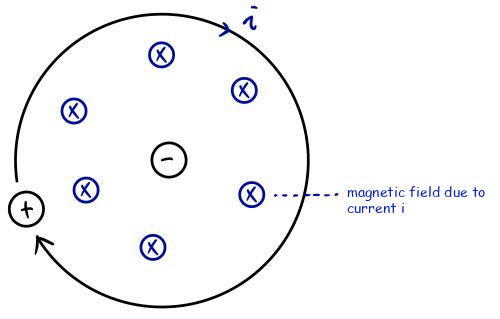
The opening sketch has already made the frame flip: the minus-marked electron is at the center, while the plus-marked proton follows the large orbit. The red arrow on the orbiting proton shows its spin, and the second red arrow shows the central electron’s spin.
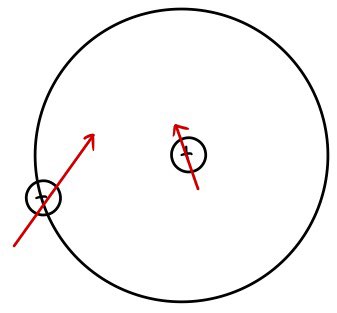
This is the electron’s instantaneous rest frame rather than the familiar nucleus-rest frame. The proton appears to move around the electron, forming a current loop. The loop produces a magnetic field at the electron, and that field interacts with the electron’s spin magnetic moment.
The interaction Hamiltonian has the familiar magnetic-dipole form
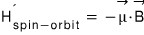
The sign matters: the interaction changes the energy according to the relative orientation of the magnetic moment and the field.
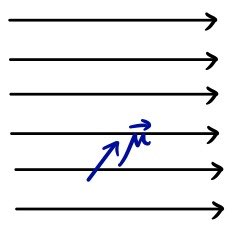
To evaluate this perturbation, we need two ingredients: the magnetic field $\mathbf B$ produced by the apparent proton current and the electron spin magnetic moment $\boldsymbol{\mu}_e$.
2. Magnetic field from the apparent proton current
Keep the two frames’ variables distinct when applying the Biot–Savart law. In the nucleus frame, let $\mathbf r_e$ point from the proton to the electron and let $\mathbf v_e$ be the electron velocity, so the electron’s orbital angular momentum is $\mathbf L=m\mathbf r_e\times\mathbf v_e$. In the electron frame the apparent proton velocity is $\mathbf v_p=-\mathbf v_e$, while the source-to-field displacement in Biot–Savart points from the proton to the electron, $\mathbf R=\mathbf r_e$. Therefore
$$ \mathbf v_p\times\mathbf R =(-\mathbf v_e)\times\mathbf r_e =\mathbf r_e\times\mathbf v_e =\frac{\mathbf L}{m}. $$Thus the image’s $m\mathbf v\times\mathbf r=\mathbf L$ must be read with its electron-frame apparent-proton variables, $\mathbf v=\mathbf v_p$ and $\mathbf r=\mathbf R$; it is not the nucleus-frame product $m\mathbf v_e\times\mathbf r_e$. Writing the current magnitude as $I=e/T=ev_p/(2\pi r)$ then gives the field at the center:
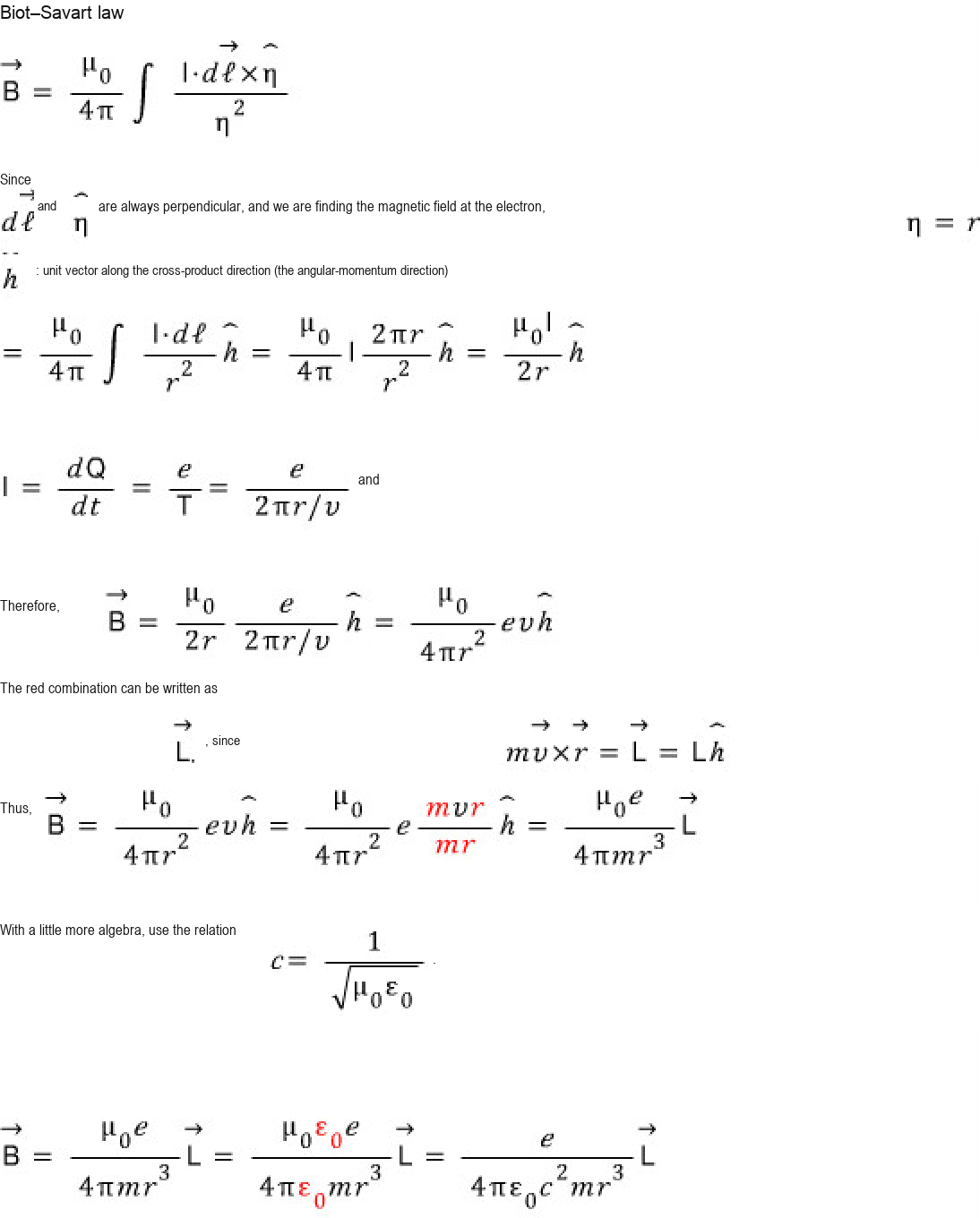
where $m$ is the electron mass in this approximation and $c^{-2}=\mu_0\varepsilon_0$.
3. The electron spin magnetic moment
A magnetic moment is current times the oriented area of the loop. Because the electron has charge $-e$, the simple rotating-charge picture starts from
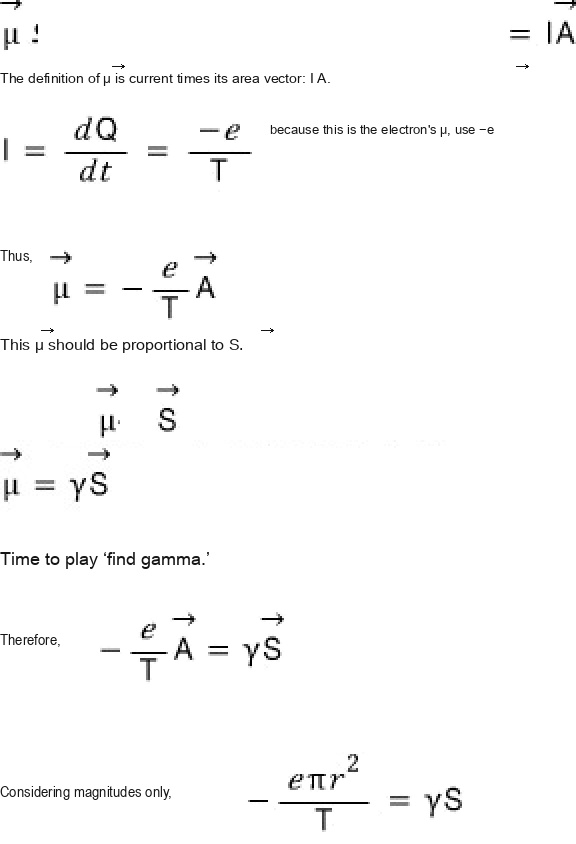
To see what that argument is trying to do, imagine—only heuristically—that the electron is a rotating sphere.
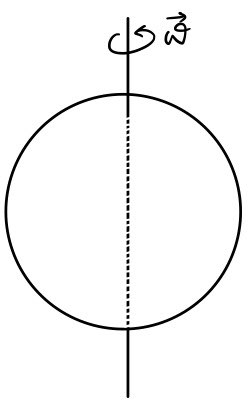
For such a model, $S=I\omega$, with a moment of inertia proportional to $mr^2$, while the angular speed is $\omega=2\pi/T$.
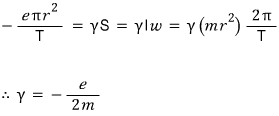
The classical estimate then gives the gyromagnetic ratio
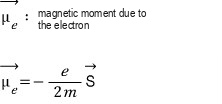
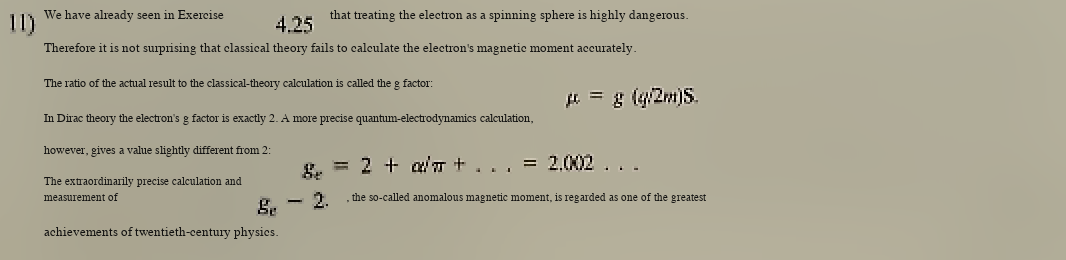
That was pleasantly easy—and it is also incomplete. An electron is not a tiny classical sphere, and its intrinsic spin cannot be derived from a literal surface rotation. Relativistic quantum mechanics supplies the missing factor through the electron spin $g$ factor:
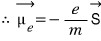
so the Dirac-level result is $\boldsymbol{\mu}_e\approx-(e/m)\mathbf S$. Quantum electrodynamics adds a small anomalous correction to $g=2$.
4. The spin-orbit Hamiltonian and the Thomas factor
Combining the effective field with the Dirac magnetic moment first produces

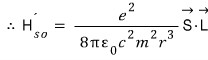
This electron-frame argument still overcounts the interaction by a factor of two. The electron’s instantaneous rest frame is continuously accelerating, and successive Lorentz boosts do not combine into a pure boost; their extra rotation is the Thomas precession. Accounting for it introduces the Thomas factor $1/2$.
Equivalently, a systematic treatment in the nucleus-rest frame couples the electron’s motion and magnetic moment to the nuclear electric field and yields the same corrected term. The compact result for a Coulomb potential is
5. Why the coupled angular-momentum basis is useful
We now want the first-order expectation value of $H'_{\mathrm{so}}$. The uncoupled hydrogen basis $|n,\ell,m_\ell,s,m_s\rangle$ diagonalizes $L^2$, $L_z$, $S^2$, and $S_z$, but it does not diagonalize $\mathbf L\cdot\mathbf S$.
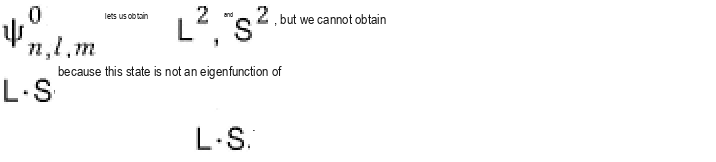
The desired correction is

Define the total angular momentum

The coupled basis $|n,\ell,s,j,m_j\rangle$ simultaneously diagonalizes the relevant squared angular momenta:

Squaring $\mathbf J=\mathbf L+\mathbf S$ gives the key identity
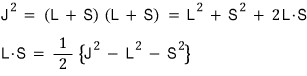
This is exactly why the coupled quantum numbers $n,\ell,s,j,m_j$ are the convenient choice.
6. First-order spin-orbit energy shift
Insert the angular-momentum identity into the expectation value:
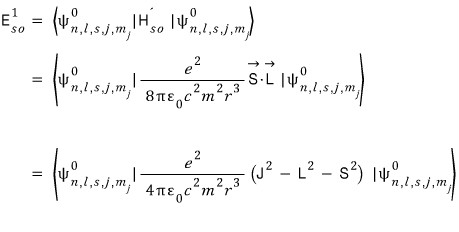
The retained image contains an inherited coefficient error. Starting from the correct $1/(8\pi)$ coefficient multiplying $\mathbf L\cdot\mathbf S$, substitution of $\mathbf L\cdot\mathbf S=\tfrac12(J^2-L^2-S^2)$ must produce $1/(16\pi)$, not the $1/(4\pi)$ printed in the image. The authoritative corrected operator expression is
$$ E_{\mathrm{so}}^{(1)} =\left\langle \frac{e^2}{16\pi\varepsilon_0c^2m^2r^3} \left(J^2-L^2-S^2\right) \right\rangle. $$The eigenvalue of $\mathbf L\cdot\mathbf S$ in the coupled basis is
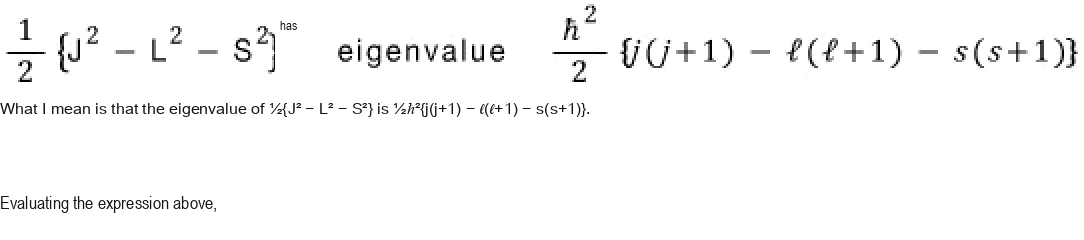
Therefore,
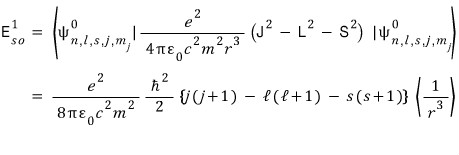
The first line of this retained image repeats the erroneous $1/(4\pi)$ coefficient. Its second line silently changes to a factor $e^2/(8\pi\varepsilon_0c^2m^2)$ multiplied by $\hbar^2/2$, which gives the correct $e^2\hbar^2/(16\pi\varepsilon_0c^2m^2)$ coefficient. The native equation below is authoritative.
$$ E_{\mathrm{so}}^{(1)} =\frac{e^2\hbar^2}{16\pi\varepsilon_0c^2m^2} \left[j(j+1)-\ell(\ell+1)-s(s+1)\right] \left\langle\frac1{r^3}\right\rangle. $$The remaining radial expectation value was derived in Quantum Mechanics #29: Kramers’ Relation.
For hydrogen states with $\ell\ne0$,
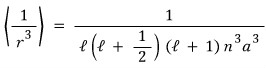
where $a$ is the Bohr radius. Substitution gives the final shift displayed in the source derivation:
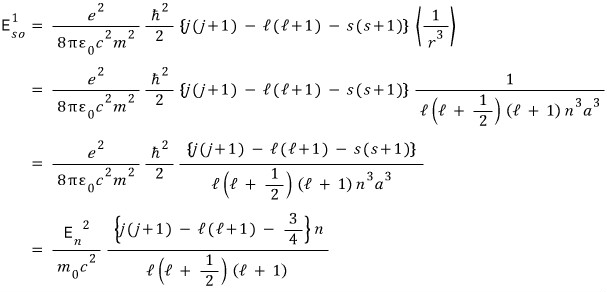
The nonrelativistic hydrogen energy depends only on $n$, whereas this correction depends on the coupling of $\mathbf L$ and $\mathbf S$ through $j$. Together with the relativistic kinetic-energy correction from the previous post, this produces the familiar fine splitting of the hydrogen spectrum. Its relative scale is of order $\alpha^2$, so the source’s closing description—about one part in ten thousand of the nonrelativistic energy—is a reasonable order-of-magnitude statement, with the precise coefficient depending on the state. A complete leading-order treatment also handles the $\ell=0$ sector separately through the Darwin contact term; the $\langle r^{-3}\rangle$ formula above is not to be extended to $s$ states.
Comments
Discussion happens via GitHub Discussions. You'll need a GitHub account to comment.