Perturbation Theory Practice Problems
Working through classic perturbation theory homework problems — delta-function bumps in infinite square wells and harmonic oscillator perturbations, step by step.
These exercises focus on the basic machinery of time-independent perturbation theory rather than hydrogen fine structure, the Zeeman effect, or hyperfine structure. Our professor emphasized this material, so we worked through a lot of examples. Here are three of them.
Problem 6.1: a delta-function bump in an infinite square well
Consider an infinite square well on $0\lt x\lt a$ with a delta-function perturbation of strength $\alpha$ at the center:
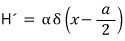
(a) First-order energy correction
For the unperturbed well,
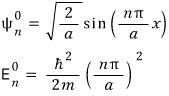
or, in accessible notation,
$$ \psi_n^{(0)}(x)=\sqrt{\frac{2}{a}}\sin\!\left(\frac{n\pi x}{a}\right), \qquad E_n^{(0)}=\frac{\hbar^2\pi^2n^2}{2Ma^2}, $$where $M$ is the particle mass. The first-order correction is the expectation value of $H'$:
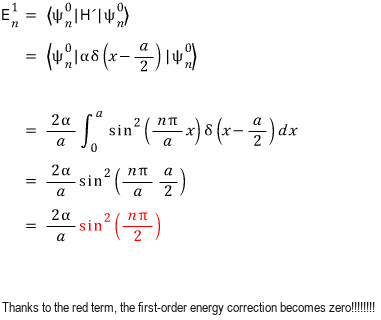
Thus
$$ E_n^{(1)}=\langle n|H^{\prime}|n\rangle=\frac{2\alpha}{a}\sin^2\!\left(\frac{n\pi}{2}\right)=\begin{cases}2\alpha/a,&n\ \text{odd},\cr 0,&n\ \text{even}.\end{cases} $$The even-$n$ states vanish at $x=a/2$, so a delta function placed there has zero overlap with them. That node is the simple reason their first-order energies do not move.
(b) First three nonzero terms in the ground-state wavefunction correction
We want the first-order correction to the ground-state wavefunction,

which is expanded as
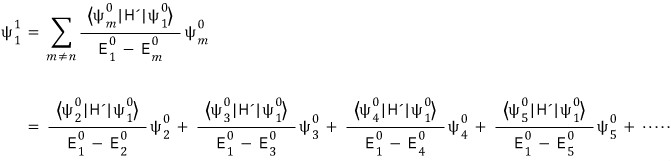
The standard nondegenerate formula is
$$ |1^{(1)}\rangle =\sum_{m\ne1} \frac{\langle m^{(0)}|H'|1^{(0)}\rangle} {E_1^{(0)}-E_m^{(0)}}|m^{(0)}\rangle. $$The handwritten calculation is preserved below as part of the original working.
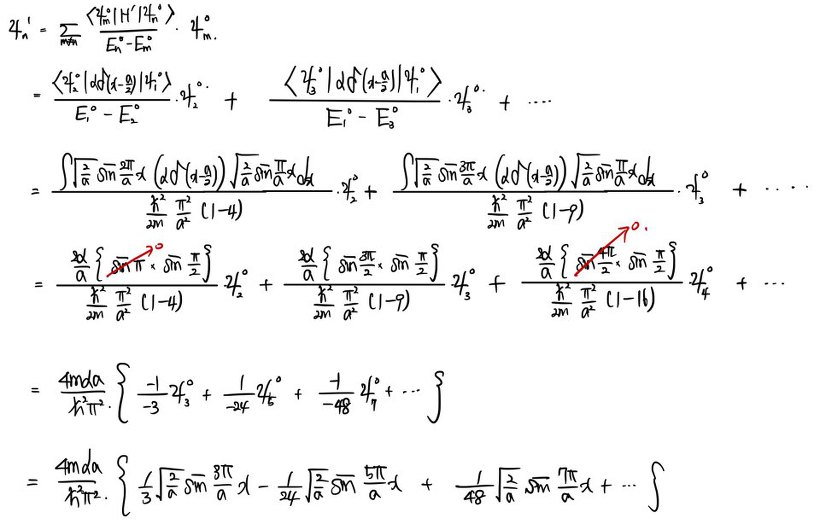
At the center of the well,
$$ \langle m^{(0)}|H'|1^{(0)}\rangle =\frac{2\alpha}{a}\sin\!\left(\frac{m\pi}{2}\right). $$Only odd $m$ survive, and $m=1$ is excluded from the sum. Writing the particle mass as $M$ to avoid confusing it with the summation index, the first three nonzero terms are therefore
$$ |1^{(1)}\rangle =\frac{M\alpha a}{\hbar^2\pi^2} \left( \frac12|3^{(0)}\rangle -\frac16|5^{(0)}\rangle +\frac1{12}|7^{(0)}\rangle +\cdots \right). $$This native expression is the corrected result to use. The preserved handwritten image appears to start from an even intermediate state and gives coefficients that do not follow from the displayed matrix element; those are source-working errors, not steps being endorsed here.
Problem 6.2: changing the spring constant
For the simple harmonic oscillator,
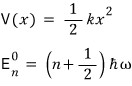
Now perturb the spring constant according to
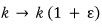
so that $k\mapsto k(1+\varepsilon)$.
Exact expansion
The exact frequency becomes $\omega'=\omega\sqrt{1+\varepsilon}$, hence
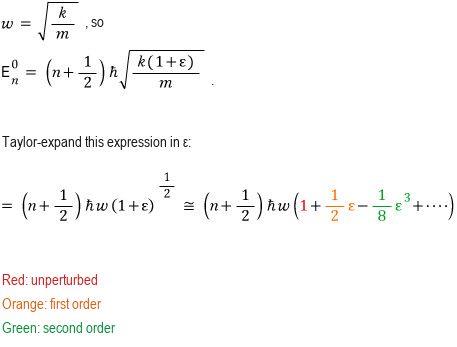
The correct Taylor series is
$$ E_n =\left(n+\frac12\right)\hbar\omega\sqrt{1+\varepsilon} =E_n^{(0)}\left(1+\frac{\varepsilon}{2}-\frac{\varepsilon^2}{8} +\frac{\varepsilon^3}{16}+O(\varepsilon^4)\right). $$The preserved image labels the green term as second order but prints $-\varepsilon^3/8$. That exponent is a source-image typo: the second-order term is $-\varepsilon^2/8$.
Perturbative check
The next source image writes $H_0+H'$ as though it were only the perturbed quadratic potential:
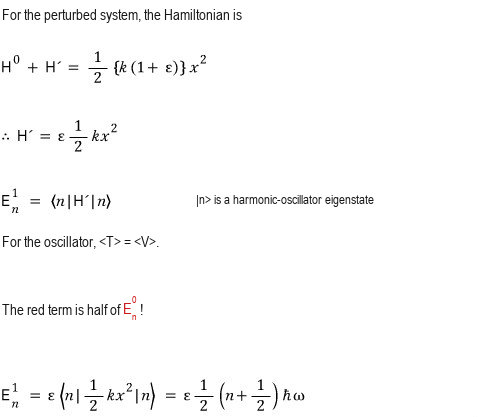
That displayed equality omits the unchanged kinetic term and is not a complete Hamiltonian identity. It is valid only for the potential-energy part. The full Hamiltonian and its perturbation are
$$ H_0+H'=\frac{p^2}{2M}+\frac12k(1+\varepsilon)x^2, \qquad H'=\frac12\varepsilon kx^2 =\frac{\varepsilon\hbar\omega}{4}(a+a^\dagger)^2. $$Using $\langle n|x^2|n\rangle=\hbar(n+\tfrac12)/(M\omega)$ gives
$$ E_n^{(1)} =\frac{\varepsilon}{2}\left(n+\frac12\right)\hbar\omega =\frac{\varepsilon}{2}E_n^{(0)}. $$For second order, $x^2$ connects $|n\rangle$ only to $|n\pm2\rangle$ off the diagonal. The two contributions give
$$ E_n^{(2)} =\sum_{m\ne n}\frac{|\langle m|H'|n\rangle|^2}{E_n^{(0)}-E_m^{(0)}} =-\frac{\varepsilon^2}{8}\left(n+\frac12\right)\hbar\omega =-\frac{\varepsilon^2}{8}E_n^{(0)}, $$in agreement with the corrected exact expansion.
Problem 6.5: a charged oscillator in a weak electric field
Consider a particle of charge $q$ in a one-dimensional harmonic-oscillator potential. A constant weak electric field $\mathcal E$ adds
$$ H'=-q\mathcal E x. $$We will show that the first-order correction vanishes, calculate the second-order correction, and then verify the result by solving the shifted oscillator exactly.
(a) Perturbation theory
The first-order correction is introduced in the preserved source as follows:
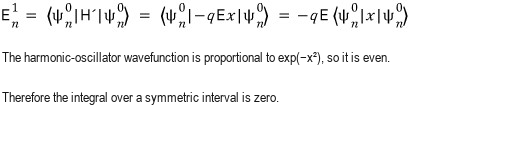
The image’s claim that every $\psi_n$ is even is incorrect: oscillator eigenfunctions have parity $(-1)^n$, so odd-$n$ wavefunctions are odd. What is even for every number state is the probability density $|\psi_n(x)|^2$. Therefore the integrand $x|\psi_n(x)|^2$ is odd, and
$$ E_n^{(1)}=-q\mathcal E\langle n|x|n\rangle=0. $$The next preserved image has already moved to second order; it is not another first-order parity argument:
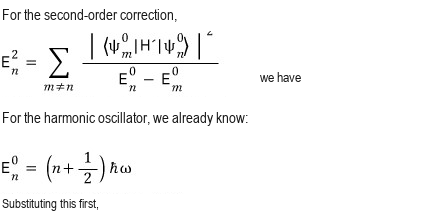
For the second-order correction,
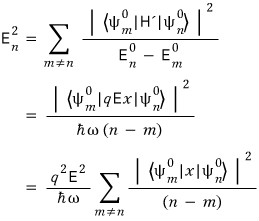
Direct integration with oscillator wavefunctions is possible, but ladder operators are cleaner. The preserved reminder below labels a Gaussian-only expression as the general $\psi_n^{(0)}$:
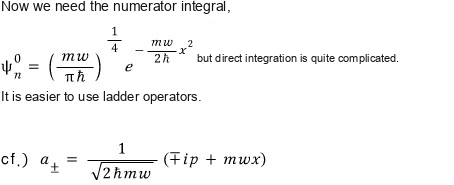
That Gaussian-only form is the $n=0$ shape, up to normalization. In general,
$$ \psi_n(x)\propto H_n\!\left(\sqrt{\frac{M\omega}{\hbar}}x\right) e^{-M\omega x^2/(2\hbar)}, $$so the Hermite polynomial supplies the $n$-dependence and parity. This source-image defect does not affect the ladder-operator derivation that follows.
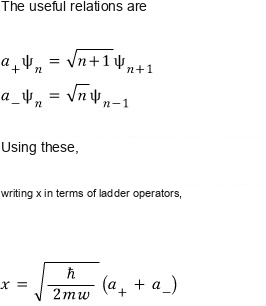
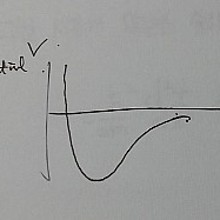
For a refresher, see The Harmonic Oscillator and Ladder Operators. The sketch below shows the original oscillator-potential reminder.
Write the bra and ket as number states,
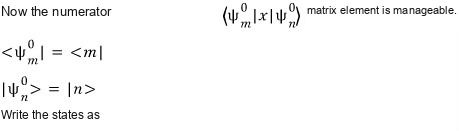
and use $x=\sqrt{\hbar/(2M\omega)}(a+a^\dagger)$:
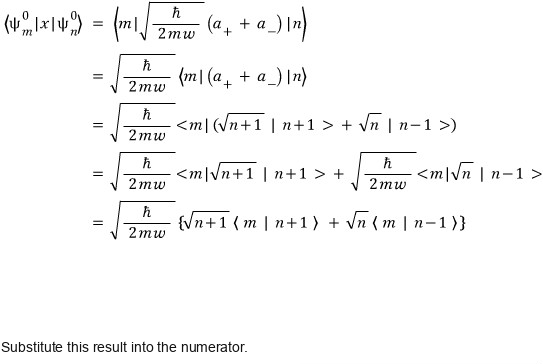
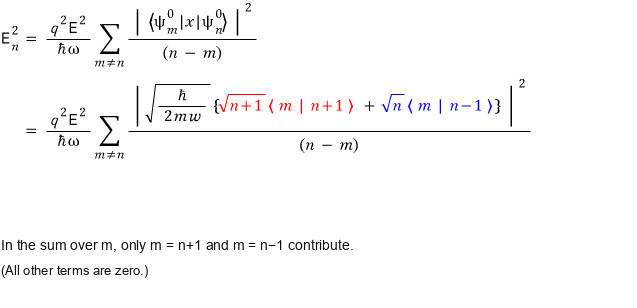
The Kronecker deltas leave only $m=n+1$ and $m=n-1$. Evaluating those two terms,

gives the $n$-independent shift
$$ E_n^{(2)} =\frac{q^2\mathcal E^2}{2M\omega^2} \left(\frac{n}{1}-\frac{n+1}{1}\right) =-\frac{q^2\mathcal E^2}{2M\omega^2}. $$(b) Exact solution by shifting the coordinate
Now solve the Schrödinger equation directly:
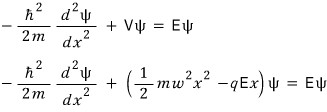
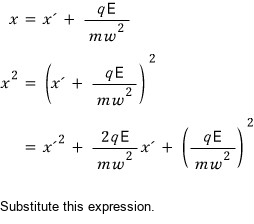
The suggested coordinate shift is
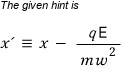
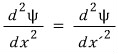
Because the shift is constant, the second derivative is unchanged:
Substituting the shifted coordinate gives

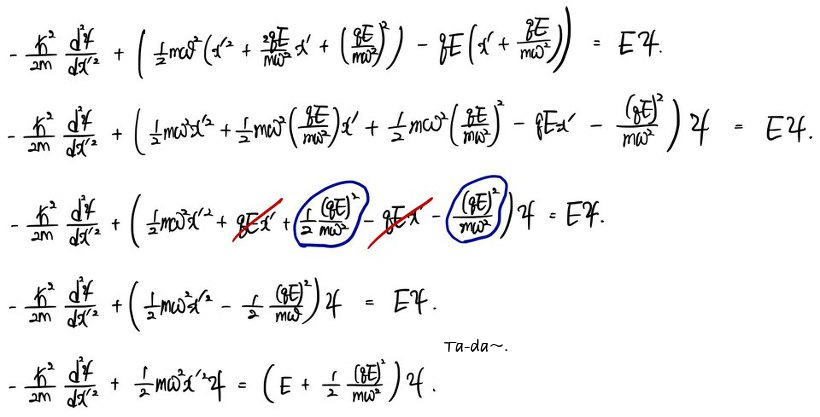
Equivalently, completing the square directly yields
$$ \frac12M\omega^2x^2-q\mathcal E x =\frac12M\omega^2 \left(x-\frac{q\mathcal E}{M\omega^2}\right)^2 -\frac{q^2\mathcal E^2}{2M\omega^2}. $$The Hamiltonian therefore has the usual oscillator spectrum plus a constant negative shift:
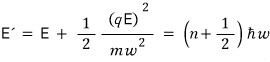
$$ E_n=\left(n+\frac12\right)\hbar\omega -\frac{q^2\mathcal E^2}{2M\omega^2}. $$The preserved source next writes an intermediate primed-energy relation,
and summarizes it as follows:

Those two images use $E$ and $E'$ ambiguously. If $E'=E+q^2\mathcal E^2/(2M\omega^2)$ denotes the eigenvalue on the completed-square oscillator side, then $E'=(n+\tfrac12)\hbar\omega$ and the physical energy is
$$ E=E'-\frac{q^2\mathcal E^2}{2M\omega^2}. $$So the physical shift is negative, exactly matching the second-order perturbative result. In this case all higher-order corrections vanish because completing the square gives the exact answer. That is the reassuring point of the exercise: when an exact solution is available, it confirms the perturbative calculation—and when it is not, the same method can still provide a controlled approximation.
Comments
Discussion happens via GitHub Discussions. You'll need a GitHub account to comment.