Van der Waals Interaction and the Stark Effect
A walkthrough of Griffiths Problem 6.31, deriving the weak van der Waals attraction between two polarizable atoms using perturbation theory and Taylor series.
This post works through two applications of time-independent perturbation theory. Problem 6.31 models the van der Waals attraction between two neutral but polarizable atoms. Problem 6.36 introduces the linear Stark effect in hydrogen. The original equation images are retained in their existing order, and typed equations below them make the derivations accessible and explicitly identify and correct several formula errors in the source images.
Problem 6.31: van der Waals attraction
Coupled-oscillator model
Place two heavy nuclei a distance \(R\) apart and let \(x_1\) and \(x_2\) be the small longitudinal displacements of their electrons. Each electron has mass \(m\), charge \(-e\), and a harmonic restoring force with spring constant \(k\). The nuclei are treated as fixed. The unperturbed Hamiltonian is

The next source image attempts to list the four Coulomb interactions between the two nuclei and two electrons:

Its denominator signs do not match the geometry used by the subsequent derivation: the raster shows \(-1/(R-x_2)\) and \(+1/(R+x_1-x_2)\). With the stated displacement convention, those two denominators must instead be \(R+x_2\) and \(R-x_1+x_2\). The corrected exact interaction is
\[ H'=\frac{e^2}{4\pi\epsilon_0} \left(\frac1R-\frac1{R-x_1}-\frac1{R+x_2}+\frac1{R-x_1+x_2}\right). \]For \(|x_1|,|x_2|\ll R\), the leading nonzero term is
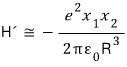
To see the cancellation explicitly, first factor \(1/R\) from every corrected denominator:

The needed binomial expansions are
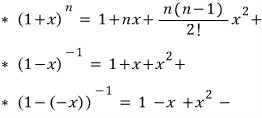
Substituting these series gives the intermediate expansion. The retained source image is not a complete or sign-consistent version of this step: its first line reverts the fourth denominator to \(R+x_1-x_2\), instead of the corrected \(R-x_1+x_2\), and its factorized second line closes after the third term, omitting the fourth Coulomb term altogether.
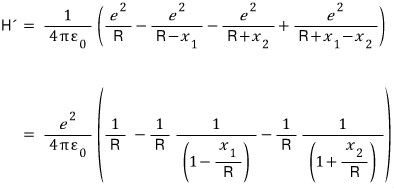
The next retained source image is internally inconsistent. Its top exact-expression line repeats the incorrect fourth denominator \(R+x_1-x_2\), but the following factorized line switches to the corrected factor \(1-(x_1-x_2)/R\), and its bottom Taylor expansion follows that corrected sign. The authoritative second-order expansion is therefore the native equation below, not the raster’s top line:
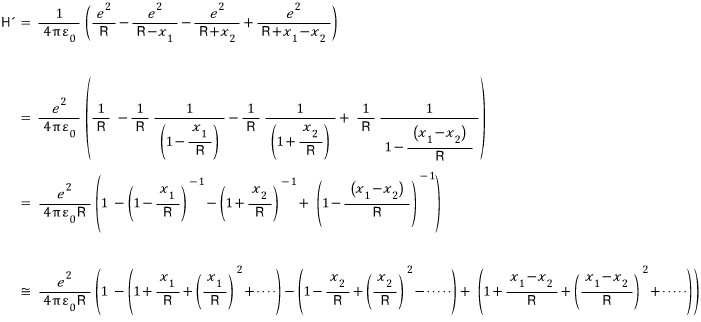
The constant and linear terms cancel. The surviving quadratic numerator is
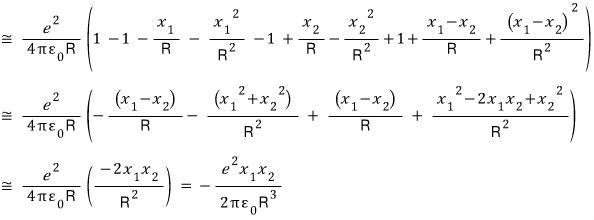
which proves the stated dipole-dipole approximation.
Normal modes
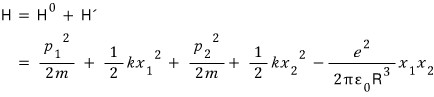
The retained raster below is already written in the normal coordinates \(x_+\) and \(x_-\), despite appearing before their definition. It is not the unseparated \(x_1,x_2\) Hamiltonian. Moreover, it uses \(e^2/(4\pi\epsilon_0R^3)\) as the effective-spring shift, one half of the required coupling \(\lambda=e^2/(2\pi\epsilon_0R^3)\):

The correct coupled Hamiltonian from which the normal modes must be derived is
\[ H=\frac{p_1^2+p_2^2}{2m}+\frac{k}{2}(x_1^2+x_2^2) -\lambda x_1x_2, \qquad \lambda\equiv\frac{e^2}{2\pi\epsilon_0R^3}. \]Introduce the orthonormal normal coordinates
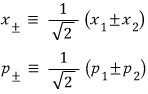
together with \(p_+=(p_1+p_2)/\sqrt2\) and \(p_-=(p_1-p_2)/\sqrt2\). The starting Hamiltonian may then be written compactly as
The next raster repeats the already separated expression from \(\mathrm{eq\_024}\); it is not a coupled Hamiltonian waiting to be separated, and it repeats the same factor-of-two error in the effective-spring shifts:

The inverse coordinate transformation is
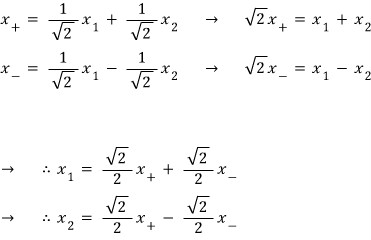
The momenta transform in exactly the same way:
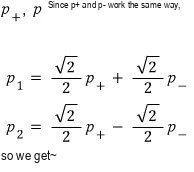
Substitute these relations into
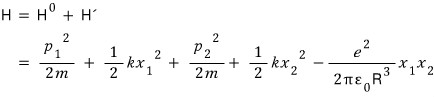
The handwritten working below correctly cancels the mixed terms: orthogonality gives \(p_1^2+p_2^2=p_+^2+p_-^2\) and \(x_1^2+x_2^2=x_+^2+x_-^2\), while \(x_1x_2=(x_+^2-x_-^2)/2\). Its final line, however, again uses \(e^2/(4\pi\epsilon_0R^3)\) as the spring shift. That is a factor-of-two error; the shift is \(\lambda=e^2/(2\pi\epsilon_0R^3)\).
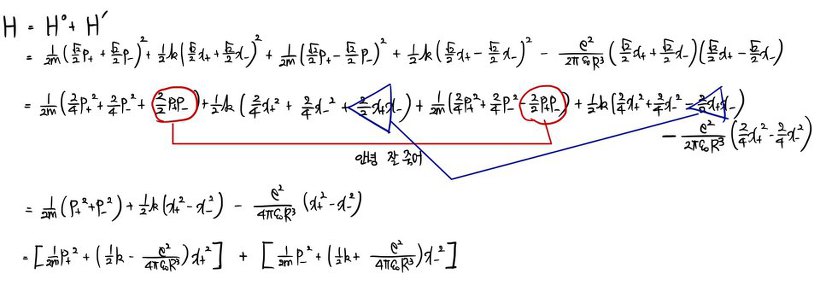
Therefore the correct separated Hamiltonian is

The two effective spring constants are consequently
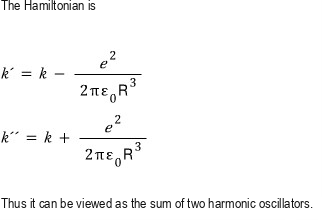
The factor \(1/2\) in the oscillator potential \(\tfrac12k_\pm x_\pm^2\) does not halve the spring-constant shift. Because \(-\lambda x_1x_2=-(\lambda/2)x_+^2+(\lambda/2)x_-^2\), comparison with \(\tfrac12k_\pm x_\pm^2\) gives the full shifts \(k_+=k-\lambda\) and \(k_-=k+\lambda\). This is precisely why the half-sized shifts in \(\mathrm{eq\_024}\), \(\mathrm{eq\_031}\), and the last line of \(\mathrm{img\_038}\) are incorrect.
Ground-state energy and the \(R^{-6}\) potential
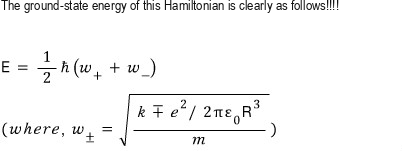
The mode frequencies and coupled ground-state energy are
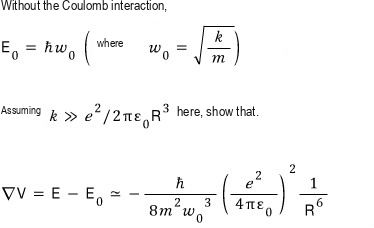
Without the interaction, \(\omega_0=\sqrt{k/m}\) and the two oscillators have total ground-state energy \(E_0=\hbar\omega_0\). The source image labels the requested difference with a symbol that resembles \(\nabla V\) or \(\Delta V\), but the quantity actually calculated is the energy shift \(\Delta E=E-E_0\). It also uses \((e^2/(4\pi\epsilon_0))^2\) in the final \(R^{-6}\) coefficient. Since the correct coupling contains \(e^2/(2\pi\epsilon_0)\), the raster coefficient is too small by a factor of four:
Define the dimensionless coupling
\[ \alpha=\frac{\lambda}{k}=\frac{e^2}{2\pi\epsilon_0R^3k},\qquad |\alpha|\ll1. \]Then the exact normal-mode expression becomes
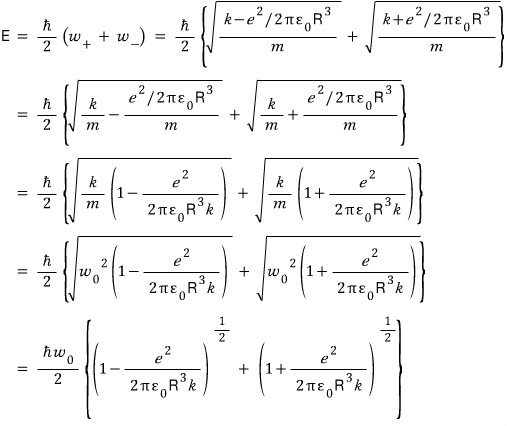
Using \(\sqrt{1\pm\alpha}=1\pm\alpha/2-\alpha^2/8+O(\alpha^3)\), the odd powers cancel between the two modes:

The interaction energy is therefore
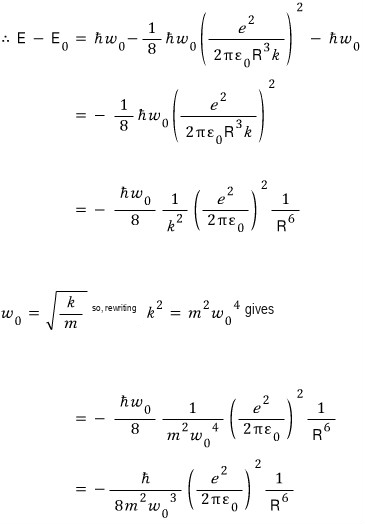
The negative sign means attraction, and the \(R^{-6}\) dependence is the characteristic result of this simple fluctuating-dipole model.
Problem 6.36: the Stark effect in hydrogen
Put a hydrogen atom in a uniform external electric field

directed along \(+z\). With scalar potential \(\Phi=-E_{\mathrm{ext}}z\), the electron’s charge \(-e\) gives the perturbation
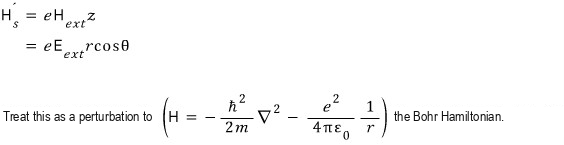
Spin and hyperfine structure are ignored, as specified in the problem.
Ground state
The nondegenerate ground state is spherically symmetric and has even parity. Since \(z\) is odd under parity, its first-order shift must vanish:
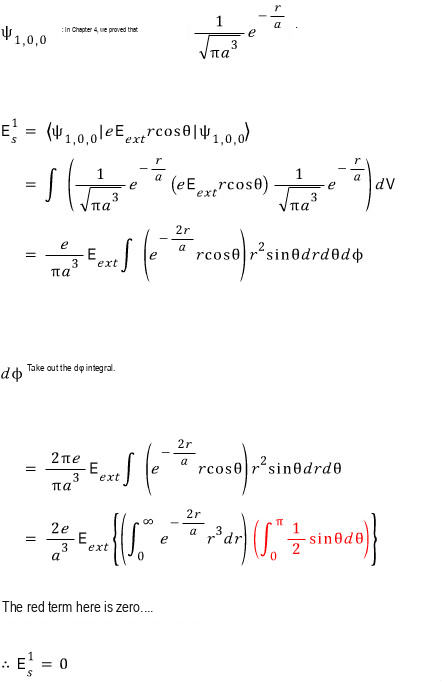
There is a formula error in this source image: the red angular factor is written as an integral involving \(\tfrac12\sin\theta\), which is not zero. The correct angular factor retains \(\cos\theta\):
\[ \int_0^{2\pi}d\phi\int_0^\pi\cos\theta\sin\theta\,d\theta=0. \]That parity cancellation—not the displayed red integral—is the valid reason the first-order ground-state shift vanishes.
The fourfold-degenerate \(n=2\) level
Ignoring spin, the \(n=2\) eigenspace is spanned by

The source image below contains a second setup error: it first calls this a “two-fold” case and displays a \(2\times2\) template, then asks for a \(4\times4\) matrix. The full degenerate subspace is four-dimensional. Only one \(2\times2\) block is nontrivial because \(z=r\cos\theta\) obeys \(\Delta l=\pm1\) and \(\Delta m=0\).
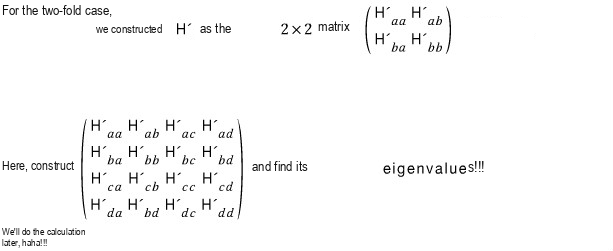
In the image’s basis order \((|200\rangle,|211\rangle,|210\rangle,|21{-1}\rangle)\), the correct first-order matrix is
\[ W= \begin{pmatrix} 0&0&d&0\\ 0&0&0&0\\ d&0&0&0\\ 0&0&0&0 \end{pmatrix}, \qquad d=\langle200|eE_{\mathrm{ext}}z|210\rangle=-3ea_0E_{\mathrm{ext}}, \]where the sign of \(d\) depends on the phase convention chosen for \(|210\rangle\), but the eigenvalues do not. Diagonalizing gives
\[ E^{(1)}=+3ea_0E_{\mathrm{ext}},\quad -3ea_0E_{\mathrm{ext}},\quad 0,\quad 0. \]Thus the original \(n=2\) energy splits into three distinct first-order levels: two singly degenerate shifted levels and one unshifted level that remains twofold degenerate. The shifted eigenstates are the two normalized combinations of \(|200\rangle\) and \(|210\rangle\); the \(m=\pm1\) states remain unshifted at first order.
Comments
Discussion happens via GitHub Discussions. You'll need a GitHub account to comment.