The WKB Approximation (Wentzel–Kramers–Brillouin)
Ch8 is all about WKB — the go-to approximation when V(x) varies slowly, letting you tackle bound states and tunneling without solving Schrödinger exactly.
Chapter 8 introduces the Wentzel–Kramers–Brillouin (WKB) approximation. It is useful when the time-independent Schrödinger equation cannot be solved exactly but the potential changes little over one local wavelength.
The preceding approximation methods address different situations. Perturbation theory starts from an exactly solvable Hamiltonian plus a small correction. The variational method starts from a trial state and gives an upper bound on the ground-state energy. WKB instead exploits slow spatial variation. In one dimension it describes oscillation in classically allowed regions, exponential behavior in forbidden regions, and—after turning-point matching—tunneling through a barrier.
The historical sketch plots one potential $V(x)$, a horizontal energy $E$, and alternating intervals labeled “bound” and “tunneling.”
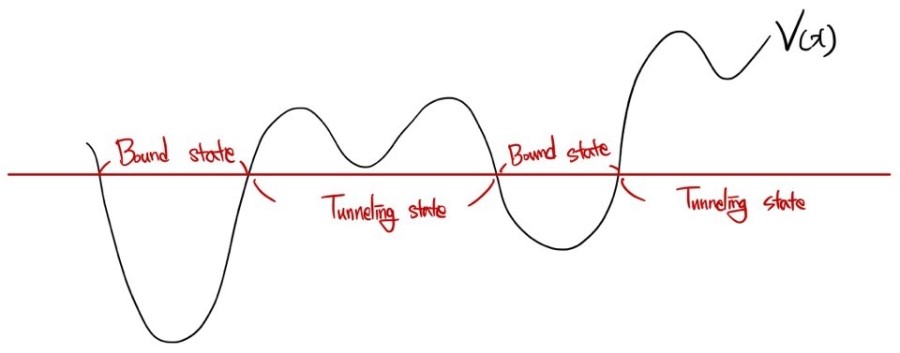
Those labels need refinement. A classically allowed region satisfies $E>V(x)$ and has real local momentum
$$ p(x)=\sqrt{2m[E-V(x)]}. $$A classically forbidden region satisfies $E\lt V(x)$ and uses the positive decay momentum
$$ \kappa_p(x)=\sqrt{2m[V(x)-E]}. $$A bound state is a globally normalizable state fixed by the entire potential and its boundary conditions. A forbidden interval does not by itself imply tunneling; tunneling means nonzero transmission obtained by matching solutions across a barrier.
From a constant potential to a local wave number
For $V=0$, the stationary Schrödinger equation is
$$ \frac{d^2\psi}{dx^2} =-\frac{2mE}{\hbar^2}\psi =-k^2\psi, \qquad k=\frac{\sqrt{2mE}}{\hbar}. $$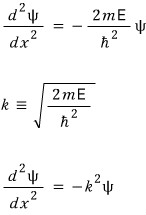
Its general solution is a superposition of two independent plane waves:
$$ \psi(x)=A e^{ikx}+B e^{-ikx}. $$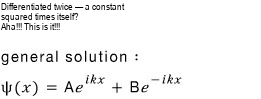
The same form applies within each interval where a finite-well potential is constant.
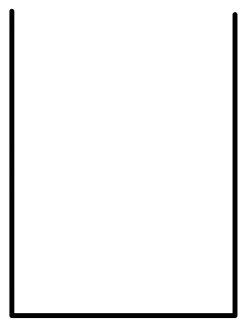

For constant $V$ and $E>V$,
$$ k=\frac{\sqrt{2m(E-V)}}{\hbar}, \qquad \psi(x)=A e^{ikx}+B e^{-ikx}. $$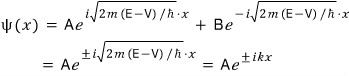
Source correction. The raster places only one power of $\hbar$ under its square root, which is dimensionally wrong, and its final plus-or-minus notation hides the two independent constants. The native equation above is the corrected form.
WKB extends this local plane-wave idea to a potential that varies smoothly.
The historical source begins with a position-dependent amplitude and a phase written as $k(x)x$.

Source correction. For varying $k(x)$, the WKB phase is not generally $k(x)x$, because $d[k(x)x]/dx=k+xk'$. Introduce an independent phase:
$$ \psi(x)=A(x)e^{i\phi(x)}, \qquad \phi'(x)=\pm\frac{p(x)}{\hbar}, $$and therefore
$$ \phi(x)=\phi(x_0)\pm\frac{1}{\hbar} \int_{x_0}^{x}p(x')\,dx'. $$Classically allowed region: $E>V(x)$
With $p(x)=\sqrt{2m[E-V(x)]}$, the stationary equation becomes
$$ \psi''(x)=-\frac{p^2(x)}{\hbar^2}\psi(x). $$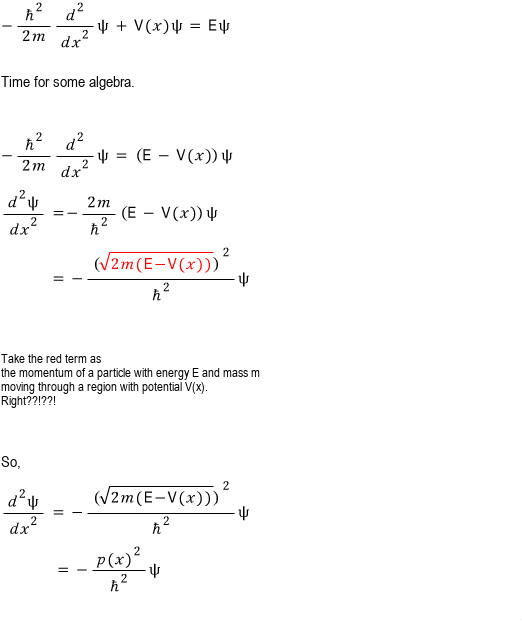
Use $\psi=Ae^{i\phi}$, not the literal $A(x)e^{ik(x)x}$ shown in the retained historical raster.


The source renames $k(x)x$ as $\phi(x)$.

In the corrected derivation, the first derivative is
$$ \psi'=(A'+iA\phi')e^{i\phi}. $$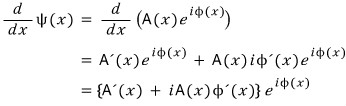
Differentiating again gives
$$ \psi''= \left[ A''-A(\phi')^2 +i\left(2A'\phi'+A\phi''\right) \right]e^{i\phi}. $$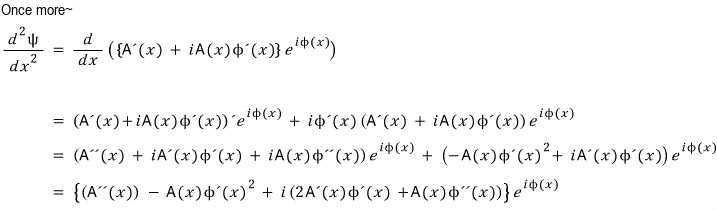
Insert this result into $\psi''=-(p^2/\hbar^2)\psi$.
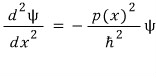


The common factor $e^{i\phi}$ cancels.

The exact real part is
$$ A''-A(\phi')^2=-\frac{p^2}{\hbar^2}A, $$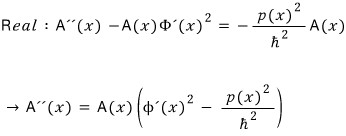
and the exact imaginary part is
$$ 2A'\phi'+A\phi''=0 \quad\Longrightarrow\quad \left(A^2\phi'\right)'=0. $$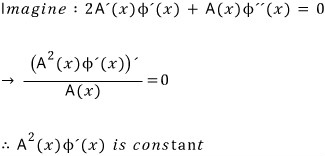
Thus $A^2\phi'=C'^2$, so
$$ A(x)=\frac{C'}{\sqrt{\phi'(x)}}. $$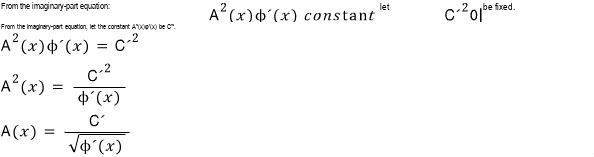
At this stage,
$$ \psi(x)=\frac{C'}{\sqrt{\phi'(x)}}e^{i\phi(x)}. $$
The real equation determines the leading phase.
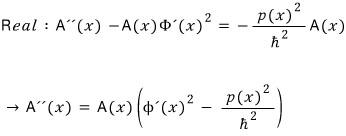
The source raster now sets $A''=0$.

Source correction. WKB does not require $A''$ to vanish or the amplitude to have no inflection point. It neglects $A''$ only relative to the leading phase term:
$$ \left|A''\right|\ll\left|A(\phi')^2\right|. $$The usual local validity condition is
$$ \left|\frac{\hbar p'(x)}{p^2(x)}\right|\ll1, \qquad\text{equivalently}\qquad |k'(x)|\ll k^2(x). $$It fails as $p\to0$, so ordinary WKB cannot be used at a turning point itself.
The next source raster incorrectly obtains $\phi'=\pm\sqrt{p/\hbar}$.
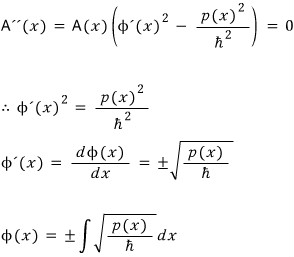
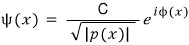
The correct leading equation is
$$ \phi'(x)=\pm\frac{p(x)}{\hbar}, \qquad A(x)\propto\frac{1}{\sqrt{|p(x)|}}. $$The factor from $C'/\sqrt{|p|/\hbar}$ is $C'\sqrt{\hbar}/\sqrt{|p|}$. It may be absorbed only after explicitly redefining the arbitrary constant. Keeping two independent branches, the general allowed-region solution is
$$ \boxed{ \psi(x)\approx \frac{1}{\sqrt{p(x)}} \left[ C_+e^{\frac{i}{\hbar}\int^x p(x')\,dx'} +C_-e^{-\frac{i}{\hbar}\int^x p(x')\,dx'} \right]. } $$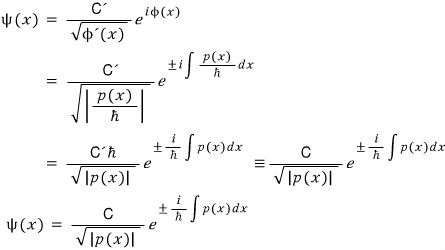
For one running branch normalized to constant leading-order flux,
$$ |\psi(x)|^2\propto\frac{1}{|p(x)|} =\frac{1}{m|v(x)|}, $$and
$$ j=\frac{\hbar}{2mi} \left(\psi^*\psi'-\psi\psi'^*\right) $$is constant to leading WKB order.
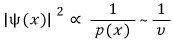
A standing wave has interference fringes, so its pointwise density is not simply $1/|v|$. That relation describes a running branch or the slowly varying envelope after averaging over rapid oscillations.
Check: an infinite square well
Consider an infinite well on $0\lt x\lt a$.
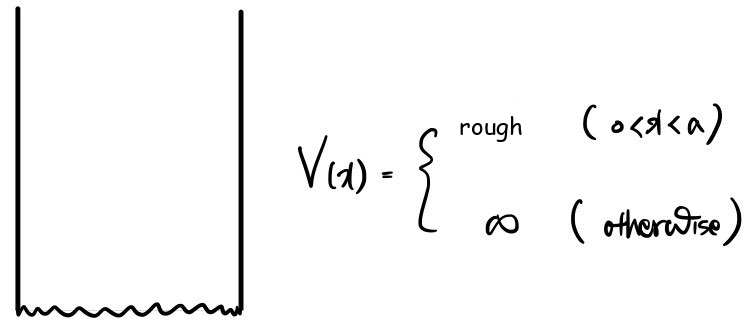
Inside the well, retain both allowed-region WKB branches.
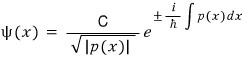

Define
$$ \phi(x)=\frac{1}{\hbar}\int_0^x p(x')\,dx'. $$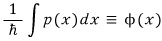

The exponentials can be combined into sine and cosine terms.
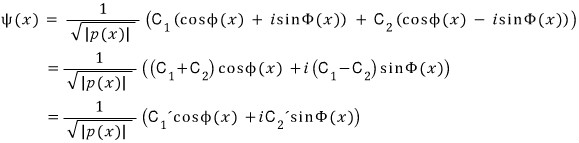
The hard-wall conditions are
$$ \psi(0)=\psi(a)=0. $$
At the left wall, the correct statement is
$$ \psi(0)=\frac{C'_1}{\sqrt{|p(0)|}}=0 \quad\Longrightarrow\quad C'_1=0. $$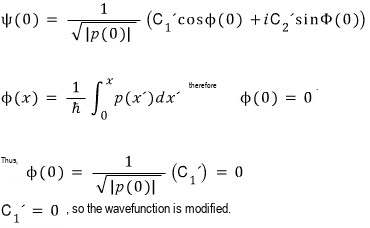
The right wall then gives
$$ \phi(a)=n\pi, \qquad \int_0^a p(x)\,dx=n\pi\hbar, \qquad n=1,2,\ldots $$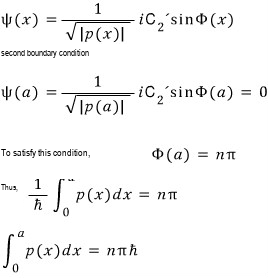
The local momentum is
$$ p(x)=\sqrt{2m[E-V(x)]}. $$
For $V=0$, $p=\sqrt{2mE}$, so
$$ a\sqrt{2mE_n}=n\pi\hbar, \qquad E_n=\frac{n^2\pi^2\hbar^2}{2ma^2}. $$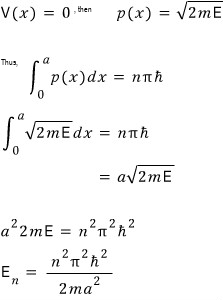
This is a hard-wall result. A smooth potential with two simple turning points instead obeys
$$ \int_{x_1}^{x_2}p(x)\,dx =\left(n+\frac12\right)\pi\hbar, \qquad n=0,1,2,\ldots $$at leading WKB order. The half-unit is the two-turning-point Maslov phase.
Classically forbidden regions and connection formulas
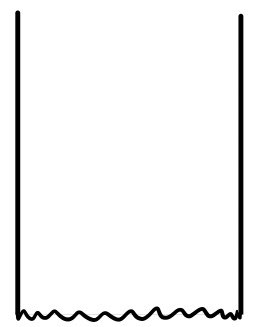
A rectangular barrier is the familiar discontinuous tunneling problem.
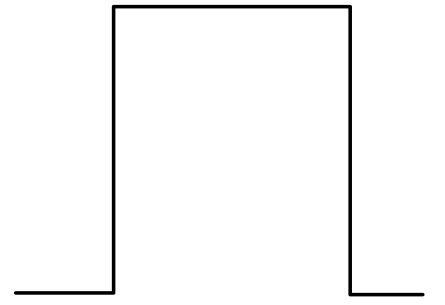
The next historical sketch also has vertical sides. It is an abrupt schematic, not a smooth two-turning-point potential.
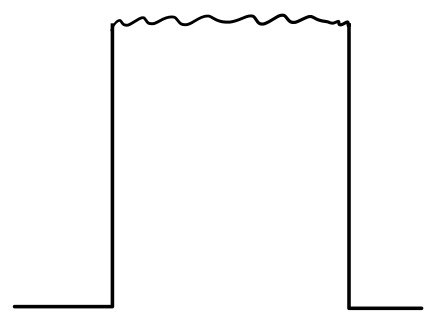
For an abrupt step, solve each constant-potential region and match $\psi$ and $\psi'$ exactly at the interfaces. The Airy formula below applies instead near a smooth simple turning point $x_t$ satisfying
$$ V(x_t)=E, \qquad V'(x_t)\ne0. $$In an allowed region the source uses

and then writes an inconsistent imaginary momentum.

Define the positive forbidden-region momentum
$$ \kappa_p(x)=\sqrt{2m[V(x)-E]}>0, \qquad p(x)=\pm i\kappa_p(x). $$Analytically continuing the phase changes oscillation into exponential behavior.
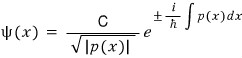
The general forbidden-region form is
$$ \boxed{ \psi(x)\approx \frac{1}{\sqrt{\kappa_p(x)}} \left[ D_+e^{\frac{1}{\hbar}\int^x\kappa_p(x')\,dx'} +D_-e^{-\frac{1}{\hbar}\int^x\kappa_p(x')\,dx'} \right]. } $$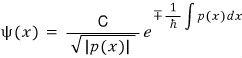
At a smooth turning point, the separate WKB amplitudes diverge because $p$ and $\kappa_p$ vanish. Linearizing the potential reduces the local equation to the Airy equation. For an allowed region to the left and a forbidden region to the right, the physical decaying connection is
$$ \frac{D}{\sqrt{\kappa_p(x)}} \exp\left[ -\frac{1}{\hbar}\int_{x_t}^{x}\kappa_p(x')\,dx' \right] \longleftrightarrow \frac{2D}{\sqrt{p(x)}} \sin\left[ \frac{1}{\hbar}\int_x^{x_t}p(x')\,dx' +\frac{\pi}{4} \right]. $$The arrow relates the two asymptotic forms of one local Airy solution; it is not an equality at $x_t$. Reversing the geometry reverses the integral anchors.
The three-region sketch below organizes an incident wave, a barrier, and a transmitted wave.
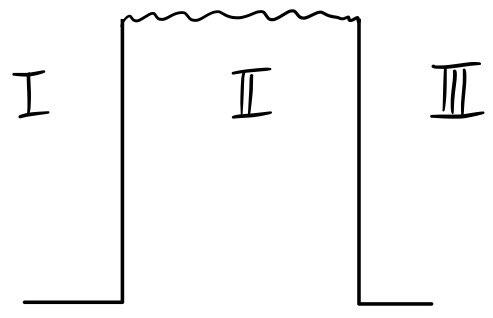
In region I,
$$ \psi_I=Ae^{ik_Ix}+Be^{-ik_Ix}. $$
The barrier region contains growing and decaying components.

In region III, with no wave incident from the right,
$$ \psi_{\mathrm{III}}=Fe^{ik_{\mathrm{III}}x}. $$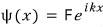
The ratio $t=F/A$ is a transmission amplitude.

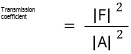
The physical transmission coefficient is a flux ratio:
$$ T=\frac{j_{\mathrm{trans}}}{j_{\mathrm{inc}}} =\frac{k_{\mathrm{III}}}{k_I} \left|\frac{F}{A}\right|^2 =\frac{p_{\mathrm{III}}}{p_I} \left|\frac{F}{A}\right|^2. $$Only equal asymptotic potentials give $T=|F/A|^2$.
The decaying branch contains an exponential attenuation.
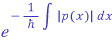
For turning points $x_1\lt x_2$, define the dimensionless barrier action
$$ K=\frac{1}{\hbar}\int_{x_1}^{x_2} \sqrt{2m[V(x)-E]}\,dx. $$For an opaque barrier, $K\gg1$, the leading exponential behavior is
$$ \boxed{T\approx e^{-2K}.} $$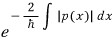
The omitted prefactor depends on turning-point or step matching and on the asymptotic fluxes.
Example 8.1: an infinite well with a sharp shelf
Take an infinite well of width $a$ whose left half is raised by $V_0$.
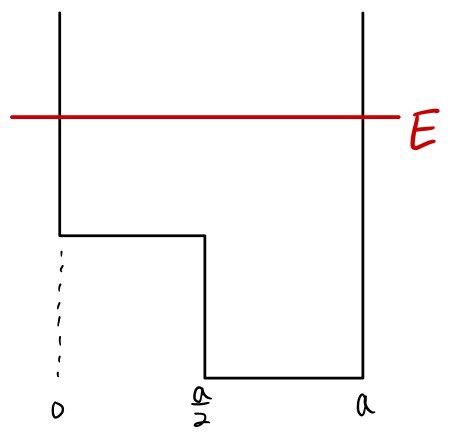
The source begins from an oscillatory WKB form.

The hard walls impose

and motivate a hard-wall phase integral.
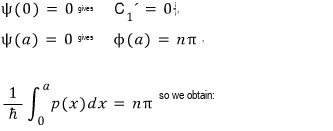
Because the shelf jumps at $x=a/2$, WKB’s slow-variation condition fails there. The controlled result comes from exact piecewise matching.
Let $L=a/2$. For $E>V_0$, define
$$ k_1=\frac{\sqrt{2m(E-V_0)}}{\hbar}, \qquad k_2=\frac{\sqrt{2mE}}{\hbar}. $$Solutions satisfying the outer hard walls can be written
$$ \psi_1(x)=A\sin(k_1x), \qquad \psi_2(x)=B\sin[k_2(a-x)]. $$Continuity of $\psi$ and $\psi'$ at $x=L$ gives
$$ A\sin(k_1L)=B\sin(k_2L), $$$$ A k_1\cos(k_1L)=-B k_2\cos(k_2L), $$and therefore the exact eigenvalue condition
$$ \boxed{ k_1\cot(k_1L)+k_2\cot(k_2L)=0. } $$For $0\lt E\lt V_0$, define
$$ q_1=\frac{\sqrt{2m(V_0-E)}}{\hbar}, \qquad k_2=\frac{\sqrt{2mE}}{\hbar}. $$The left-half solution is evanescent:
$$ \psi_1(x)=A\sinh(q_1x), \qquad \psi_2(x)=B\sin[k_2(a-x)]. $$Exact matching yields
$$ \boxed{ q_1\coth(q_1L)+k_2\cot(k_2L)=0. } $$At $E=V_0$, the limit is $q_1\coth(q_1L)\to1/L$.
The source instead applies a single phase integral. If it is retained as an uncontrolled sharp-step estimate for $E>V_0$, its equation is
$$ \frac{a}{2}\sqrt{2m(E-V_0)} +\frac{a}{2}\sqrt{2mE} =n\pi\hbar. $$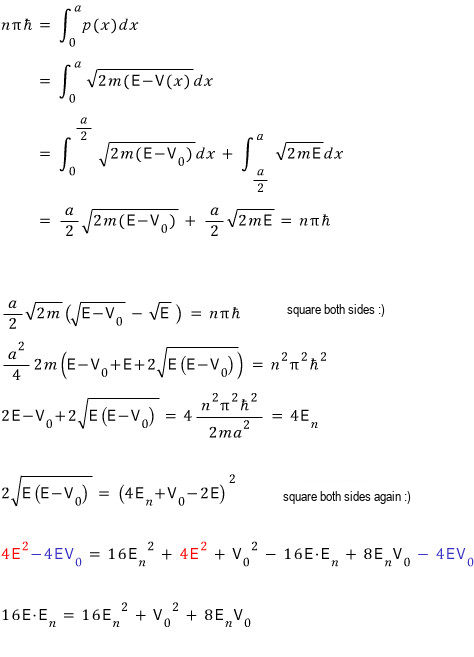
Define
$$ \varepsilon_n=\frac{n^2\pi^2\hbar^2}{2ma^2}. $$Keeping the plus sign and choosing the branch consistent with $E>V_0$ gives only the estimate
$$ \boxed{ E_{\mathrm{phase}} =\varepsilon_n+\frac{V_0}{2} +\frac{V_0^2}{16\varepsilon_n}. } $$The unsquared phase equation additionally requires $V_0\lt 4\varepsilon_n$ for this $E>V_0$ branch; equality is the threshold $E=V_0$. Squaring without enforcing that condition introduces an extraneous branch.
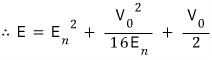
The raster’s $E_n^2$ term cannot be added to energies. More importantly, neither corrected algebra nor its branch condition makes this the exact sharp-shelf spectrum; the cotangent equations above are the physical eigenvalue conditions.
Example 8.2: Gamow’s alpha-decay model
An alpha particle is a helium-4 nucleus containing two protons and two neutrons. Alpha decay is not proton-by-proton emission, and the strong nuclear interaction is not merely a proton–proton force.
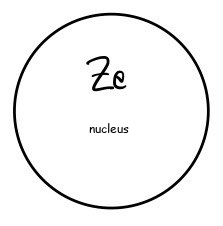
The alpha particle may be confined by the short-range nuclear interaction while facing a repulsive Coulomb barrier outside the nuclear surface.
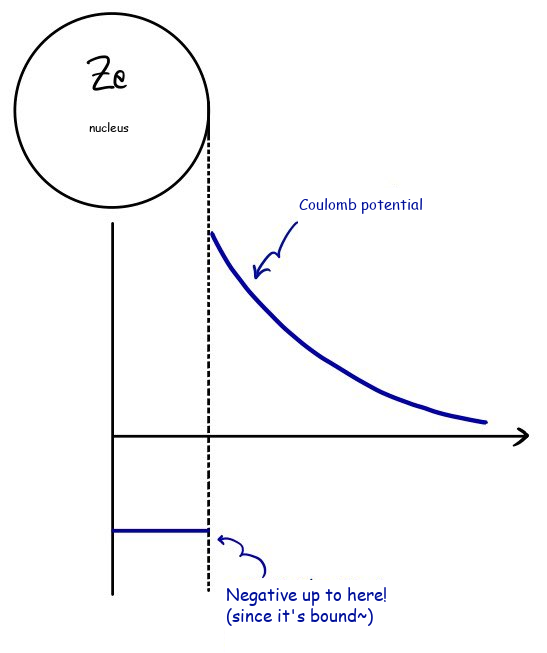
The next historical diagram has a labeling defect: it marks the outer intersection of $E$ and the Coulomb curve as $r_1$.
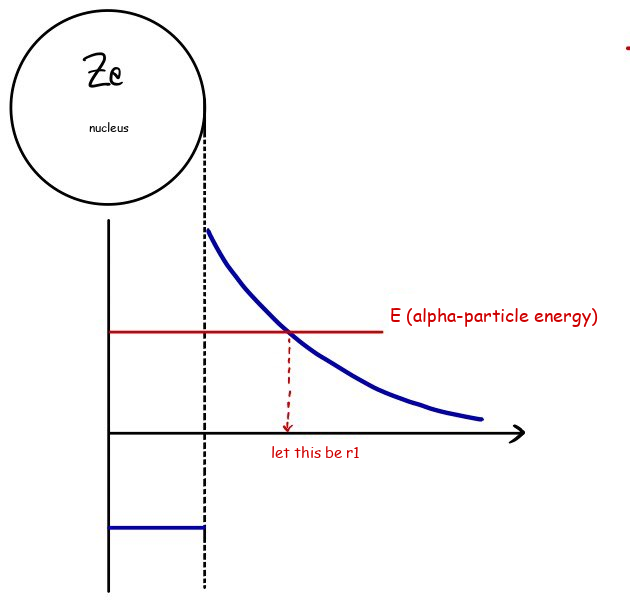
Source correction. In the equations below, $r_1\approx R$ is the nuclear surface and $r_2$ is the outer turning point defined by $V_C(r_2)=E$. Thus the barrier interval is $r_1\lt r\lt r_2$. The retained raster’s outer label must be read as $r_2$, not $r_1$.
Let $Z_p$ and $Z_d$ be the parent and daughter charge numbers. Alpha decay gives $Z_d=Z_p-2$. Outside the nucleus,
$$ V_C(r)=\frac{1}{4\pi\epsilon_0}\frac{2Z_d e^2}{r}, \qquad E=V_C(r_2), $$so
$$ r_2=\frac{1}{4\pi\epsilon_0}\frac{2Z_d e^2}{E}. $$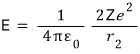
The radial two-body mass is the alpha–daughter reduced mass
$$ \mu=\frac{m_\alpha m_d}{m_\alpha+m_d}. $$For a heavy daughter, $\mu\approx m_\alpha$ is a useful approximation, but it is not an identity.
The displayed Coulomb-only derivation assumes $s$-wave emission and neglects the centrifugal term. For higher angular momentum, radial WKB uses the Langer form
$$ V_{\mathrm{eff}}(r) =V_C(r) +\frac{\hbar^2(\ell+\tfrac12)^2}{2\mu r^2}. $$Within the stated Coulomb-only model,
$$ T\approx e^{-2K}, \qquad K=\frac{\sqrt{2\mu E}}{\hbar} \int_{r_1}^{r_2} \sqrt{\frac{r_2}{r}-1}\,dr. $$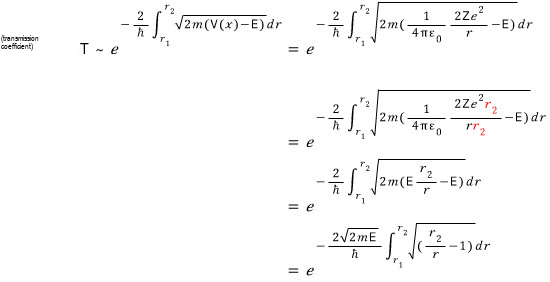
Use the exact substitution
$$ r=r_2\sin^2u, \qquad dr=2r_2\sin u\cos u\,du. $$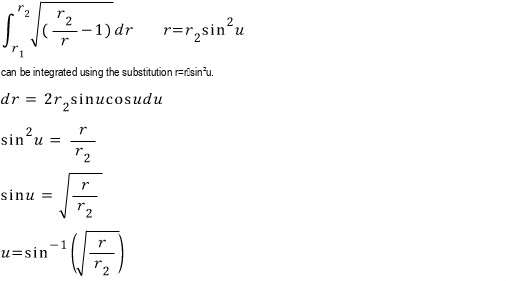
Then
$$ \sqrt{\frac{r_2}{r}-1}\,dr =2r_2\cos^2u\,du. $$With $\rho=r_1/r_2$,
$$ I\equiv\int_{r_1}^{r_2} \sqrt{\frac{r_2}{r}-1}\,dr =r_2\left[ \arccos\sqrt{\rho} -\sqrt{\rho(1-\rho)} \right], $$or equivalently
$$ I=r_2\arccos\sqrt{\frac{r_1}{r_2}} -\sqrt{r_1(r_2-r_1)}. $$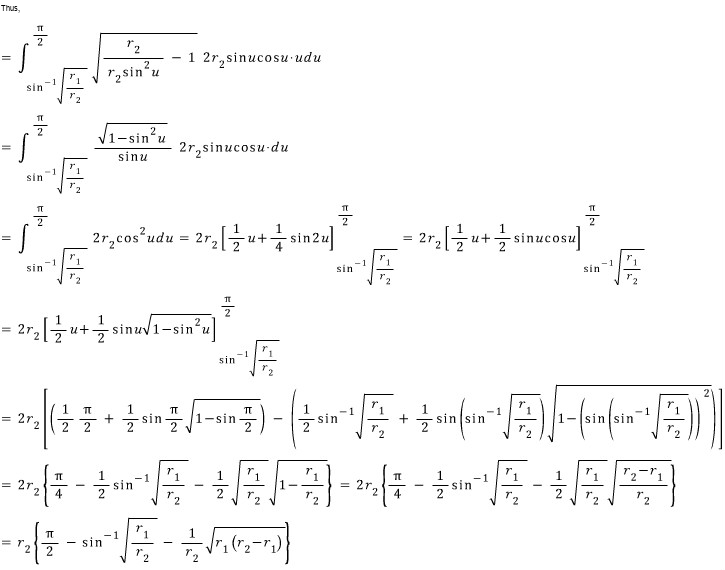
Therefore
$$ T\approx \exp\left[ -\frac{2\sqrt{2\mu E}}{\hbar} r_2 \left( \arccos\sqrt{\rho} -\sqrt{\rho(1-\rho)} \right) \right]. $$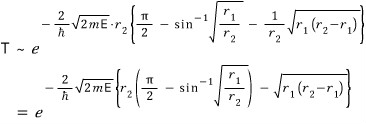
The source estimates the distance between successive barrier encounters as $2r_1$.

This gives the approximate assault frequency
$$ \nu_{\mathrm{assault}}\approx\frac{v}{2r_1}. $$
The penetration probability per encounter is modeled as $e^{-2K}$.

Real decay also depends on an alpha preformation probability $P_\alpha$ and nuclear-structure effects. In this simple factorized model,
$$ \lambda\approx P_\alpha\,\nu_{\mathrm{assault}}\,T \approx P_\alpha\frac{v}{2r_1}e^{-2K}. $$
The mean lifetime and half-life are distinct:
$$ \tau=\frac{1}{\lambda}, \qquad t_{1/2}=\frac{\ln2}{\lambda}=(\ln2)\tau. $$
Taking the natural logarithm gives
$$ \ln\tau \approx 2K+\ln\left(\frac{2r_1}{P_\alpha v}\right). $$
To see the leading Geiger–Nuttall trend, define
$$ C=\frac{2Z_d e^2}{4\pi\epsilon_0}, \qquad r_2=\frac{C}{E}. $$When $r_1/r_2\ll1$,
$$ 2K\approx \frac{\pi C\sqrt{2\mu}}{\hbar\sqrt{E}} -\frac{4\sqrt{2\mu C r_1}}{\hbar}. $$Consequently,
$$ \ln\tau\approx\frac{A}{\sqrt{E}}+B $$is a leading trend only within a suitably restricted decay family for which $Z_d$, $\mu$, $r_1$, $P_\alpha$, and the assault prefactor vary slowly enough to be treated as approximately fixed. The equation here uses the natural logarithm; empirical Geiger–Nuttall plots often use $\log_{10}t_{1/2}$, which changes the fitted constants but not the inverse-square-root energy structure.
Comments
Discussion happens via GitHub Discussions. You'll need a GitHub account to comment.