WKB Connection Formulas
At an isolated simple turning point, a local Airy solution and asymptotic matching connect the allowed and forbidden WKB regions.
The WKB approximation works away from a turning point, where the local classical momentum is nonzero and varies slowly. At a turning point, however, the usual WKB amplitude diverges. This post derives the standard connection formula by replacing the potential locally with a straight line, solving the resulting Airy equation, and matching its asymptotic forms to WKB on the two sides.
The handwritten and typeset rasters below are preserved from the original 2015 source post in the author’s historical archive. Several rasters contain known algebraic or typographical errors. I leave those images unchanged for provenance and place corrected, accessible native equations beside them.
Why ordinary WKB fails at a turning point
Piecewise-constant examples often use vertical potential steps.
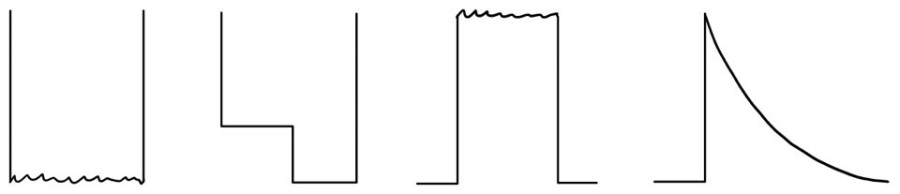
A smooth potential is different: an energy line can meet the potential continuously.
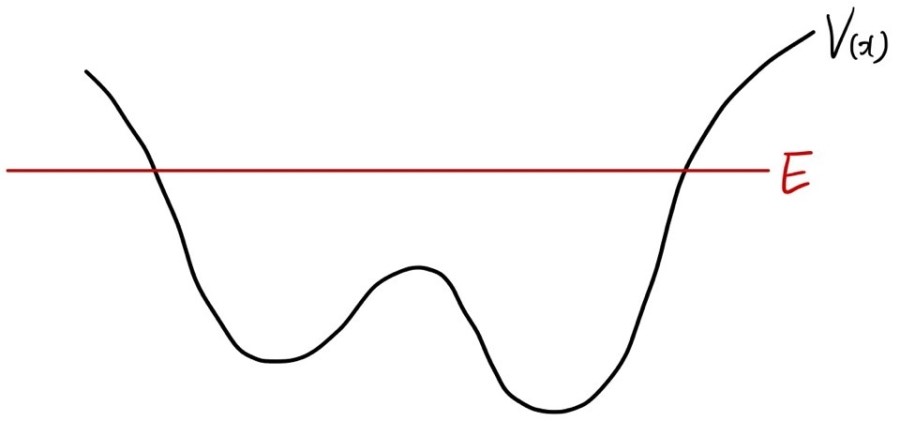
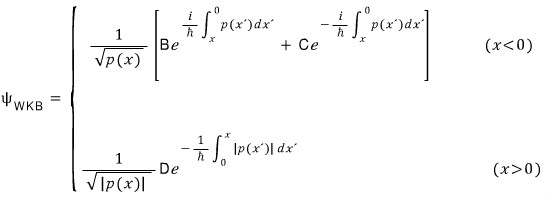
For a general smooth potential, the leading WKB forms are
$$ \psi_{\mathrm{allow}}(x)\approx \frac{1}{\sqrt{p(x)}} \left[ B e^{\frac{i}{\hbar}\int^x p(x')\,dx'} +C e^{-\frac{i}{\hbar}\int^x p(x')\,dx'} \right], $$in a classically allowed region, and
$$ \psi_{\mathrm{forbid}}(x)\approx \frac{1}{\sqrt{\kappa(x)}} \left[ D e^{-\frac{1}{\hbar}\int^x \kappa(x')\,dx'} +F e^{\frac{1}{\hbar}\int^x \kappa(x')\,dx'} \right], $$in a classically forbidden region, where
$$ p(x)=\sqrt{2m[E-V(x)]}, \qquad \kappa(x)=\sqrt{2m[V(x)-E]}. $$The historical overview shows these formulas on opposite sides of a turning point.
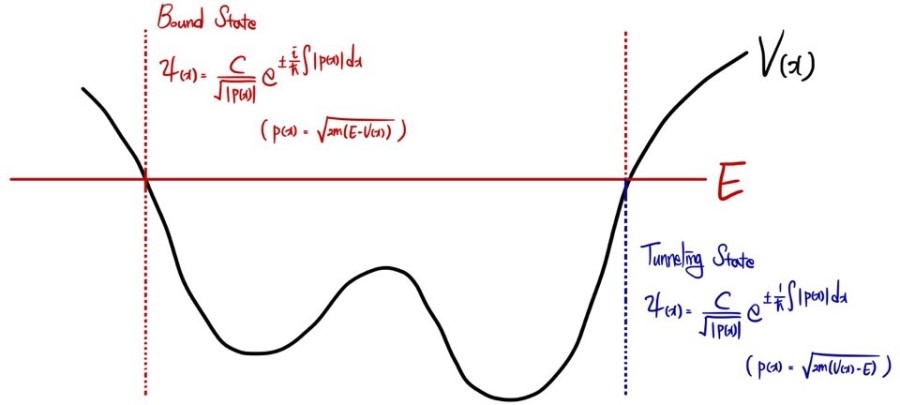
At a turning point $x_t$, $E=V(x_t)$, so $p$ and $\kappa$ vanish and the factors $1/\sqrt{p}$ and $1/\sqrt{\kappa}$ diverge.
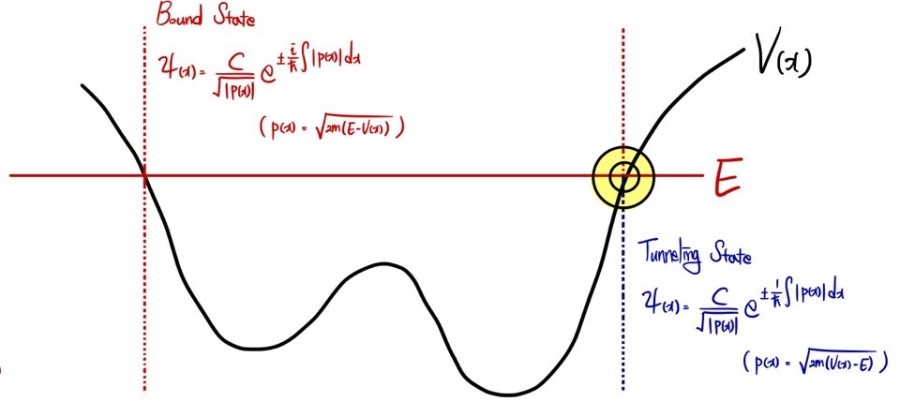
This divergence belongs to the approximation, not to the exact wavefunction. Ordinary WKB is invalid at the turning point itself. A local exact solution will bridge the two WKB regions.
Choose a simple turning point
Translate the coordinate so that the turning point is at $x=0$. For the orientation used throughout this derivation, assume
$$ V(0)=E, \qquad V'(0)\gt0. $$Then $x\lt0$ is classically allowed and $x\gt0$ is classically forbidden sufficiently close to the origin.
The diagram labels these local regions “Bound” and “Tunneling.” More precisely, they are the classically allowed and classically forbidden sides of one turning point. Whether the complete state is bound or describes scattering depends on the global potential and boundary conditions.
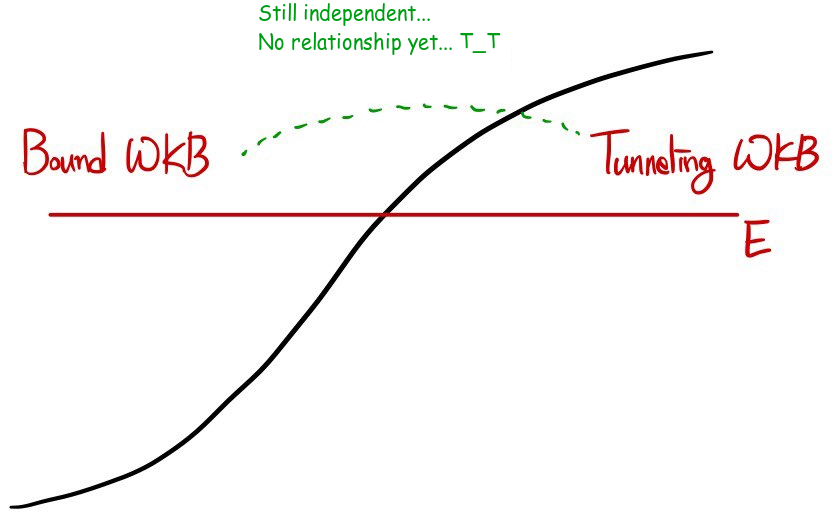
Our goal is to relate those apparently independent coefficients by a single wavefunction that remains finite through the turning-point neighborhood.
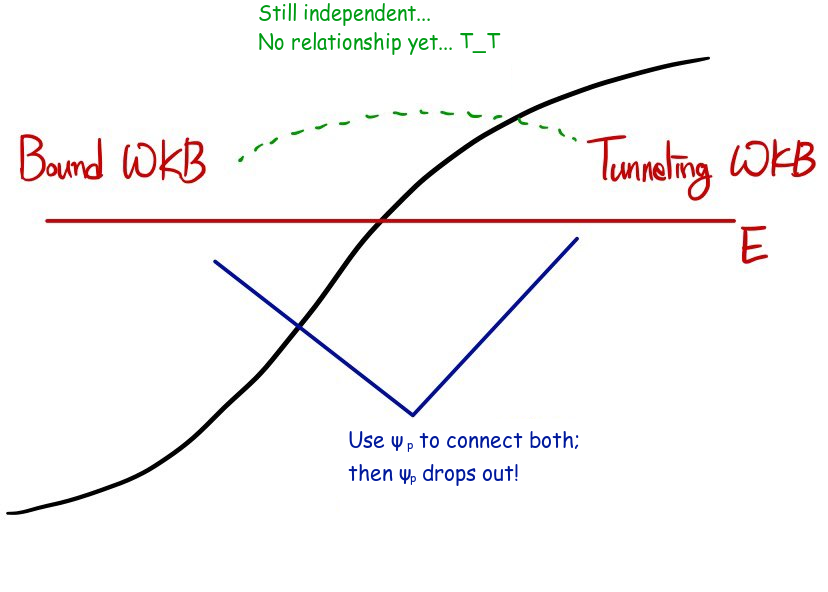
Call that local bridge $\psi_{\mathrm{patch}}$.

Once the bridge selects the physically relevant continuation, an inadmissible local branch can be discarded according to the boundary condition.

The construction therefore starts by finding $\psi_{\mathrm{patch}}$.

Linearize the potential
Near a simple turning point,
$$ V(x)=V(0)+V'(0)x+O(x^2) =E+V'(0)x+O(x^2). $$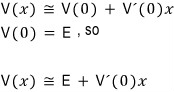
We seek the local wavefunction near $x=0$.

Keeping only the linear term in the stationary Schrödinger equation gives
$$ -\frac{\hbar^2}{2m}\frac{d^2\psi}{dx^2} +[E+V'(0)x]\psi=E\psi, $$or
$$ \frac{d^2\psi}{dx^2}-\frac{2mV'(0)}{\hbar^2}x\psi=0. $$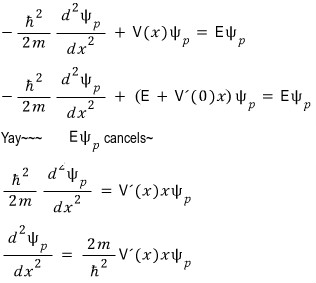
Define
$$ \alpha^3=\frac{2mV'(0)}{\hbar^2}, \qquad z=\alpha x. $$Because $V'(0)\gt0$, $\alpha$ is real and positive. Since $d^2/dx^2=\alpha^2d^2/dz^2$, the local equation becomes
$$ \frac{d^2\psi}{dz^2}-z\psi=0. $$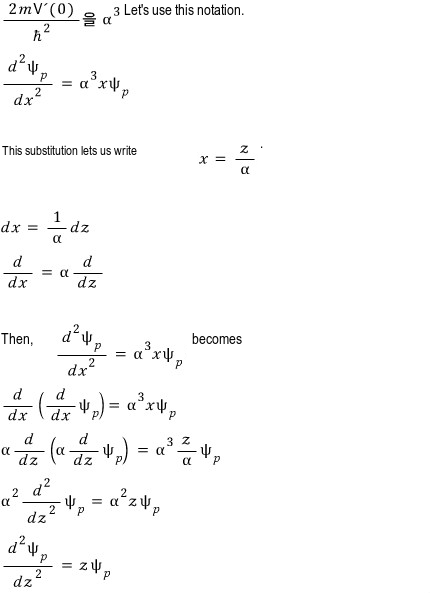
This is Airy’s equation. Its general solution is
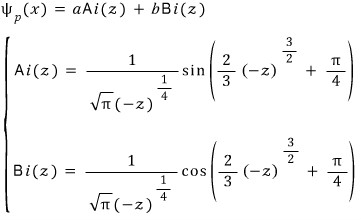
$$ \psi_{\mathrm{patch}}(x)=a\,\operatorname{Ai}(z)+b\,\operatorname{Bi}(z), \qquad z=\alpha x. $$Integral representations for the two Airy functions are retained below as part of the source derivation.
$$ \begin{aligned} \operatorname{Ai}(z) &=\frac{1}{\pi}\int_0^\infty \cos\left(\frac{s^3}{3}+sz\right)\,ds,\\ \operatorname{Bi}(z) &=\frac{1}{\pi}\int_0^\infty \left[ \exp\left(-\frac{s^3}{3}+sz\right) +\sin\left(\frac{s^3}{3}+sz\right) \right]ds. \end{aligned} $$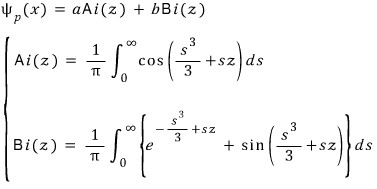
The symbol $\psi_{\mathrm{patch}}$ emphasizes that this Airy solution is local: it is accurate where the linear approximation to $V(x)$ is accurate.

The same local solution crosses the turning point and therefore connects the asymptotic WKB descriptions on both sides.

If instead $V'(0)\lt0$, the allowed and forbidden sides interchange. One may reverse the coordinate, or define the Airy variable with the corresponding sign. The connection rule is otherwise the same.
Match the forbidden side, $x\gt0$
For the chosen orientation, the forbidden-side WKB solution that decays as $x$ increases is
$$ \psi_{\mathrm{WKB}}(x) \approx \frac{D}{\sqrt{\kappa(x)}} \exp\left[ -\frac{1}{\hbar}\int_0^x\kappa(x')\,dx' \right], \qquad x\gt0. $$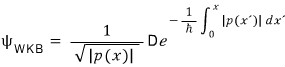
Here the classical momentum $p$ would be imaginary. To avoid mixing an imaginary quantity with a positive decay rate, use
$$ \kappa(x)=|p(x)|=\sqrt{2m[V(x)-E]}. $$With $V(x)-E\approx V'(0)x$,
$$ \begin{aligned} \kappa(x) &=\sqrt{2mV'(0)x}\\ &=\sqrt{2mV'(0)}\sqrt{x}\\ &=\hbar\alpha^{3/2}\sqrt{x} =\hbar\alpha\sqrt{z}. \end{aligned} $$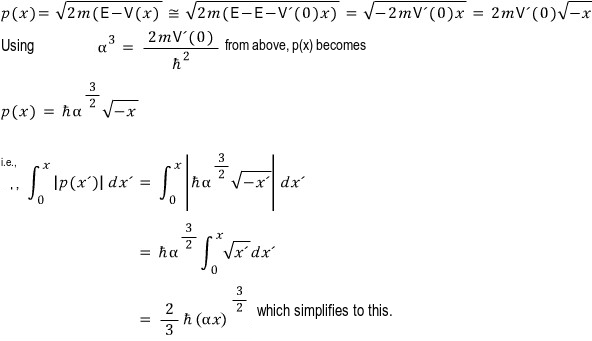
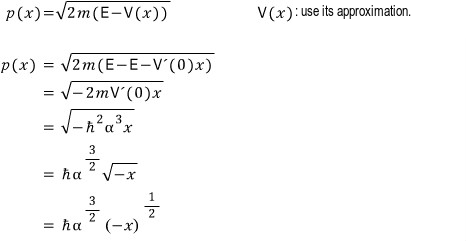
Source correction: imaginary momentum and a missing square root. The raster works with the forbidden-side classical momentum on its principal branch: $p(x)=\sqrt{-2mV'(0)x}=\sqrt{2mV'(0)}\sqrt{-x}=i\kappa(x)$ for $x\gt0$. Its middle expression incorrectly writes $2mV'(0)\sqrt{-x}$, omitting the square root on the coefficient. The raster’s later $\hbar\alpha^{3/2}\sqrt{-x}$ form is consistent with the corrected imaginary $p$; the positive decay rate used in the native derivation above is separately $\kappa(x)=\hbar\alpha^{3/2}\sqrt{x}$.
The exponent is
$$ \begin{aligned} \frac{1}{\hbar}\int_0^x\kappa(x')\,dx' &=\alpha^{3/2}\int_0^x\sqrt{x'}\,dx'\\ &=\frac{2}{3}(\alpha x)^{3/2}\\ &=\frac{2}{3}z^{3/2}. \end{aligned} $$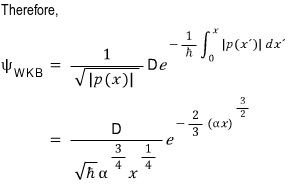
Thus the WKB branch has the same exponential behavior as the large-positive-$z$ asymptotic form of an Airy function.

It must be compared with the same local patching solution introduced above.

The comparison is not made at $z=0$, where WKB fails, but in an overlap region where the potential is still well approximated by its linear term and $z\gg1$ is already large enough for the Airy asymptotics.

The local solution remains
$$ \psi_{\mathrm{patch}}=a\operatorname{Ai}(z)+b\operatorname{Bi}(z). $$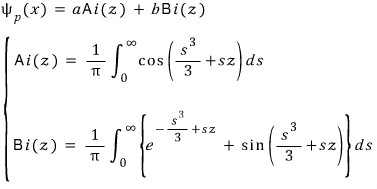
For $z\gg1$,
$$ \operatorname{Ai}(z) \sim\frac{1}{2\sqrt{\pi}}z^{-1/4} e^{-\frac{2}{3}z^{3/2}}, \qquad \operatorname{Bi}(z) \sim\frac{1}{\sqrt{\pi}}z^{-1/4} e^{+\frac{2}{3}z^{3/2}}. $$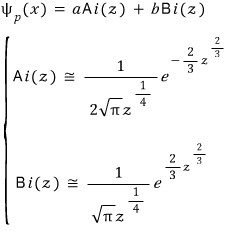
Source correction: Airy exponent. This raster prints $z^{2/3}$. The correct Airy exponent is $z^{3/2}$, which is also what follows from the WKB integral above.
Therefore,
$$ \psi_{\mathrm{patch}} \sim \frac{a}{2\sqrt{\pi}}z^{-1/4}e^{-\frac{2}{3}z^{3/2}} +\frac{b}{\sqrt{\pi}}z^{-1/4}e^{+\frac{2}{3}z^{3/2}}. $$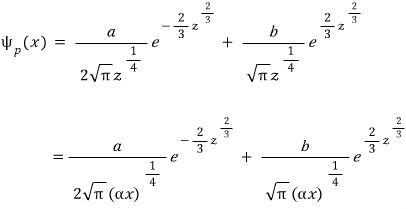
Source correction: repeated exponent. Both powers in this raster must likewise be $z^{3/2}$, not $z^{2/3}$.
Meanwhile, the decaying WKB branch becomes
$$ \psi_{\mathrm{WKB}} \sim \frac{D}{\sqrt{\hbar\alpha}}z^{-1/4} e^{-\frac{2}{3}z^{3/2}}. $$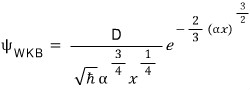
The boundary condition selects the decaying solution on the forbidden side. It therefore excludes the growing $\operatorname{Bi}$ contribution: this is why $b=0$. It is a physical boundary condition, not an algebraic identity. Matching the remaining coefficients gives
$$ \frac{a}{2\sqrt{\pi}}= \frac{D}{\sqrt{\hbar\alpha}}, \qquad a=\sqrt{\frac{4\pi}{\hbar\alpha}}\,D. $$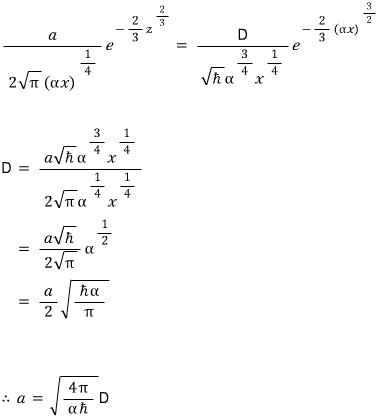
Source correction: matching exponent. The Airy-side exponential in this raster should contain $z^{3/2}$, not $z^{2/3}$. The WKB-side exponential already contains the correct $(\alpha x)^{3/2}$, and matching uses $z^{3/2}=(\alpha x)^{3/2}$. The displayed coefficient relation for $a$ and $D$ follows after correcting the Airy side.
Match the allowed side, $x\lt0$
On the allowed side,
$$ p(x)=\sqrt{2m[E-V(x)]}, $$and a convenient phase measured from the turning point is
$$ \theta(x)=\frac{1}{\hbar}\int_x^0p(x')\,dx'. $$The general WKB form is
$$ \psi_{\mathrm{WKB}}(x) \approx \frac{1}{\sqrt{p(x)}} \left[B e^{i\theta(x)}+C e^{-i\theta(x)}\right]. $$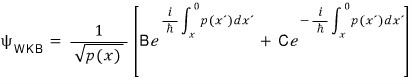
Using the linearized potential,
$$ \begin{aligned} p(x) &=\sqrt{-2mV'(0)x}\\ &=\hbar\alpha^{3/2}\sqrt{-x} =\hbar\alpha\sqrt{-z}, \end{aligned} $$for $x\lt0$.
The phase integral becomes
$$ \begin{aligned} \theta(x) &=\alpha^{3/2}\int_x^0\sqrt{-x'}\,dx'\\ &=\frac{2}{3}(-\alpha x)^{3/2}\\ &=\frac{2}{3}(-z)^{3/2}. \end{aligned} $$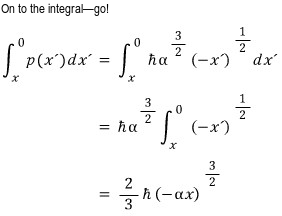
Thus
$$ \psi_{\mathrm{WKB}}(x) \sim \frac{1}{\sqrt{\hbar\alpha}(-z)^{1/4}} \left[ B e^{i\frac{2}{3}(-z)^{3/2}} +C e^{-i\frac{2}{3}(-z)^{3/2}} \right]. $$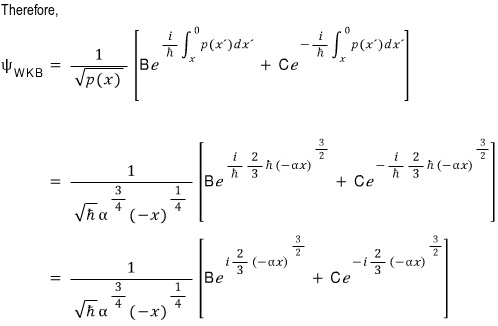
This must match the same Airy solution. The next retained raster repeats a positive-$z$ approximation note even though this part of the derivation needs the negative-$z$ limit; the governing native formula follows immediately below.

With the growing forbidden-side branch excluded, $b=0$ everywhere in this one Airy solution. Before the source applies the negative-$z$ limit, it repeats the same general Airy solution and Ai/Bi integral representations shown earlier.
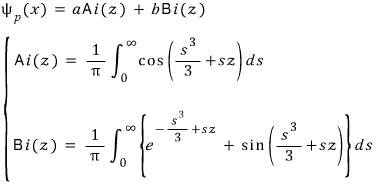
The integral representations have been transcribed in native math above. The required large-negative-$z$ asymptotic is, for $z\ll-1$,
$$ \operatorname{Ai}(z) \sim \frac{1}{\sqrt{\pi}}(-z)^{-1/4} \sin\left[ \frac{2}{3}(-z)^{3/2}+\frac{\pi}{4} \right]. $$Again, matching occurs in an overlap region: $|z|\gg1$ while the first-order Taylor approximation to $V$ remains accurate. WKB itself is still not valid at $x=0$. The actual historical negative-$z$ asymptotic appears in the next raster.
Substituting the matched value of $a$ gives
$$ \psi_{\mathrm{patch}}(x) \sim \frac{2D}{\sqrt{p(x)}} \sin\left[ \theta(x)+\frac{\pi}{4} \right], \qquad x\lt0. $$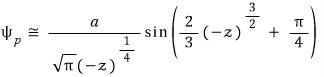
Euler’s formula converts the sine into the two WKB traveling-wave branches:
$$ \frac{2D}{\sqrt{p}} \sin\left(\theta+\frac{\pi}{4}\right) =\frac{D}{\sqrt{p}} \left[ e^{-i\pi/4}e^{i\theta} +e^{i\pi/4}e^{-i\theta} \right]. $$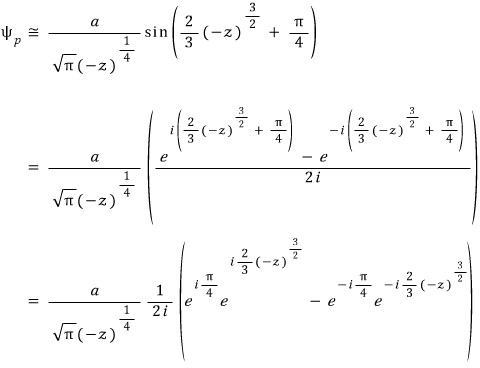
Compare this expression with the allowed-side WKB basis.
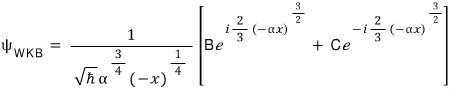
For the phase convention $\theta=\hbar^{-1}\int_x^0p\,dx$, the coefficient relations are
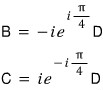
$$ B=-i e^{i\pi/4}D=e^{-i\pi/4}D, \qquad C=i e^{-i\pi/4}D=e^{i\pi/4}D. $$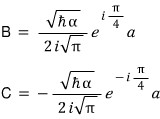
The earlier forbidden-side match was
$$ a=\sqrt{\frac{4\pi}{\hbar\alpha}}\,D. $$
Combining the two matches expresses both allowed-side coefficients in terms of the decaying forbidden-side amplitude.
The result can be written most transparently as one connection formula:
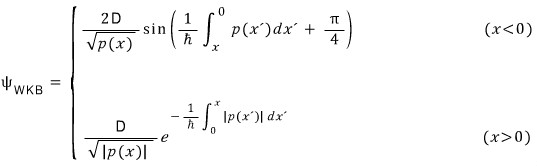
$$ \boxed{ \frac{D}{\sqrt{\kappa(x)}} \exp\left[ -\frac{1}{\hbar}\int_0^x\kappa(x')\,dx' \right] \quad (x\gt0) \;\longleftrightarrow\; \frac{2D}{\sqrt{p(x)}} \sin\left[ \frac{1}{\hbar}\int_x^0p(x')\,dx' +\frac{\pi}{4} \right] \quad (x\lt0). } $$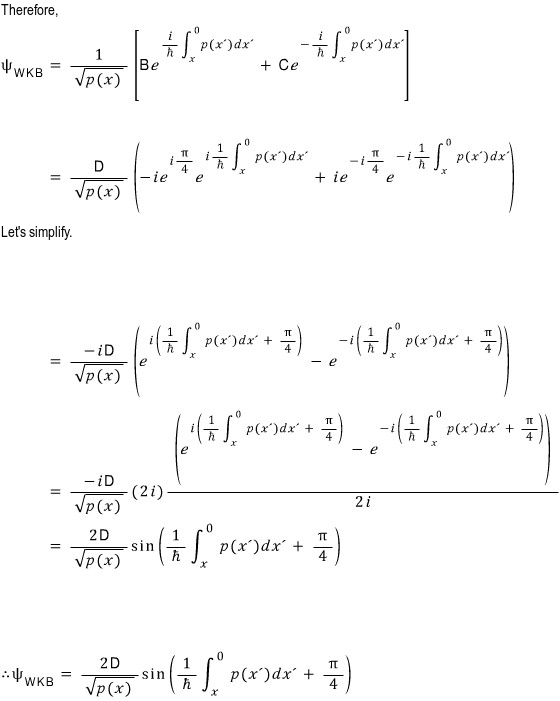
What the connection formula does—and does not do
The Airy solution does not “repair WKB at $x=0$.” Instead, it supplies a local solution that is valid through the simple turning point. Its asymptotic forms match WKB in overlap regions on the two sides. That matched continuation produces the factor of two and the phase shift $\pi/4$.
The historical concluding raster summarizes the same allowed-to-forbidden connection.
This derivation assumes an isolated simple turning point, $V(0)=E$ and $V'(0)\ne0$, with a region where both the linear potential approximation and the Airy asymptotics are accurate. A higher-order or non-isolated turning point requires a different uniform approximation.
Finally, $D$ is fixed by global normalization only for a normalizable bound-state problem. In a scattering problem it is instead determined by incident, reflected, and transmitted boundary conditions, usually with amplitudes compared through probability flux.
Comments
Discussion happens via GitHub Discussions. You'll need a GitHub account to comment.