WKB Quantization Practice: Two Turning Points, a Hard Wall, and a Logarithmic Potential
Three worked WKB quantization problems: the two-turning-point condition, the harmonic oscillator and half-oscillator, and the radial logarithmic potential.
This post puts the WKB connection formulas from the previous chapter to work. We will first recover the quantization rule for a well with two smooth turning points, then apply the same reasoning to a harmonic oscillator, a half-oscillator with one hard wall, and a radial logarithmic potential.
The notation used throughout is
$$ p(x)=\sqrt{2m\,[E-V(x)]} $$in a classically allowed region. WKB is reliable where the potential varies slowly on the scale of the local de Broglie wavelength; the connection formulas handle the immediate neighborhoods of simple turning points.
Matching across two turning points
Begin with one smooth turning point at $x_2$. The region to its left is classically allowed and the region to its right is forbidden.
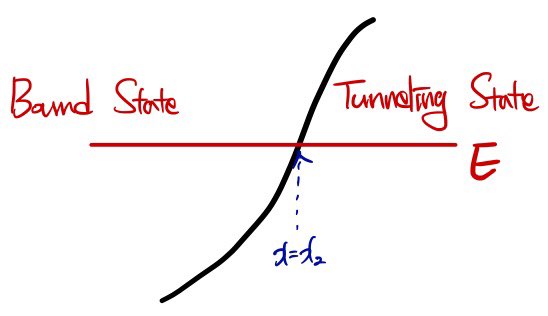
The connection formula for a solution that decays to the right is shown below.
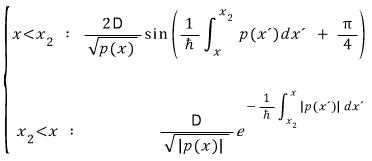
Nothing special depends on placing the turning point at the origin; the integration limit simply changes to $x_2$. If the allowed region lies on the other side, reverse the orientation of the connection formula.
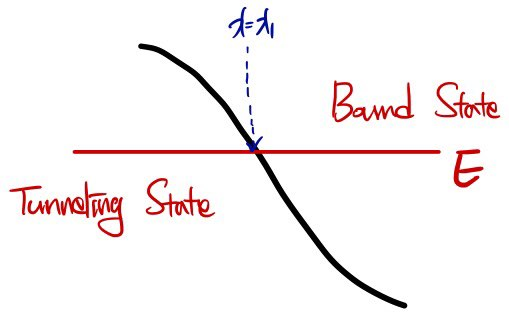
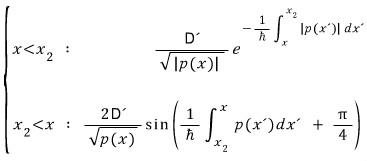
The connection formula is not an arbitrary mnemonic. It follows by replacing the potential with its linear approximation near the turning point, solving the resulting Airy equation, and matching the Airy asymptotics to the WKB forms. Here we will use that result rather than repeat the proof.
Now consider a bound state between two smooth turning points $x_1$ and $x_2$.
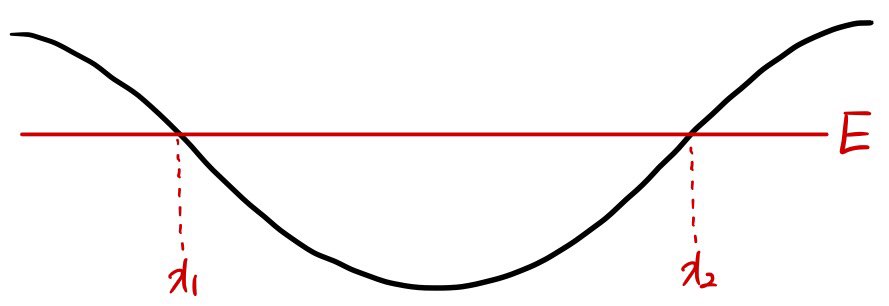
Matching from the right turning point gives one representation of the wavefunction in $x_1 < x < x_2$:

Matching from the left turning point gives another:

These are not two independent physical states. They must describe the same wavefunction throughout the well. More precisely, their phases must be compatible up to the periodicity and reflection identities of the sine, while their normalization constants must be chosen consistently. Merely saying that the phases can differ by an arbitrary multiple of $\pi$ is incomplete because $\sin A=\sin B$ also has the reflected branch $A=\pi-B+2k\pi$.
Using $\sin z=-\sin(-z)$ to put both expressions in a common form produces the intermediate steps below.
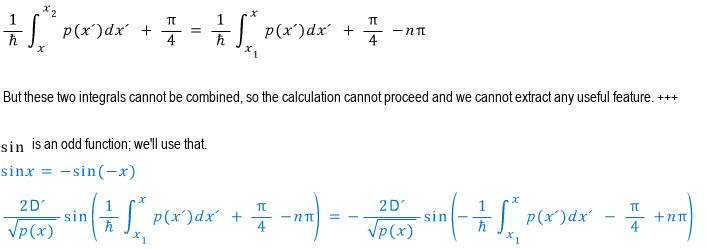
Combining the two action integrals gives the bound-state condition
$$ \int_{x_1}^{x_2}p(x)\,dx=\left(n-\frac12\right)\pi\hbar, \qquad n=1,2,3,\ldots $$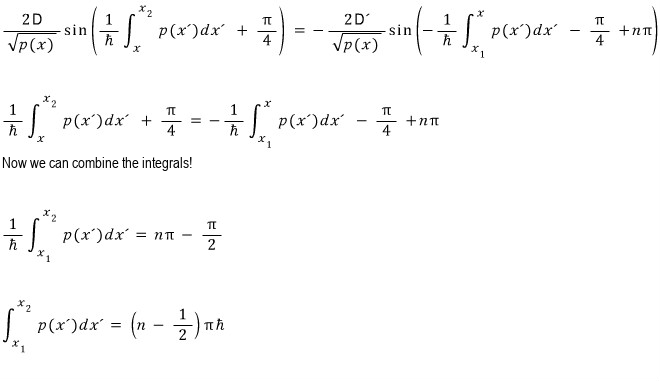
If the levels are instead numbered from $n=0$, the same result is more commonly written as
$$ \int_{x_1}^{x_2}p(x)\,dx=\left(n+\frac12\right)\pi\hbar. $$This is the Bohr–Sommerfeld quantization rule with the two turning-point phase shifts included.
Practice problem 1: harmonic oscillator
Use WKB to find the allowed energies of
$$ V(x)=\frac12m\omega^2x^2. $$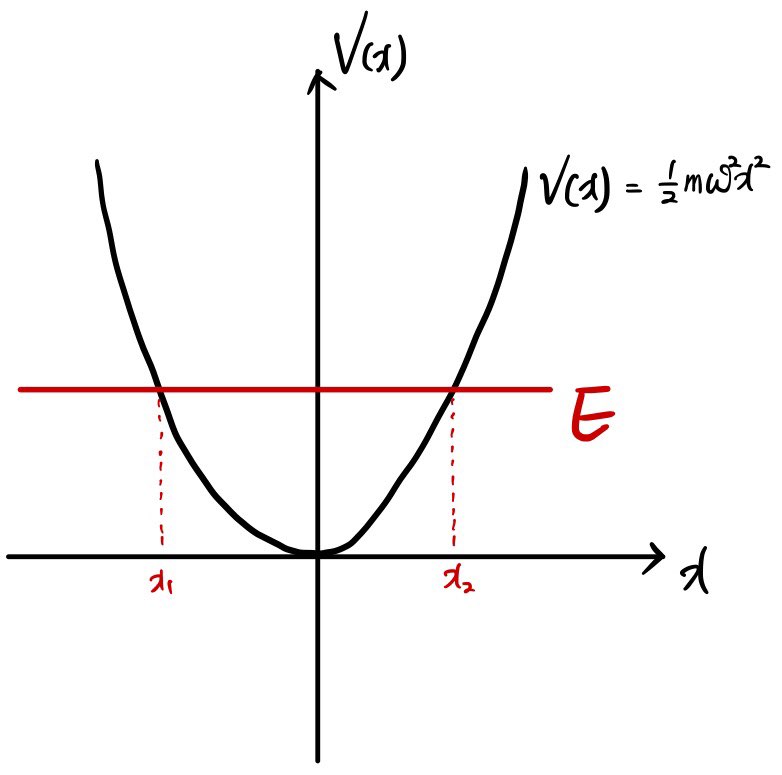
For two smooth turning points, the quantization condition is
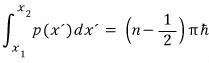
The turning points are symmetric, $x_1=-x_2$, and satisfy
$$ E=\frac12m\omega^2x_2^2. $$
Inside the allowed region,
$$ p(x)=\sqrt{2m\left(E-\frac12m\omega^2x^2\right)} =m\omega\sqrt{x_2^2-x^2}. $$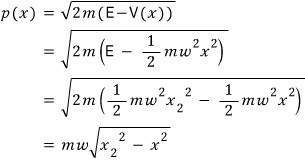
Symmetry changes the action integral to an integral from $-x_2$ to $x_2$.
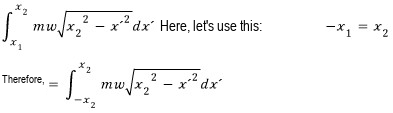
The needed antiderivative is the familiar semicircle integral.

Evaluating at the limits gives
$$ \int_{-x_2}^{x_2}m\omega\sqrt{x_2^2-x^2}\,dx =\frac{\pi E}{\omega}. $$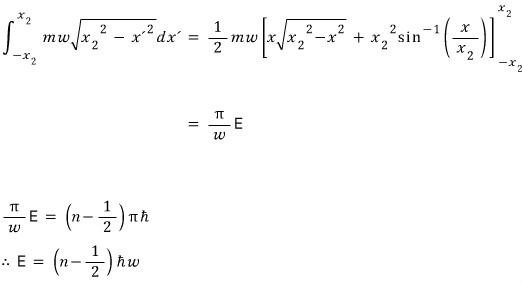
Therefore
$$ E_n=\left(n-\frac12\right)\hbar\omega, \qquad n=1,2,3,\ldots $$or $E_n=(n+\tfrac12)\hbar\omega$ when numbering starts at zero. For the harmonic oscillator the leading WKB rule happens to reproduce the exact spectrum.
Practice problem 2: one hard wall and one smooth turning point
Next put an infinite wall at $x=0$ and retain the harmonic potential for $x>0$. The wavefunction must vanish at the wall, while $x_2$ remains a smooth turning point.
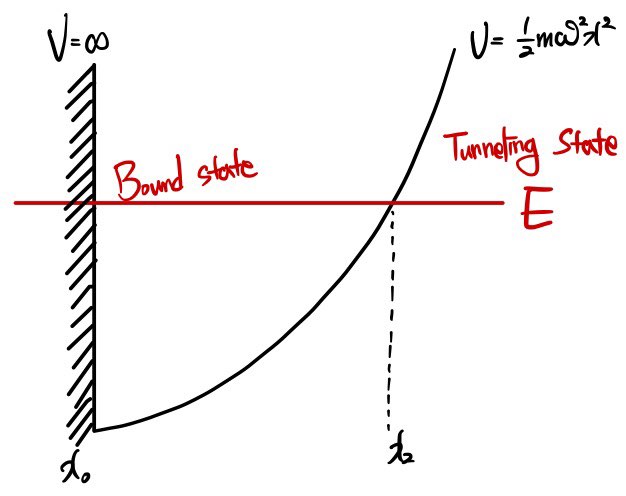
Matching at $x_2$ gives the allowed-region WKB form

and the hard-wall condition $\psi(0)=0$ requires the sine phase at $x=0$ to be an integer multiple of $\pi$. Thus
$$ \int_0^{x_2}p(x)\,dx=\left(n-\frac14\right)\pi\hbar, \qquad n=1,2,3,\ldots $$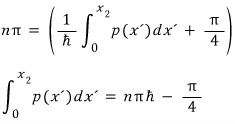
The momentum and turning-point relation are the same as before.
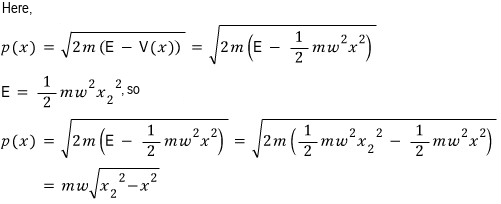
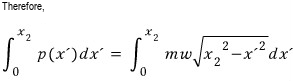
Using the quarter-circle integral

gives
$$ \int_0^{x_2}m\omega\sqrt{x_2^2-x^2}\,dx =\frac{\pi E}{2\omega}. $$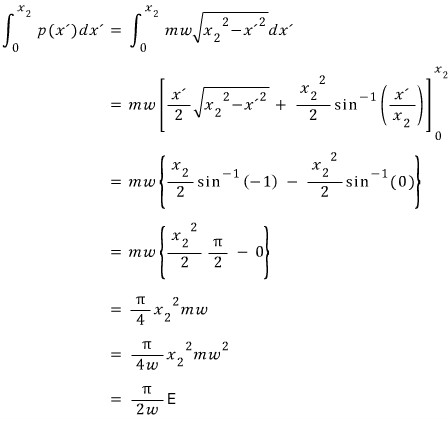
Source correction: In the preserved historical raster above, the upper endpoint is written as $\sin^{-1}(-1)$. Because $x'=x_2$ there, the argument must be $+1$, so this line should read $\sin^{-1}(1)=\pi/2$. The adjacent native TeX and the final action $\pi E/(2\omega)$ retain the corrected result.
The spectrum is therefore
$$ E_n=2\left(n-\frac14\right)\hbar\omega =\left(2n-\frac12\right)\hbar\omega, \qquad n=1,2,3,\ldots $$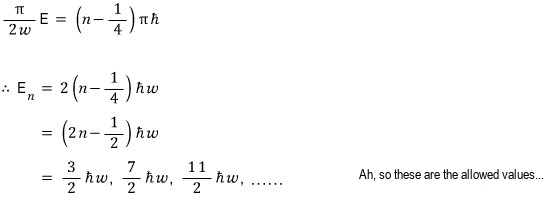
These are $3\hbar\omega/2,7\hbar\omega/2,11\hbar\omega/2,\ldots$. They are precisely the odd-parity levels of the full oscillator, because only odd oscillator wavefunctions vanish at the origin.
Practice problem 3: radial logarithmic potential
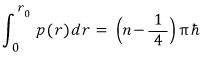
For an $l=0$ state in a spherically symmetric potential, write the reduced radial wavefunction as $u(r)=rR(r)$. Its boundary condition is $u(0)=0$, so the origin acts like a hard boundary for the one-dimensional radial problem. With one smooth outer turning point $r_0$, the WKB rule used here is
Consider
$$ V(r)=V_0\ln\frac{r}{a}. $$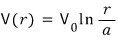
At the turning point, $E=V(r_0)=V_0\ln(r_0/a)$. Hence
$$ E-V(r)=V_0\ln\frac{r_0}{r}, $$and the action becomes
$$ \int_0^{r_0}\sqrt{2mV_0\ln\frac{r_0}{r}}\,dr. $$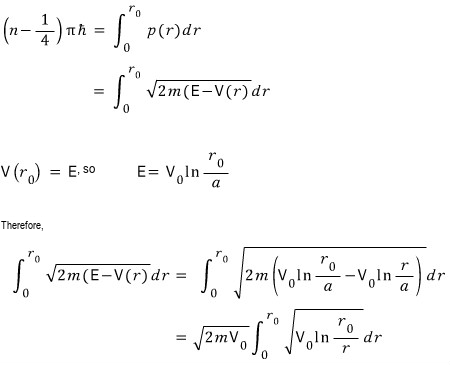
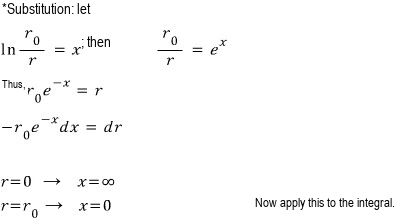
Set $x=\ln(r_0/r)$, so $r=r_0e^{-x}$ and $dr=-r_0e^{-x}dx$. As $r$ runs from $0$ to $r_0$, $x$ runs from $\infty$ to $0$.
The remaining integral is a Gamma-function integral:
$$ \int_0^\infty x^{1/2}e^{-x}\,dx =\Gamma\!\left(\frac32\right) =\frac{\sqrt\pi}{2}. $$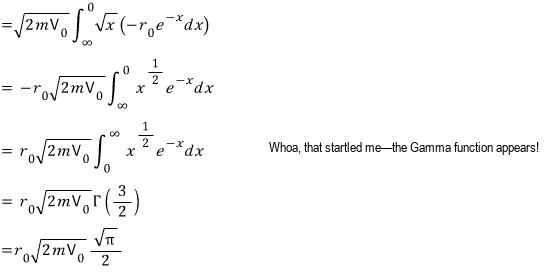
Therefore
$$ r_0=\sqrt{\frac{2\pi}{mV_0}}\left(n-\frac14\right)\hbar $$and
$$ E_n =V_0\ln\!\left[ \sqrt{\frac{2\pi}{mV_0}} \left(n-\frac14\right)\frac{\hbar}{a} \right]. $$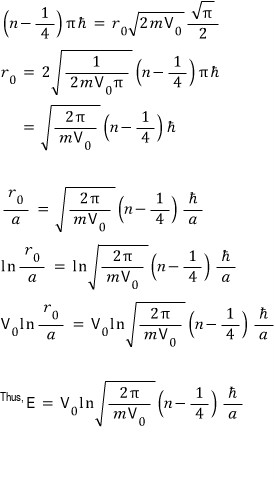
Taking the difference of adjacent levels cancels every mass-dependent factor:
$$ E_{n+1}-E_n =V_0\ln\!\left(\frac{4n+3}{4n-1}\right). $$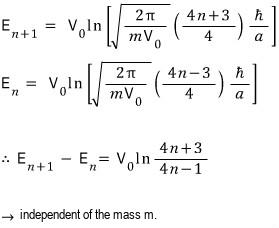
Source correction: In the preserved historical raster above, the displayed $E_n$ factor $(4n-3)/4$ is a typo. Consistency with $n-\tfrac14$ requires $(4n-1)/4$. The adjacent native TeX retains the corrected levels and the correct spacing $V_0\ln[(4n+3)/(4n-1)]$.
The conclusion is that the spacing is independent of the particle mass, not that it is constant: the logarithm still makes the spacing depend on $n$. Also, because the logarithmic potential is singular at the origin, this result should be understood as the stated radial WKB approximation with the boundary phase built in, not as a claim that ordinary WKB remains uniformly valid all the way to $r=0$.
Takeaway
The phase correction depends on the kind of boundary encountered:
- two smooth turning points give a total half-integer shift;
- one hard wall plus one smooth turning point gives the quarter-shift rule used above;
- changing the potential changes the action integral, but the matching logic remains the same.
The historical raster equations and diagrams are preserved in this edition. The surrounding text supplies searchable equations, definitions, indexing conventions, and the scientific qualifications that were only implicit in the original notes.
Original Korean post: WKB approximation practice problems — Quantum Mechanics I Studied #37.
Comments
Discussion happens via GitHub Discussions. You'll need a GitHub account to comment.