Fermi's Golden Rule and Selection Rules
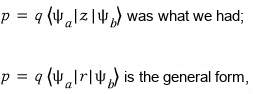
Light of every color at once: weigh the single-frequency transition probability by the light's energy density ρ(ω) and add up every ω, and the sharp sin² peak turns the probability into a rate, R = π|p|²ρ(ω₀)/(ε₀ħ²): Fermi's golden rule. Light from every direction with every polarization brings in a factor 1/3, and asking when p = q⟨ψ_a|r|ψ_b⟩ is non-zero gives the selection rules Δℓ = ±1, Δm = 0, ±1.
Previously we shot monochromatic light; now use weak, incoherent broadband light. Its random relative phases let us add the frequency contributions as probabilities after averaging. However, rather than building everything anew from scratch,
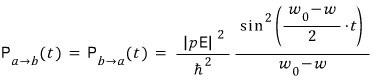
we’ll nicely Modify this thing we got from monochromatic light~~ Let’s get started~
For each $\omega$, the energy density $u$ of the electromagnetic wave is
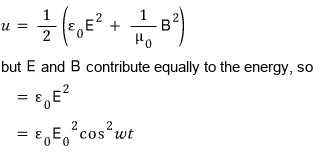
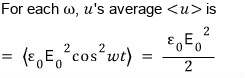
(From Electromagnetic Waves (Electromagnetism I Studied #29))
I’m going to use this~~
In this, we’re going to write the amplitude squared, $E_0^2$, using $\langle u\rangle$. Then
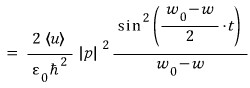
I have kept emphasizing “for each $\omega$” whenever I talk about $\langle u\rangle$. The continuum needs a spectral density: $\rho(\omega)\,d\omega$ is the energy per volume in a narrow frequency band. The picture’s  is shorthand; $\rho$ itself is energy density per unit angular frequency. Therefore
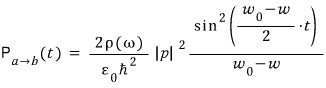
Then  turns out to mean ’the transition probability for one particular $\omega$’!!
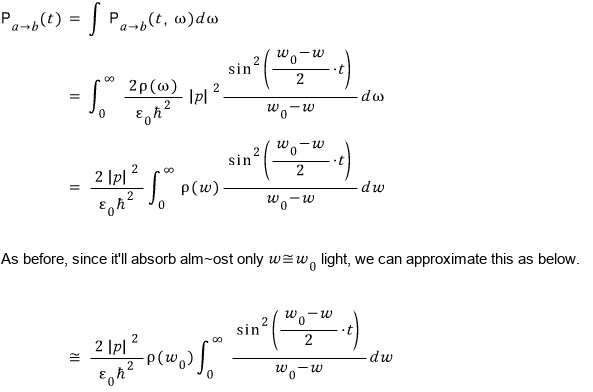
But we shot every $\omega$??? That is, it seems like we really should be calling the sum of all these individual probabilities the Probability????!
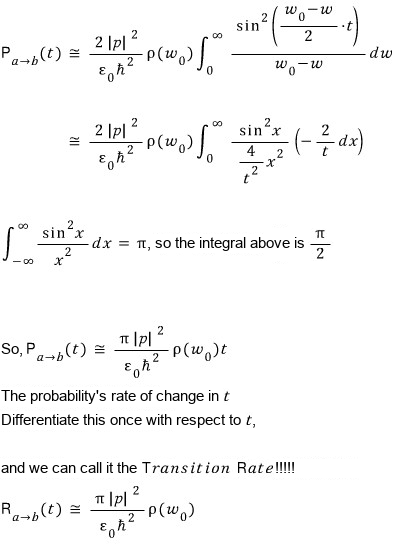
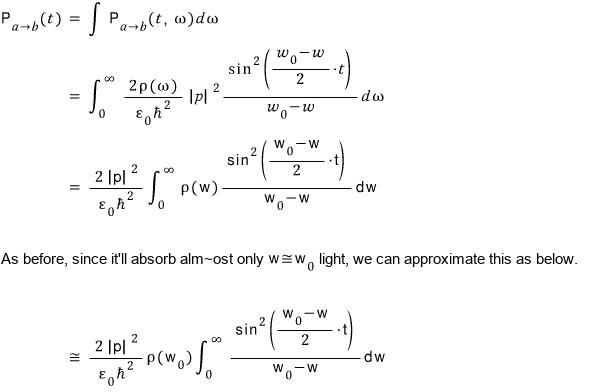
We need to fix it like this. Take a time long enough to resolve the narrow resonance, with $\rho$ nearly constant across its width, but short enough that the transition probability remains small.
This time, let’s say the light comes with its polarization vector pointing in every direction. And this light, holding polarization vectors in all directions, also comes in from all directions.
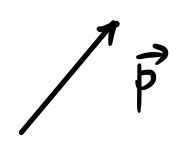
On a particle with this kind of Polarization, I mean.
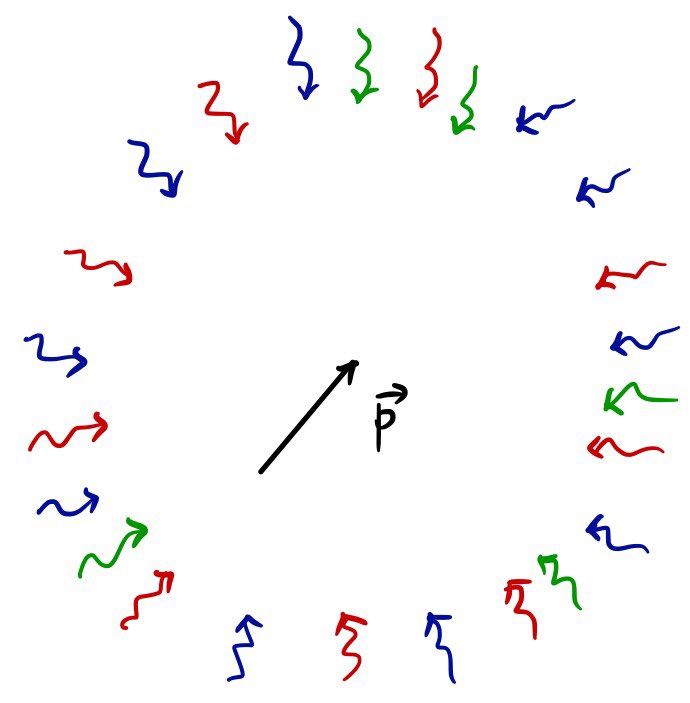
It means we’re going to look at the situation where lights of all sorts of colors come in from every direction.
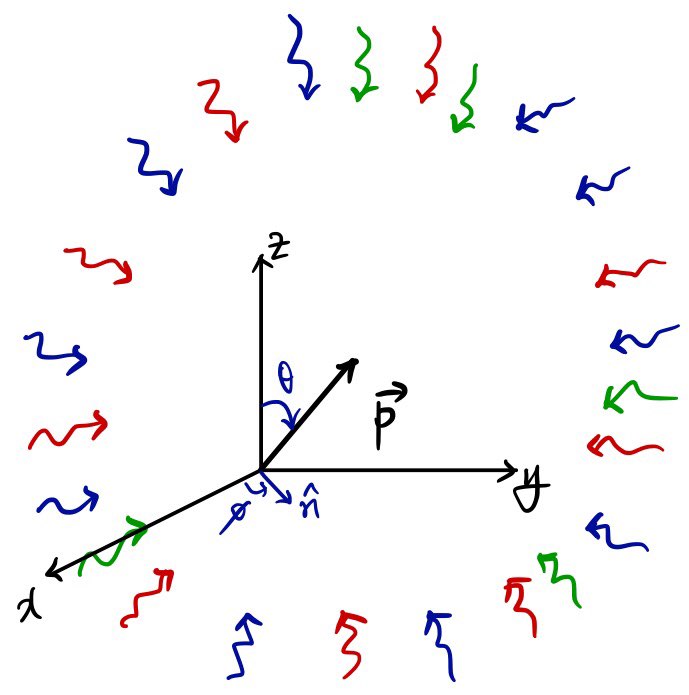
When we calculate this, we’ll set up spherical coordinates like this and calculate. As for the calculation method: first, we’ll call the light’s polarization direction (the direction its electric field points)  . Also,
and since the axis setting and variable setting have been done like that, we’re going to sum over all $\theta$ and all $\varphi$, that is, take the average. We’re going to find the average of  . Then let’s give it a try.
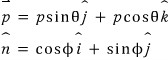
(We said the vector $\vec{p}$ is stuck on the yz plane.)
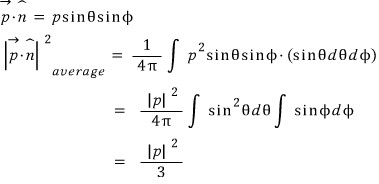
For light coming in from all directions,
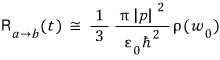
We’ll stop here and draw conclusions.
1. Fermi’s Golden Rule
The conclusion we can draw by looking at  : only light with
  is selected in this long-time resonance approximation. At finite time, the peak has a finite width.
2. Selection Rule
The conclusion we can draw by looking at 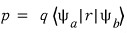 : the transition or emission happens only when is non-Zero for an electric-dipole transition. These orbital $\Delta\ell$, $\Delta m$ rules apply to central-potential states; a dipole-forbidden line can still occur through weaker interactions, such as magnetic-dipole or electric-quadrupole coupling.
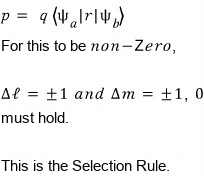
Heads-up. The figures here are the original notes, slips and all. A few things to watch for:
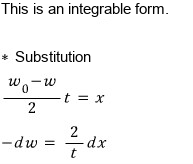
- In the transition probability, the denominator is $(\omega_0 - \omega)^2$, not $(\omega_0 - \omega)$, in every picture that writes $\frac{\sin^2\left(\frac{\omega_0 - \omega}{2}t\right)}{\omega_0 - \omega}$ (the line after the substitution already uses the square, $\frac{4x^2}{t^2}$). And the energy density in a band $d\omega$ is $\langle u\rangle = \rho(\omega)\,d\omega$.
- After the substitution $x = \frac{\omega_0 - \omega}{2}t$, the integral runs over $x$ from $-\infty$ to $\infty$ (for large $t$), and $\int \frac{\sin^2\left(\frac{\omega_0 - \omega}{2}t\right)}{(\omega_0 - \omega)^2}\,d\omega = \frac{\pi t}{2}$, not $\frac{\pi}{2}$; the final $P_{a\to b}(t) \simeq \frac{\pi|p|^2}{\varepsilon_0\hbar^2}\rho(\omega_0)\,t$ and the rate $R_{a\to b}$ are right.
- In the average over polarization directions, the squares belong on $p$ and on the angular factors: $\frac{1}{4\pi}\int |p|^2\sin^2\theta\sin^2\phi\,\sin\theta\,d\theta\,d\phi = \frac{|p|^2}{3}$; the result $\frac{|p|^2}{3}$ is right.
Comments
Discussion happens via GitHub Discussions. You'll need a GitHub account to comment.