Spontaneous Emission and Einstein Coefficients
Fill a box with two-level atoms and balance spontaneous emission (A), absorption (B_ab ρ) and stimulated emission (B_ba ρ). At thermal equilibrium the Boltzmann ratio N_a/N_b = e^(ħω₀/k_BT) gives ρ(ω₀) = A/(e^(ħω₀/k_BT)B_ab − B_ba); matching Planck's blackbody formula forces B_ab = B_ba and A = (ħω³/π²c³)B_ba, and with B_ba = π|p|²/(3ε₀ħ²) the spontaneous emission rate comes out as A = ω³|p|²/(3πε₀ħc³).
As I mentioned before, spontaneous emission can occur even with no incoming photons: an excited atom couples to the quantized electromagnetic field and releases some of its own excitation energy as a photon. And the scientist who succeeded in writing spontaneous emission down as equations is… ugh… Einstein, apparently.
Alright, let’s get started.
Einstein A & B coefficients
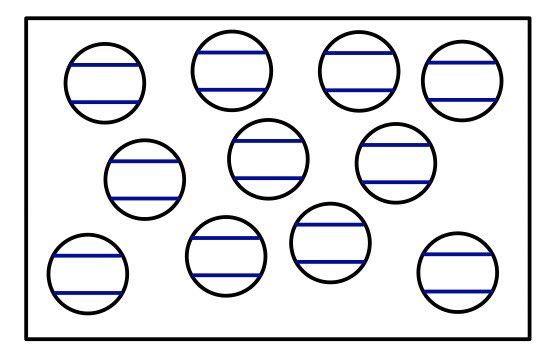
Let’s say a box is packed full of atoms, each one a two-level system. We take the two levels to be nondegenerate (or equally degenerate), with an isotropic thermal radiation field. Here $\rho(\omega)$ is energy density per unit angular frequency.
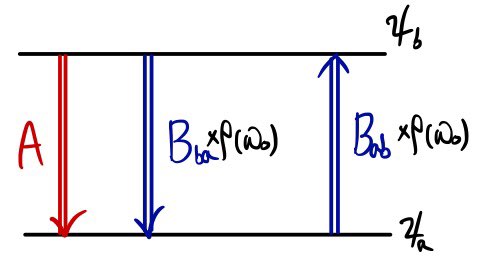
Inside the box, let the number of atoms in the  state be
  , and the number of atoms in the
  state be
  .
.
And if I write out what $A$ and those other numbers in the figure above mean,
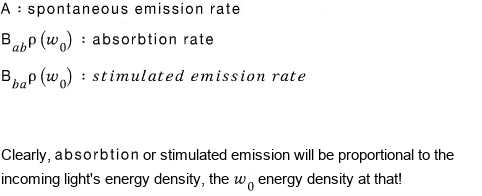
If we use these numbers to write the rate of change of $N_b$,

That time-dependent population change is measurable and useful too. Here, though, let’s focus on thermal equilibrium.
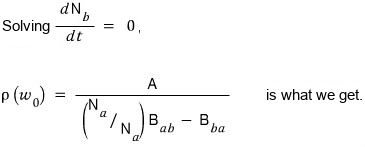
What we’re curious about is the equilibrium at $t \to \infty$, so the rate of change there will be 0!!!! That’s what equilibrium means!!!!!
So, like, the number $N_b$ will look constant. (It means the system has reached thermal equilibrium at temperature $T$.)
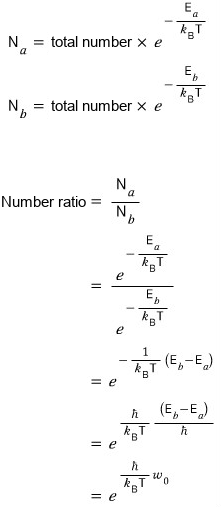
And the energy of the atoms in the box is either $E_a$ or $E_b$, right???? In a system at temperature $T$, an atom’s energy is $E_a$ or $E_b$, and how many atoms sit at each one follows the Boltzmann distribution!!!!
(You can check my Thermal & Statistical Mechanics series for that~)
That is,
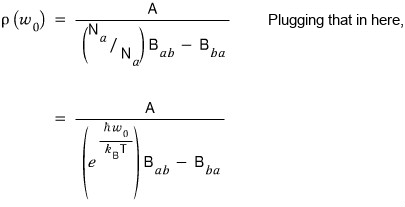
This, apparently, can be connected to Planck’s blackbody radiation formula.
So what’s blackbody radiation?
(You can also check The Rayleigh-Jeans Formula and Blackbody Radiation (Modern Physics I Studied #7) for this.) To put it simply, when we heat something up, light comes out, right???? If you study that light,
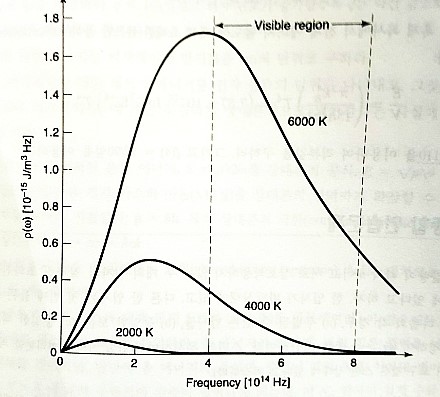
it comes out like this, apparently.
The classical Rayleigh–Jeans formula works in the low-frequency limit $\hbar\omega\ll k_BT$, but fails at high frequencies. Planck’s formula covers both limits, ta-da~!
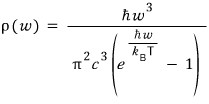
That’s what he fixed it to, apparently.
(Thanks to that, the curtain rose on quantum mechanics, too.)
So we can compare this with the blackbody radiation formula!!!!
At thermal equilibrium, the atoms emit and absorb radiation at balanced rates — this is not a directed beam. What we did was write the spectral energy density of that  light in terms of the Einstein coefficients, right!!!! Let’s compare this formula with Planck’s formula, the one that matches the experiments!!!!!
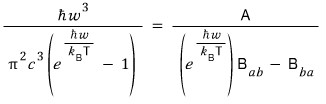
As you can see from the comparison, we find  .
.
We proved 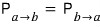 before, didn’t we?????? So you might even think it’s obvious!!!! hehe
And $A$ is
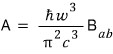
Earlier, we derived
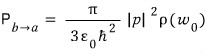
didn’t we?? That is,
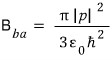
and therefore $A$ is
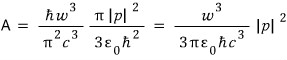
(What is this, an all-star reunion of the universe’s physical constants? lol)
And that’s how we get the spontaneous emission rate $A$~
Heads-up. The figures here are the original notes, slips and all. A few things to watch for:
- In $\rho(\omega_0)$, the ratio in the denominator is $\frac{N_a}{N_b}$, not $\frac{N_a}{N_a}$: setting $\frac{dN_b}{dt} = -N_bA - N_bB_{ba}\rho(\omega_0) + N_aB_{ab}\rho(\omega_0) = 0$ gives $\rho(\omega_0) = \frac{A}{\frac{N_a}{N_b}B_{ab} - B_{ba}}$ (the same ratio in the line where $e^{\hbar\omega_0/k_BT}$ is plugged in).
- In the Boltzmann ratio, $\frac{N_a}{N_b} = e^{\frac{1}{k_BT}(E_b - E_a)}$, with no minus sign in front (the next lines, ending in $e^{\hbar\omega_0/k_BT}$, are right), and each count carries the normalization: $N_a = \frac{N}{Z}e^{-E_a/k_BT}$ and $N_b = \frac{N}{Z}e^{-E_b/k_BT}$, where $Z$ cancels in the ratio.
- The formula taken from the last post, $\frac{\pi}{3\varepsilon_0\hbar^2}|p|^2\rho(\omega_0)$, is the transition rate $R_{b\to a}$ (per second), not a probability $P_{b\to a}$; $R_{b\to a} = B_{ba}\rho(\omega_0)$ then gives $B_{ba}$.
Comments
Discussion happens via GitHub Discussions. You'll need a GitHub account to comment.