The Pauli Exclusion Principle
Why don't electrons simply stop when a metal cools? Pauli exclusion explains Fermi filling, while weaker lattice scattering explains a common drop in resistivity.
English editorial update, September 2026: This revision preserves the question and recollections from the original 2016 post, corrects its explanation of metallic resistance, and answers the question it left open about very low temperatures. The four original illustrations are retained.
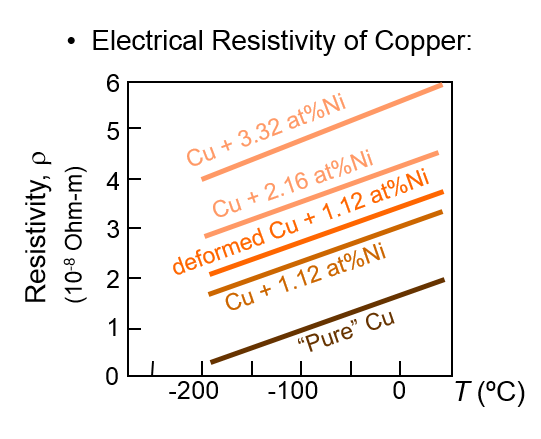
Resistivity of copper and copper–nickel alloys over a limited temperature interval. “at%” means atomic percent. The graph also compares the undeformed and deformed alloy containing 1.12 at% nickel; it does not show the limit at 0 K.
Looking at this graph, I find myself asking: why does heating these metals make it harder for current to flow? Their resistivity rises with temperature, so their conductivity falls. Under the same applied electric field, that means a smaller current density. For a uniform wire whose length and cross-sectional area stay fixed, its resistance follows the same trend as its resistivity.
The familiar answer from high school is that the atoms vibrate more. We can make that answer more precise. Heating a solid increases its thermally excited lattice vibrations, described quantum mechanically as phonons. Scattering between electrons and these vibrations disrupts the directed transport of charge. As the metal cools, this contribution to scattering becomes weaker, which accounts for the usual fall in resistivity under conditions like those illustrated here. David Tong’s notes on scattering mechanisms
The underlying periodic lattice also determines the electronic energy bands. In the ideal band picture, electrons can propagate through a perfectly periodic, static crystal; resistance requires a mechanism that relaxes their directed motion. Nickel atoms mixed into copper and defects introduced by deformation provide additional scattering, helping explain why the curves sit at different heights. Cambridge notes on electron dynamics
But now a different question starts bothering me:
“If cooling reduces thermal energy, shouldn’t the electrons lose their energy too? Shouldn’t they stop moving?”
That was the question that sent me back to the Pauli exclusion principle. Electrons are fermions, and no two identical fermions can occupy the same complete one-particle quantum state. For an electron, that state includes its spin. In a simple model where the orbital energy does not depend on spin, one spatial orbital can therefore hold at most two electrons with opposite spin projections. Bosons are not subject to this exclusion rule, so several bosons may share a state. Michigan State’s explanation of Pauli exclusion
Here is the simple picture I used to remember this. Treat each horizontal line in the following drawings as one spatial orbital. The numbers label the schematic lines, not complete atomic shells. The “Nucleus” label comes from the original atomic-style artwork; these drawings are a teaching aid, not a copper atom’s actual electron configuration or a metal’s band structure. The little up and down arrows indicate spin projections.
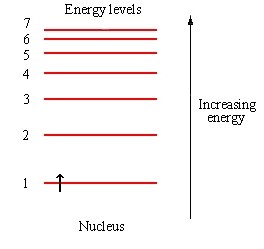
One electron occupies the lowest spatial orbital in the toy model. The upward arrow represents its spin projection.
To construct this model’s ground state, we minimize the total energy while respecting Pauli exclusion. That is why we fill the lowest available states first. The exclusion rule by itself would also allow excited arrangements with electrons in higher orbitals.
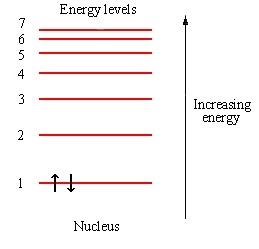
A second electron can share the lowest spatial orbital by occupying its opposite-spin state.
These electrons share a spatial orbital but occupy different complete states. Once both spin states are occupied, an additional electron must use another orbital. Also, different orbitals can have the same energy, a situation called degeneracy. There is no general rule limiting a particular energy value to only two electrons. MIT’s introduction to quantum states and their occupation
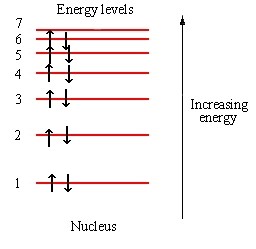
Adding electrons requires occupation of higher orbitals after the lower states fill. This illustrates the filling idea qualitatively; the upper arrow spacing carries no quantitative information about a real spectrum.
Now we can return to the metal. In a solid, the relevant electron states extend throughout the crystal, with closely spaced energies arranged into bands. In the normal, independent-electron model at zero temperature, occupied states extend from the lower energies up to the Fermi energy. The occupied momentum states form the Fermi sea, whose boundary is the Fermi surface. Electrons occupy the whole sea, not just its boundary. Even in the free-electron ground state, many occupied states have nonzero momentum and kinetic energy. Cooling removes thermal excitations without making all the electrons collect in a single lowest state. Cambridge notes on the degenerate Fermi gas
At a small nonzero temperature, the sharp boundary between occupied and empty states becomes a narrow transition in occupation probability near the chemical potential, which is close to the zero-temperature Fermi energy. This is the Fermi–Dirac distribution. MIT’s discussion of the Fermi–Dirac distribution
How does this connect to current? In the ordinary equilibrium picture with no applied field, opposite-velocity contributions cancel. A cold metal does not spontaneously supply a current just because its electrons have kinetic energy. An applied electric field produces a small imbalance in the occupations, with changes concentrated near the Fermi surface. Nearby empty states allow that response without requiring electrons to overcome an energy barrier as large as the Fermi energy. Scattering relaxes the imbalance, and Pauli exclusion affects scattering too by restricting the available final states. MIT’s notes on electron transport and scattering
This also explains why we need the band picture. A metal has nearby available states at its Fermi surface. In a band insulator, the filled and empty bands are separated by an energy gap. Its electrons obey Pauli exclusion as well, so that principle alone cannot tell us whether a material conducts. Cambridge notes on metals and band insulators
My original explanation jumped too quickly from “electrons still occupy higher-energy states” to “resistivity decreases.” Fermi filling answers why their energy does not simply disappear on cooling. The falling resistivity in the opening graph is explained mainly by weaker electron–phonon scattering. Both ideas belong in the answer.
There was another question I left for readers in 2016: what happens when the temperature gets really low, all the way toward 0 K?
The graph cannot answer that by itself. Its horizontal axis is in degrees Celsius, and extending those short straight lines to absolute zero would go beyond what it shows. For an ordinary sample that remains in its normal metallic state, the thermal phonon contribution can become very small while impurities and defects still scatter electrons. Its resistivity can then approach a residual resistivity set by the sample’s impurities and defects. NIST-hosted reference on electrical resistivity
Some materials instead enter a superconducting phase, with zero dc resistance under suitable temperature, current, and magnetic-field conditions. That is a separate physical phase, not a promise that every metal becomes resistance-free when cooled enough. Even an idealized normal metal with no disorder is not thereby a superconductor. NIST’s introduction to superconducting properties, NIST’s explanation of superconducting limits
This post began with my Materials Physics class on March 11, 2016. I was shocked that I had forgotten the exclusion rule distinguishing fermions from bosons, so as soon as class ended, I ran to the library and started writing. Surely I wouldn’t forget it after that!
I already knew the atomic drawings were a shortcut and thought a band diagram with a Fermi level would be more appropriate. The up and down arrows simply made the idea easier for me to grasp. I ended the original post by asking readers to teach me about the very-low-temperature limit. That curiosity still feels right: a question that sounds as simple as “shouldn’t the electrons stop?” opens the door to a much richer picture of matter.
Comments
Discussion happens via GitHub Discussions. You'll need a GitHub account to comment.