Hyperbolic Geometry and Non-Euclidean Geometry
We jump straight into Lorentz transformations and spacetime diagrams, playing with inertial frames and Einstein's brain-smashing assumption that light always travels at c!
Now then, let’s jump straight into the Lorentz transformation.
Basically, the basic way to understand a transformation is
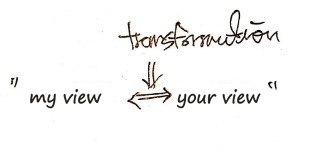
that’s how you can think of it. For an easy example, take the transformation for a rotation of the coordinate axes:
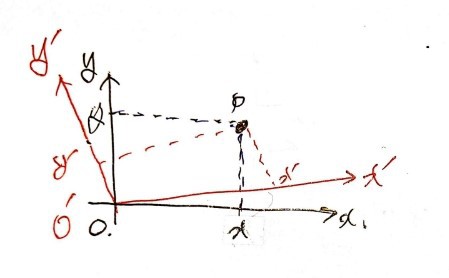
Point $O$ goes, “Hey!!! The coordinates of point $P$ over there are, from my perspective, $(x, y)$!!! ^^” But then another coordinate system $O'$, slightly rotated from $O$, shows up and goes, “Hold on~ from my perspective it’s $(x', y')$, though?!??!”
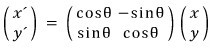
And as the con!nec!tion between the two, we once came up with an equation like this:
Drawing a moving frame in spacetime
So now we’re gonna go play in spacetime!!! Heeere we go!!!
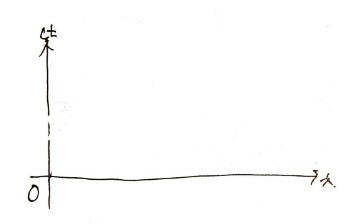
Here we have an inertial frame, and inside it we’re going to draw another inertial frame!!!
Let’s insert $ct'$, the time axis of the inertial frame $O'$ that moves at constant velocity $v$. How should you think about $ct'$? Think of it as tracing the trajectory of $x' = 0$. That is, a spaceship is flying in the $x$ direction at velocity $v$, and if you trace along its tail end, $x' = 0$, that’s the $O'$ as seen by $O$!!!
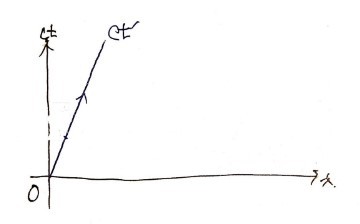
Something like this, I mean!!! So that’s how we set up the $ct'$ axis, and now we have to set up the $x'$ axis,,,
So how do we put that in?!
We have to draw it using the speed of light $c$. The light of the $O'$ frame, as seen from the $O$ frame, also has to be seen at the speed $c$ — that’s the postulate I introduced in Special Relativity Special #2, that absurd-looking assumption of Einstein’s that smashed our brains!!!
And remember, the speed of light was drawn as a 45-degree straight line in spacetime! If we shoot light at $ct = -a$, it reflects off a mirror at $x = a$, and the light arrives back at $ct = a$ — if we represent those events in spacetime
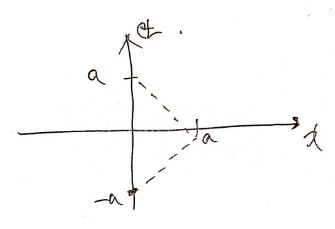
this is how it was drawn, right.
Now, “a person inside a flying spaceship shoots light at a mirror that is at distance $a$ inside the spaceship — that scene” is what the inertial frame $O$ is watching. I scribbled down the process of drawing the frame $O'$, which moves at constant velocity $v$, into the spacetime above!!!
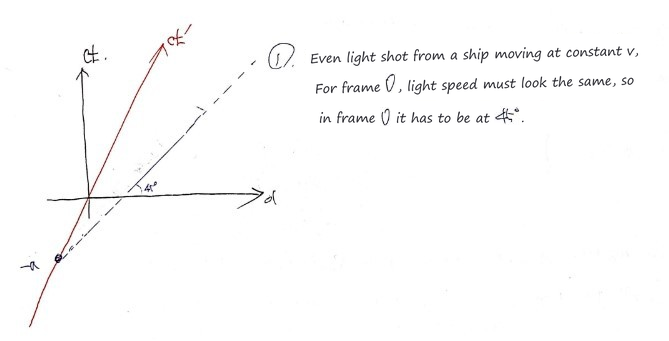
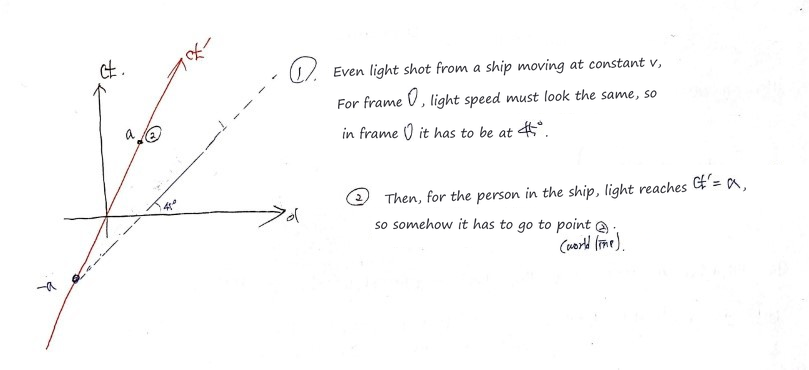
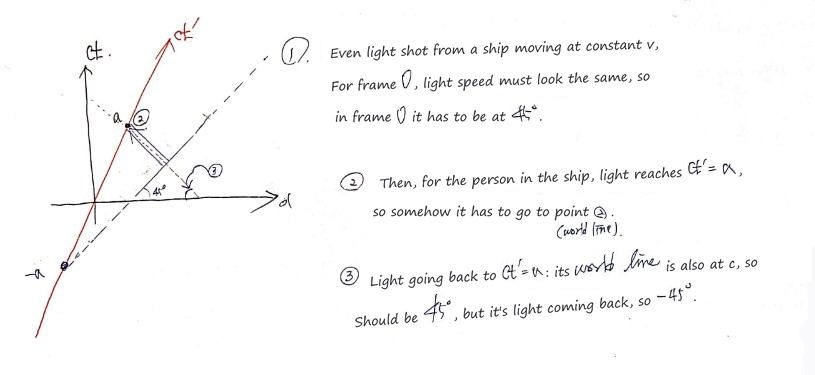
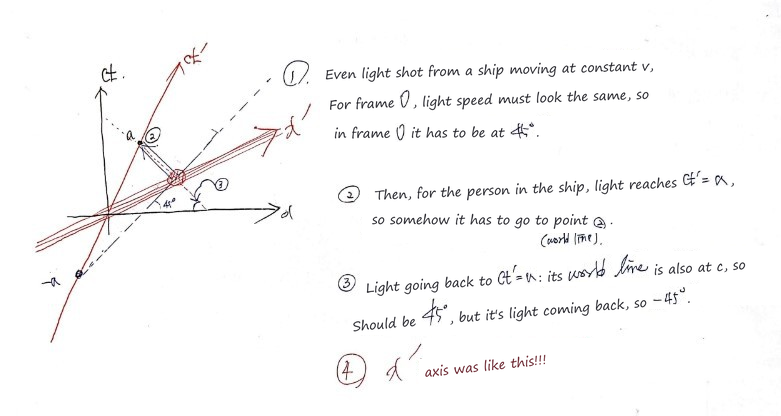
Alright, so now, at velocity $v$ — ahhhh no, to be more strict, we can now show on the inertial frame $O$ a frame that moves at relative velocity $v$.
Tick marks and the hyperbola
So we should slowly head toward the Lorentz transformation, but first let’s take a look at the tick marks of the inertial frame $O'$ as shown on the inertial frame $O$. Let’s look at drawing the tick marks!!!
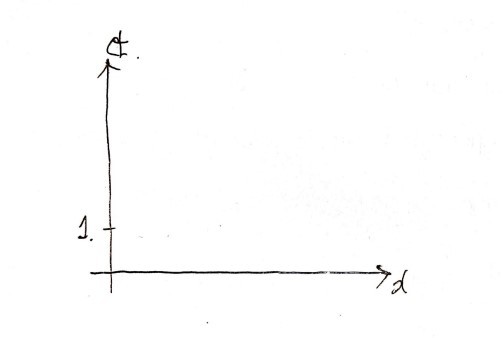
First, let’s mark a dot at the place where $ct = 1$. And instead of calling it a distance, I’ll check the interval. The (squared) interval up to this point is
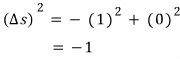
Now, let’s look at all the points in this spacetime where $(\Delta s)^2 = -1$!!!
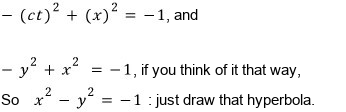
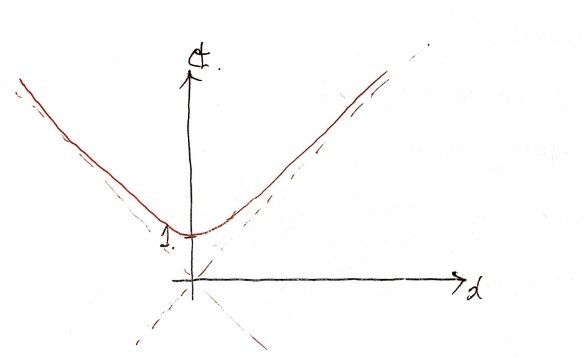
And let me draw in here the spacetime of a frame moving at velocity $v$.
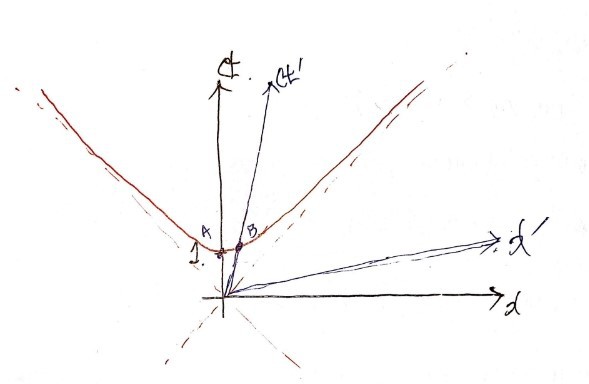
Then, in this spacetime, the place on the $ct'$ axis where $(\Delta s)^2 = -1$ will be that blue dot over there. And of course Lorentz invariance is preserved when we change coordinate axes~
Ah okay, so I get what the tick-mark drawing is about. Now what we’re after is probably…. the start of the Lorentz transformation.
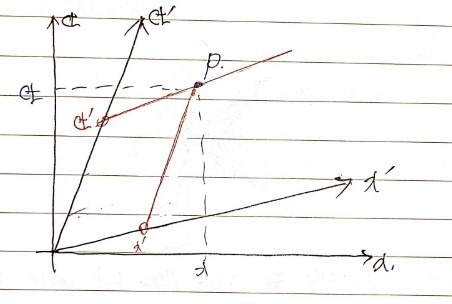
Some event $P$ is $(ct, x)$ with respect to the inertial frame $O$, but what about in the $O'$ inertial frame, whose coordinates are $ct'$ and $x'$??? It should be shown by those $ct'$ and $x'$ up there. As for how we move it over there…
Hyperbolic functions
To do that, we first have to know the “hyperbola” better. Let me briefly summarize the hyperbolic functions. Not hyperbolas but hyperbolic functions — the hyperbolics — is what you need to know!!!
For the details you’ll have to look at a general math textbook!!!
First, hyperbolic functions

are defined like this!!! This is easy enough that even a high schooler could follow it.
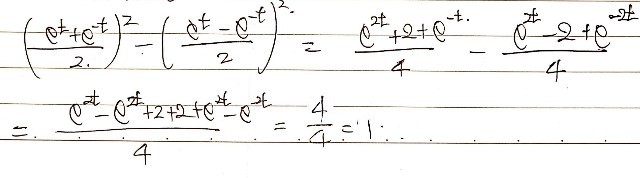
But why are they called “hyperbolic functions”, as if they were named after the hyperbola? (It’s in Boas’s mathematical physics textbook too.) Just as trig functions have $\cos^2\theta + \sin^2\theta = 1$, hyperbolic functions have this identity.

Checking the computation directly isn’t hard — you just plug in and compute.
Now here’s the thing. If we bring in a parameter $t$ and write the points as $(\cosh t, \sinh t)$, that actually means we can also draw $x^2 - y^2 = 1$ like this, you know?!
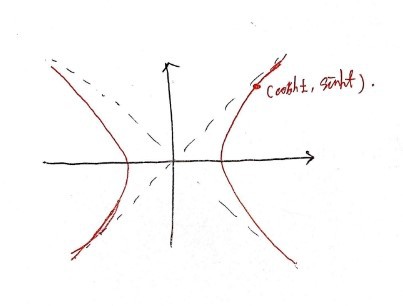
What the parameter really is
But here… what even is the parameter $t$….?
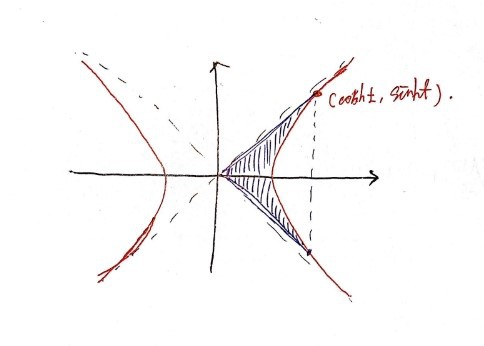
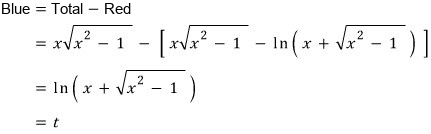
It’s precisely “this much area” that is the parameter $t$.
Let me check it.
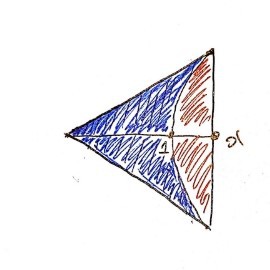
The area of the entire triangle here is
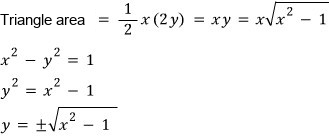
Now I’ll compute the area of the red part inside there!!!
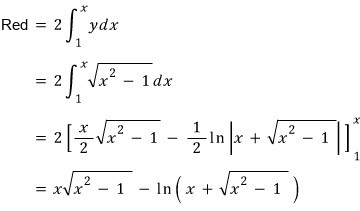
Therefore, the area of the blue part, the one we called $t$, is
Then let me mess around with the equation!!!
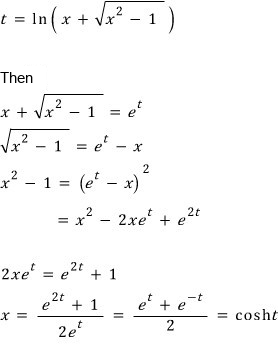
Yo!!! Neato burrito!!! $y$ can be confirmed too!!!
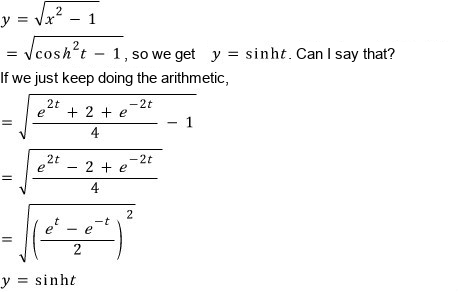
So on the unit hyperbola, at the point $(\cosh t, \sinh t)$ right now, the area drawn in that picture is
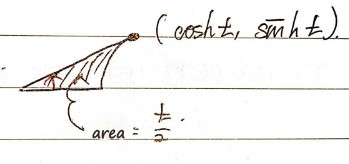
— and that a picture like this gets drawn should make sense to you now.
The hyperbolic angle
But we can discuss this not area-style but angle-style, so I’ll talk about hyperbolas a tiny bit more!!! The conclusion is
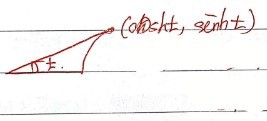
that we can call the angle here $t$ and give it the name “hyperbolic angle”!!!
I’ll confirm it briefly. On the “unit circle”
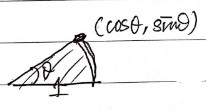
the area of the sector here was $\tfrac12\theta$.
Wait, the area was half the angle!?!?
We were on the unit hyperbola just now, right. Let’s think about it similarly.
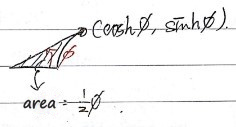
Let’s call the “angle of the half-slice of the unit hyperbola” whose area is $\tfrac12\Phi$ the hyperbolic angle $\Phi$.
So now, simply put,
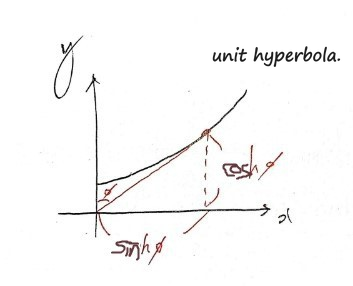
with the hyperbola set up like this, if we describe the angle as above, we can describe the coordinates on the hyperbola as above!!!
(This hyperbola has $(\Delta s)^2 = -1$, but by the discussion we just had, it doesn’t look much different from the $(\Delta s)^2 = 1$ case. And in the spacetime we’re dealing with now,,, the place we live in is the timelike separated regime, so I took this leap T_T)
Perpendicular, redefined
And now I’ll organize just one more real concept, and then for real, we’ll go to the Lorentz transformation!!! Let me just briefly touch on one thing!!!
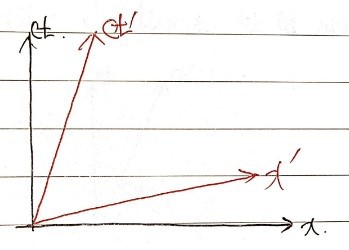
Alright, I drew two spacetimes here, and the $ct$ axis and the $x$ axis seem to be perpendicular to each other. Right?
But are the $ct'$ axis and the $x'$ axis perpendicular to each other??
Huh?? You want to kill me?? Me?? lol lol lol Sorry, lol
Anyway, the answer is…. sadly, they are perpendicular… T_T
You can’t say, “It doesn’t look like  , so they’re not perpendicular.” Because here it’s the non-Euclidean geometry of spacetime that rules, T_T So we probably have to redefine what perpendicular means.
First of all, as you can see

two points on the $x'$ axis are not simultaneous with respect to $ct$, but with respect to $ct'$ they are simultaneous.
So the new definition of perpendicular would be: things perpendicular to “some time line” are “simultaneous events,” right?
Then a new definition of parallel would seem to follow as well: different sets of simultaneous events with respect to some time line are parallel to each other.
Heads-up. The figures here are the original notes, slips and all. A few things to watch for:
- The rotation matrix in the picture right after the rotated axes, $\begin{pmatrix}\cos\theta & -\sin\theta\\ \sin\theta & \cos\theta\end{pmatrix}$, is the one for axes turned clockwise by $\theta$. For the primed axes turned counterclockwise, as they are drawn, the $\sin\theta$ terms swap signs: $x' = x\cos\theta + y\sin\theta$ and $y' = -x\sin\theta + y\cos\theta$.
- In the picture that defines the hyperbolic functions, the exponents are written with $x$; they should be $t$: $\sinh t = (e^{t} - e^{-t})/2$ and $\cosh t = (e^{t} + e^{-t})/2$.
- In the handwritten check of $\cosh^2 t - \sinh^2 t = 1$, the first numerator ends in $e^{-t}$; it should be $e^{-2t}$, as the next line uses.
Comments
Discussion happens via GitHub Discussions. You'll need a GitHub account to comment.