Lorentz Transformation and Lorentz Boosts
We finally wrap up the Lorentz transformation by using hyperbolic angles to assign ct', x' coordinates to events in a relatively moving frame!
Alright, now I’m going to wrap up the Lorentz transformation for real and be done with it!!!! As I mentioned before, what we’re about to pull off is this:
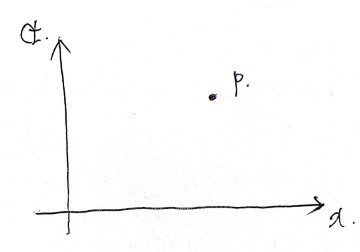
In $x$–$ct$ spacetime, event $P$ would be written as $(ct, x)$, right!?!??!
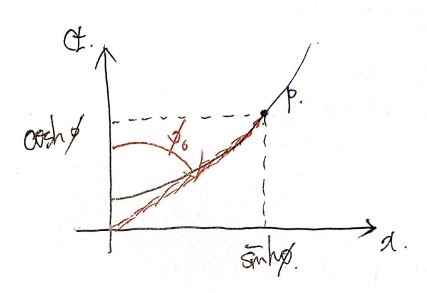
And using the hyperbolic angle, we got as far as writing its coordinates simply, like this. Here we start on the future unit hyperbola; for a general timelike point, multiply both coordinates by its interval scale. The final linear boost matrix also applies to spacelike and null events.
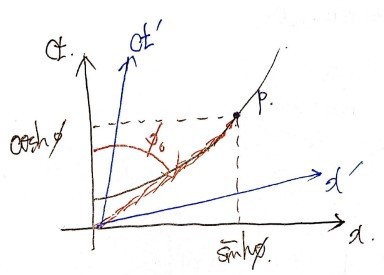
But wait, for a frame in relative motion like this one, event $P$ — how are we supposed to give it $ct'$, $x'$ coordinates!!!
Can’t we pull something off with the hyperbolic angle phi?!?! That’s exactly what we’re going to do now!!!
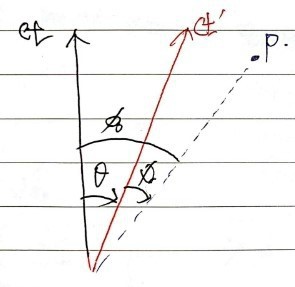
So now the problem boils down to this!!! With the picture drawn out like this!!!

we can say this!!! The hyperbolic angle is proportional to the area of a hyperbolic sector, so adjacent angles add up!!! Here $\theta$ is rapidity, $\tanh\theta=v/c$, not the ordinary angle you measure with a protractor on the page; that drawn tilt has $\tan\alpha=v/c$.
And as for the definitions of the hyperbolic functions, if you look at a general math book, there are formulas like these!!!
(Oh but, it’s been ages since I graduated from high school,,,, hyperbolics aren’t taught in high school, right?!?!)
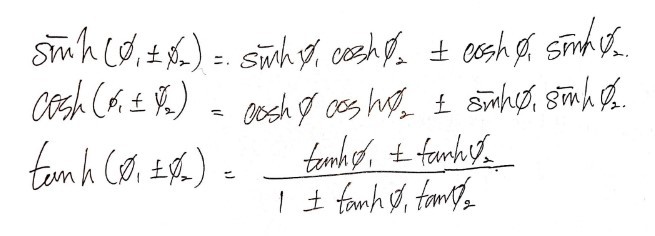
There are formulas like these, see???? The derivation is simple… so I’ll just put them to use!!! (Switch to exponentials and the derivation really is simple!)
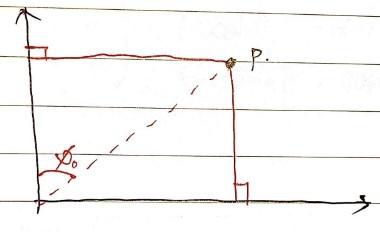
If you think carefully about writing the position of point $P$ with hyperbolic functions, we drop it onto the axes at 90 degrees like this and can call its coordinates $\cosh\Phi$ and $\sinh\Phi$.
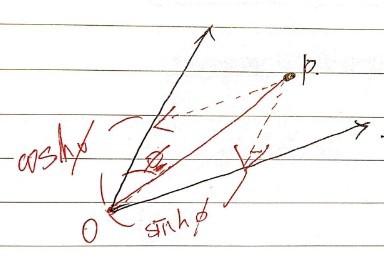
So in this kind of spacetime, it can be drawn like this. The red dashed lines and the black solid lines are at 90 degrees — spacetime’s kind of 90 degrees, the perpendicular we redefined last time!!!
Now we’re all set to work out the Lorentz transformation.
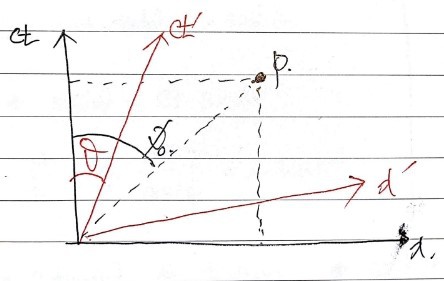
Let’s draw the spacetime of $O'$, moving with relative velocity $v$ with respect to $O$, like this, and hmm~~~ the info about $v$ should be packed into $\theta$, riiight?!?
Now let’s first write event $P$ in the black frame, and then write it in the red coordinate system.
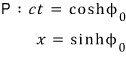
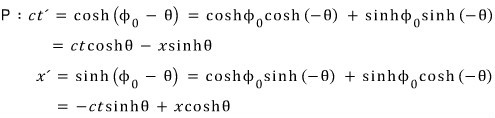
Using the fact that cosh is an even function and sinh is an odd function, you can derive it even more easily!
Now if we write those two equations as a matrix, we get the transformation!!!

And

if we plug $x' = 0$ into this equation, the equation is then about $x' = 0$ — in other words, out comes an equation for the relative velocity $v$. Let’s do it!!!
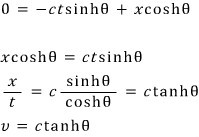
We can make it into this, oh, buuut

what if we mash it up together with this identity?
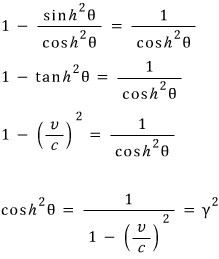
We write the hyperbolic cosine with gamma like this, and the hyperbolic sine is
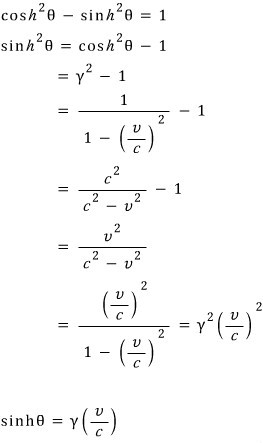
So now the matrix doesn’t need an angle anymore!!!
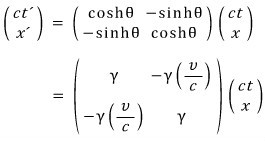
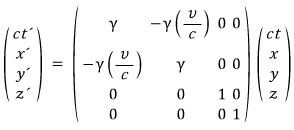
If we include the $y$, $z$ axes too!!!?!?! (But these are $y$, $z$ axes that don’t get involved. Meaning it’s not general — even though the $y$, $z$ axes are there, we’re only looking along the $x$ direction.)
Not a fan of this?!?! Then if we just list it all out as equations — typing that into the equation editor is way too much of a pain, so please… bear with me…
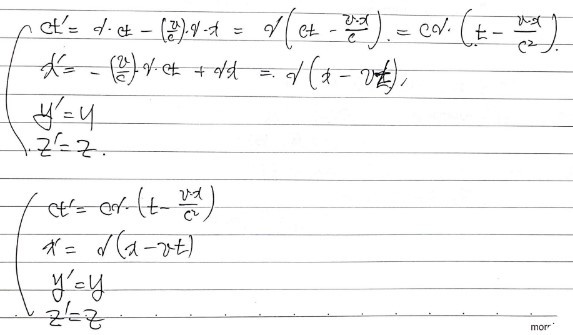
This kind of transformation is called the Lorentz transformation~~~
…is right! But let me be more specific: what we just did was a special case, since we fixed the $y$, $z$ directions and only looked at relative velocity along the $x$ direction.
More specifically, it’s a Lorentz boost along $x$ — one particular Lorentz transformation~
Lorentz transformations form the broader family: they preserve the spacetime interval and include spatial rotations as well as boosts. So calling our $x$ boost a Lorentz transformation is perfectly correct — now we just know its more specific name too!
(Still, let’s at least know that such a term exists~ and let’s moooove on! hehehehe hehe)
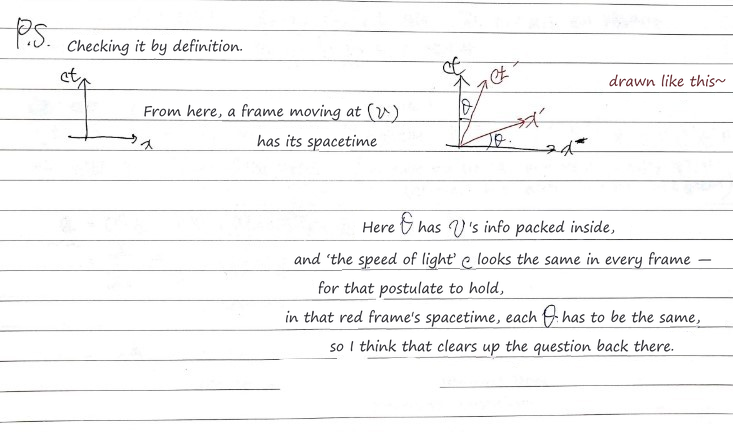
Heads-up. The figures here are the original notes, slips and all. A few things to watch for:
- In the second copy of the transformation, the $x$ line is $x' = \gamma(x - vt)$, with a prime on the left. And in the hyperbolic addition formulas, the cosh line reads $\cosh(\phi_1 \pm \phi_2) = \cosh\phi_1\cosh\phi_2 \pm \sinh\phi_1\sinh\phi_2$ (the first factor lost its subscript).
Comments
Discussion happens via GitHub Discussions. You'll need a GitHub account to comment.