Four-Vectors
Closing out the special-relativity series with a look at four-vectors — their notation, basis vectors, and how spacetime intervals set them apart from plain 3D vectors!
This will be the last post of the special relativity series!!!! A four-vector is a spacetime vector whose four components transform by the Lorentz matrix — not just any list of four numbers!!! With ordinary units, a displacement is $(ct,x,y,z)$; below we switch to $c=1$. Let’s study it, go go go!
First, let’s take it as given that you can add and subtract four-vectors just like the 3-dimensional vectors we’ve been using all along. What really sets 3-dimensional vectors and 4-dimensional vectors apart is the “spacetime distance” that kept getting emphasized in the earlier posts — you know, the thing we kept stressing as the interval!!??! That’s also why, when we first drew vectors in spacetime, spacetime got split into separate regions, remember?
Writing a four-vector
For the components of a four-vector, just like the way we’ve been handling vectors in 3 dimensions, people write  , apparently. Hmm… they stick the newly added $t$ term right at the very front????
And besides writing it out in a row like that, you can also write it as a linear combination of basis vectors. For instance, when we write the vector $(3, 5, 7)$ as 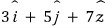 , then for a 4-dimensional four-vector those basis vectors are written
 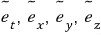 like this: an $e$ with a subscript, plus a tilde drawn on its head.
Well, the notation for four-vectors probably differs from book to book, but anyway, I get that it’s to make it obvious that this is a 4-dimensional vector, not a 3-dimensional one.
But then later on, people say even writing $t, x, y, z$ is a pain, and also to make sigma sums easier to write, 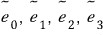 are what get used more often, apparently.
We’ve talked about basis vectors, so now let’s talk about components. To stand for each slot of $(t, x, y, z)$, they write 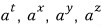 or
or 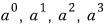 , apparently. So,
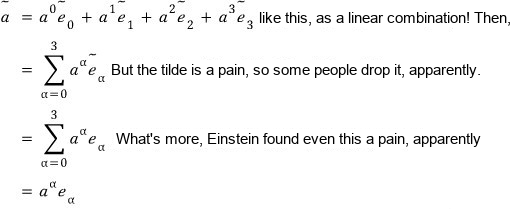
Einstein, honestly… isn’t that a bit much???? lol How much of a pain could it possibly be??? lol “Hey man!!! Isn’t it obvious that α runs from 0 to 3??? Please, let’s just agree to think of it this way… T_T”
He grandly named this Einstein’s summation convention, and apparently that’s how he satisfied his…. uh…. his desire not to do tedious stuff….. But we have to cut him some slack here, because in special and general relativity, sigma sums really, really, really got used a ton, apparently………
Oh, and just for reference, that index which says ‘sum me up’ (α above) is called a “dummy index,” just so you know… hehe
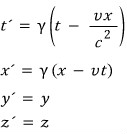
Then, if we look at this vector 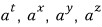 from a frame moving at velocity $v$ (in the $x$ direction), we just slap on the Lorentz transformation we studied earlier, right?????
Getting rid of c
Alright alright alright, but now we’re getting rid of $c$ too. We just set $c = 1$ and toss it out. This is us properly switching over to what’s called the ML unit system. Here’s what that is: the unit system we’ve been using so far is called the MLT (mass-length-time) system, and since we got rid of the T, it becomes the ML system, simple as that.
Setting $c=1$ doesn’t erase time or make one second equal one meter! We choose compatible time and length units. One second corresponds to one light-second of length, about $3\times10^8$ meters, as the picture shows:

If we use meters for all four coordinates, the time coordinate means $ct$ in meters; a value of 1 then corresponds to about 3.34 nanoseconds. If we use light-seconds, a time coordinate of 1 corresponds to one second. The chosen unit matters!
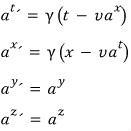
Ah, I should’ve put indices on the $a$’s like this up there too,,,, hehehe
The dot product and the metric tensor
Now let’s look at the dot product of vectors!!! Just like 3-dimensional vectors, 4-dimensional four-vectors satisfy the commutative and distributive laws for the dot product!!!
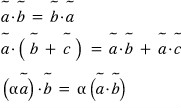
Because basic laws like these hold, if we take  and
and  and write out the dot product of these two vectors,

that’s how it can be written, and here,
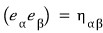
we write it like this and call it the metric tensor~ More precisely, ’the metric tensor of flat spacetime’ or ’the metric tensor of Minkowski spacetime.'
But actually, this is something we already know. Was it pretty much at the very beginning?? In classical mechanics, time is absolute, so we leave it out. And in real space, if there’s some vector, its length stays the same when you rotate the spatial coordinate axes. So this length that belongs to the vector itself was its ‘proper’ length, and we wrote it as

but here in special relativity, the quantity that stays the same even under a ‘Lorentz transformation (switching to a different inertial frame to look at things)’, our Lorentz invariance, turns out to be

and this is what we called the interval in spacetime!
But if there’s a single vector 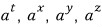 like this, its distance from the origin, that is, the length of the vector, should be that Lorentz invariance, the same in every inertial frame, right?
So  , the dot product of the vector with itself, has to be a Lorentz invariance!!!
For a displacement four-vector,  ; for other four-vectors it is their invariant quadratic norm, with their own physical units. So

Oh, then what about the dot product with some other vector?
Shall we try deriving it from the dot product of $\tilde{a} + \tilde{b}$ with itself?
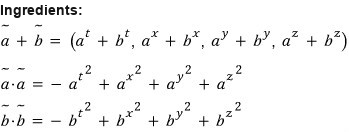
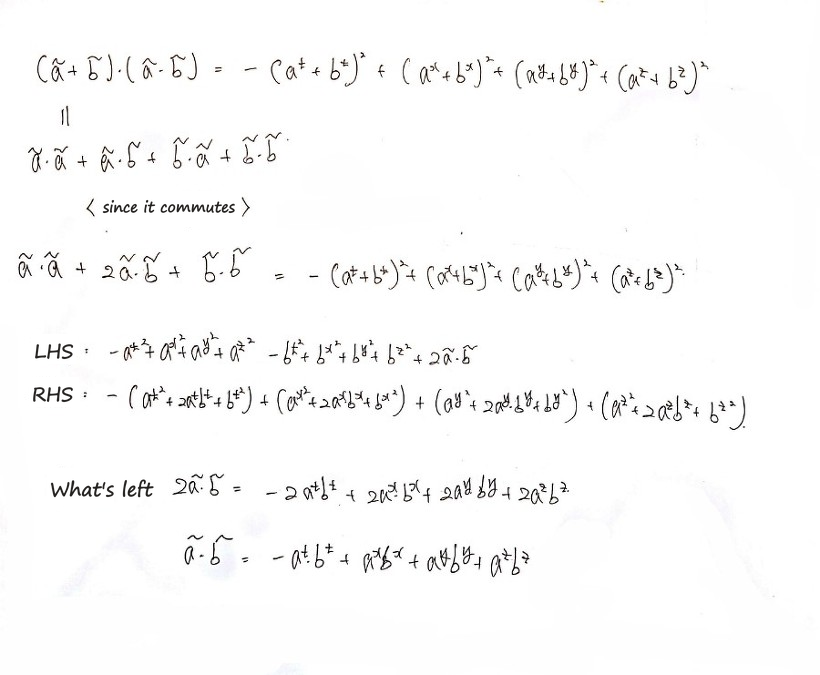
But just a moment ago, we said 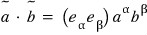 , right??? Ah, so then

It comes out like this because that eta guy, the one called the metric tensor, decides it for us; that’s what it was all about!!!
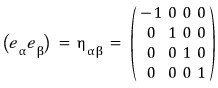
Write it like this and it’s all settled!!! hehe
Ex. 5.2
Now that we’ve learned the dot product, the thing that felt so vague and hand-wavy before,
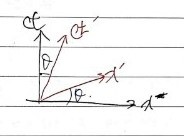
that the $t'$ axis and the $x'$ axis are perpendicular to each other: let’s check it once with the dot product.
As coordinate components in $(t', x', y', z')$, the $t'$ axis and the $x'$ axis can be written as $(1, 0, 0, 0)$ and $(0, 1, 0, 0)$, so taking the dot product of the two vectors from their own point of view gives
$= -(1\times 0) + (0\times 1) + (0\times 0) + (0\times 0) = 0$
Sure enough, the dot product is 0, but now, for the $t'$ axis and the $x'$ axis as seen from the $t$-$x$ coordinate system, we apply the Lorentz transformation. First, transforming $(1, 0, 0, 0)$ gives
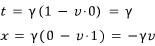
I left out $y$ and $z$.. T_T
And transforming $(0, 1, 0, 0)$ gives
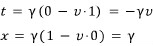
Taking the dot product of these two,
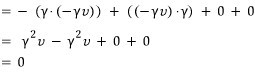
it really does come out zero…. amaaazing….
Describing a world line
If we think about the physics we learn in high-school physics class — I mean, when we describe the position of some object —
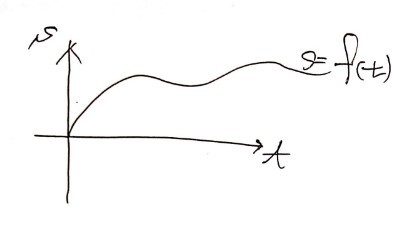
we described the position of an object in terms of (absolute) time, like this. But here there’s no absolute time anymore, so the question is how to describe a world line….
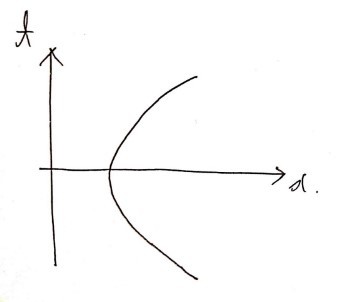
Let’s say there’s a world line like this.
How do we describe this world line….?
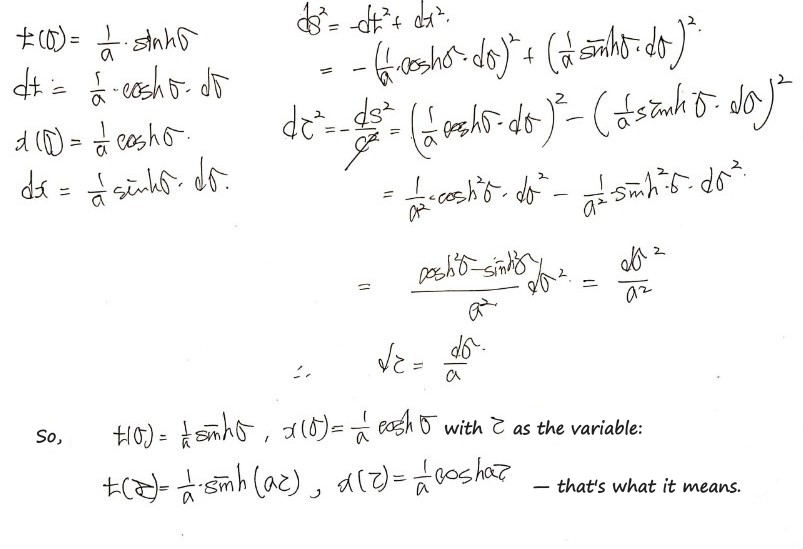
They say we describe it as  , in terms of yet another variable, and for a timelike world line of a massive particle, a convenient variable is the proper time ($\tau$)! A lightlike path has zero proper time, so it needs a different parameter. So the idea is to find the relation between $\sigma$ and $\tau$ and write everything again in terms of tau~ For example,

let’s say. Then if we tie $t$ and $x$ together through $\sigma$,

But what does it mean to write it again in terms of $\tau$?
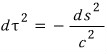
Think about this relation: since $c = 1$ here, it means we write it in terms of the proper time, that Lorentz invariance!!! That is, if we pull out the infinitesimal Lorentz invariance for the hyperbola above,
The reason I made this simple story so ridiculously complicated is that velocity as a four-vector… I mean, from four-velocity on, I’ll have to cut it off again T_T
This is suuuper long……… phew…….
Heads-up. The figures here are the original notes, slips and all. A few things to watch for:
- In the Lorentz transformation of a four-vector’s components, the brackets hold the components: $a^{t'} = \gamma(a^t - v\,a^x)$ and $a^{x'} = \gamma(a^x - v\,a^t)$ (the picture writes $t$ and $x$ for $a^t$ and $a^x$).
- In the derivation of the dot product, the first line is $(\tilde{a} + \tilde{b})\cdot(\tilde{a} + \tilde{b})$; the picture writes $(\tilde{a} - \tilde{b})$ as the second factor. The result $\tilde{a}\cdot\tilde{b} = -a^tb^t + a^xb^x + a^yb^y + a^zb^z$ is right.
- In Ex. 5.2, the $t'$ and $x'$ axes are found with the inverse transformation, $t = \gamma(t' + vx')$ and $x = \gamma(x' + vt')$: the $t'$ axis is $(\gamma, \gamma v)$ and the $x'$ axis $(\gamma v, \gamma)$, as the sketch shows (the pictures use the forward transformation, which flips the sign of $v$). Their dot product is still 0.
- In the handwritten proper-time calculation, $d\tau^2=-ds^2/c^2$ (a minus sign is missing). We take $a>0$ and increasing $\sigma$, so $d\tau=d\sigma/a$. For the world line, $t(\sigma)^2 - x(\sigma)^2 = \frac{\sinh^2\sigma - \cosh^2\sigma}{a^2} = -\frac{1}{a^2}$, with a minus sign, since $\cosh^2\sigma - \sinh^2\sigma = 1$.
Comments
Discussion happens via GitHub Discussions. You'll need a GitHub account to comment.