Microstates and Macrostates
Learning notes on thermal equilibrium, thermometry, and five-coin examples of microstates and macrostates, with separate editorial clarifications.
Translation of the complete original note. Source statements and errors are preserved; separate editorial clarifications follow.
From here on out, I’m not going to breeze through things!!!!!
I’ll try my best to give explanations that don’t leave you with questions.
If questions do come up, I really, really hope we can discuss them together!
Alright, let’s get started.
The Zeroth Law of Thermodynamics
Say there are two objects at different temperatures.
Now, if the two objects are in thermal contact such that they can exchange energy, our experience will give us the answer.
“(Unless some additional work is done on this system from the outside) ‘heat’ will flow from the hotter place to the colder place~” — is what it tells us.
We already know this, right?
cf.) In the middle of winter, when you leave the door open, the cold air comes into the room.
No — it’s the hot air in the room going out the window.
That’s the correct way to say it. Coldness is merely the ‘absence of heat’ — there’s no such thing as coldness existing on its own.
Alright~ and our experience gives us another answer too.
“The temperatures of the two will become equal~~~!” — is what it tells us.
After a bit of time has passed in this state of thermal contact,
the net heat flow between the two objects becomes zero,
and we say they are in thermal equilibrium.
(To describe it a leeetle more concretely, we can say that the macroscopic properties of two objects in thermal equilibrium no longer change with time.)
And this series of processes going from thermal contact to thermal equilibrium is called thermalization.
To our eyes the thermalization process seems ‘irreversible’ as a matter of common sense,
because we’ve never seen the reverse process, and we can’t even imagine it…
In the end, in chapter 34, this kind of thermal process is apparently used to define the ‘arrow of time’.
Anyway, what we need to squeeze out of this here is: “things in thermal equilibrium → have the same temperature”
This is now summarized as the ‘Zeroth Law of Thermodynamics’.
Zeroth Law of Thermodynamics:
Two systems that are each separately in thermal equilibrium with a third system are in thermal equilibrium with each other.
In the early days of thermodynamics, the content of the 0th law was so obvious that it wasn’t mentioned separately,
but after all the fuss had played out, and since they wanted to mention this to give legitimacy to everything,
they apparently named this — the most fundamental one — the 0th law, giving it a number at the very end.
Thermometer
Temperature, heat — it’s true that these can’t be measured directly,
but having been granted legitimacy by the Zeroth Law of Thermodynamics, we can devise a device to measure them indirectly.
When we want to measure the temperature of something, we bring some ‘somethin’’ that can measure temperature up against it (thermal contact),
wait for thermal equilibrium, and then we can measure the temperature!!!
That somethin’ that lets us measure temperature is called a thermometer.
(Of the many, many thermometers out there, one is the mercury thermometer!!)
When measuring the temperature of an object, for the act of measuring not to change the object’s temperature???
The heat capacity of the thermometer has to be
waaa~!~!!~!!!y smaller than the heat capacity of the object~~~??? haha
Galileo apparently made a water thermometer in 1593 based on this principle of the Zeroth Law of Thermodynamics.
And the scale we use today was made by Fahrenheit,
and then more refined, upgraded by Celsius.
Ah but, even here we still don’t have an answer to ‘what the heck IS temperature!!!!’…. hahaha ;_;
We need an absolute definition of temperature grounded in physics,
and that definition of temperature will come a bit later. Let’s wait just a little!
Microstate vs Macrostate
To distinguish between the microstate and the macrostate, let’s use an example with five coins to understand.
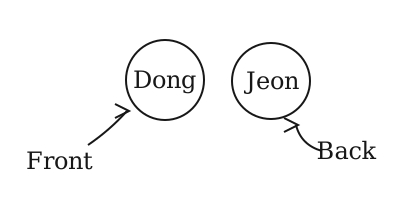
Dong and Jeon are the two syllables of the Korean word for coin, used as labels on the source faces.
Let’s say we put these 5 coins into some container.
And we shake the crap out of it.
After we’ve shaken the crap out of it, when we pop! open the lid, what states can exist?
| Coin faces: front | Coin faces: back | Direction | Multiplicity |
|---|---|---|---|
| Dong (front) × 5 | Jeon (back) × 0 | → | ${}_5C_5=1$ |
| Dong (front) × 4 | Jeon (back) × 1 | → | ${}_5C_4=5$ |
| Dong (front) × 3 | Jeon (back) × 2 | → | ${}_5C_3=10$ |
| Dong (front) × 2 | Jeon (back) × 3 | → | ${}_5C_2=10$ |
| Dong (front) × 1 | Jeon (back) × 4 | → | ${}_5C_1=15$ |
| Dong (front) × 0 | Jeon (back) × 5 | → | ${}_5C_0=1$ |
↳ State-count rows: There are a total of five possible states like this.
↳ Multiplicities: There are 32 microstates.
There will be a total of 6 possible states like this. (This is the macrostate)
There are a total of 32 states. (This is the microstate)
What I’m trying to say right now is,
when we pop! open the box with five coins in it, and exactly one is tails,
the probability of that one exact case coming up is 1/32.
But, the cases where exactly one is tails,
| ① | ② | ③ | ④ | ⑤ |
|---|---|---|---|---|
| Front | Front | Front | Front | Back |
| Front | Front | Front | Back | Front |
| Front | Front | Back | Front | Front |
| Front | Back | |||
| Back |
would be one of these 5.
Now,, instead of thinking of them as coins, let’s think of it as a system containing gas molecules.
After shaking the system, the (different) states where only one of the 5 gas molecules is ’tails’ — would their properties or characteristics be different????
Nope, nope, they would be the same.
That is, the probability of this kind of state coming up was 5/32.
In other words, a microstate means assigning numbers to molecules,
and distinguishing them down to the level of molecule #1, molecule #2~~ — that’s the microstate,
while the macrostate is looking at the ‘state’ that appears. (The wording is tough.)
Assigning numbers to each individual molecule is just utterly impossible, and also meaningless…
Microstate: a particular possible “arrangement”
Macrostate: a classification of arrangements
To add more — macrostates are ’not equally likely.’
Let me toss out a definition of temperature.
Temperature is ‘one of many macrostates’.
The content after this I think is even more important than this, so I’ll push it to the next post.
Editorial clarifications separate from the original note
-
The zeroth law expresses the transitivity of thermal equilibrium, as the source statement above states. Spontaneous heat transfer from higher to lower temperature and thermodynamic irreversibility concern the second law. Net zero heat transfer does not exclude microscopic energy exchange, and stationary macroscopic properties alone do not establish full thermal equilibrium. The statistical explanation of the arrow of time requires physical assumptions; not having observed a reverse process is not a proof that every microscopic reversal is impossible.
-
Opening a door or window can let cold air enter while warm air leaves. This transports matter and energy through air movement; denying cold-air inflow is incorrect. Heat is energy transferred because of a temperature difference, rather than stored body content or a substance whose absence defines coldness. A body has internal energy.
-
Temperature is measured operationally through calibrated thermometric properties. A contact thermometer exchanges energy while reaching equilibrium with the object. A small thermometer heat capacity reduces the temperature disturbance under the assumed contact and isolation conditions, but does not make it exactly zero.
-
The Galileo attribution, 1593 date, and “water thermometer” are retained as historical source claims, rather than established facts. Historical sources disagree on the exact dating and attribution; an early thermoscope should be distinguished from a calibrated thermometer, and the account does not establish that Galileo applied a later formal statement of the zeroth law. Fahrenheit and Celsius are different temperature scales, rather than one simply being an accuracy upgrade of the other.
-
In the coin multiplicity table, the source literally writes ${}_5C_1=15$; the correct count is ${}_5C_1=5$. The six head-count categories have multiplicities $1,5,10,10,5,1$, totaling $32=2^5$. The red source caption says five possible states, while the adjacent prose says six. Six is the correct number of head-count macrostates. The historical 15 and red-caption five remain in the reconstructed source content.
-
The probability $1/32$ applies to one specified labelled arrangement, rather than the entire category “exactly one tail.” The probability of that category is $5/32$. These values require five distinguishable positions, independent fair coins, and equiprobable configurations. The five complete one-back arrangements are FFFFB, FFFBF, FFBFF, FBFFF, and BFFFF, with F meaning front and B meaning back. The source arrangement table leaves the last three cells of its fourth row and the last four cells of its fifth row blank. Those source blanks are preserved, rather than silently completed.
-
A microstate specifies the complete microscopic configuration; a macrostate is defined by specified macroscopic variables and can correspond to many microstates. The numbered-coin example illustrates this grouping. Gas particles do not literally have coin fronts or backs; a classical description of positions and momenta must also be distinguished from the state counting of indistinguishable quantum particles. The example does not establish that every configuration involving one different labelled molecule has identical properties under every macrostate definition. Macrostates need not be equally probable even if accessible microstates are equiprobable. Temperature is a macroscopic state variable, rather than an entire macrostate by itself.
These bounded clarifications are new editorial material, not translated source prose.
Comments
Discussion happens via GitHub Discussions. You'll need a GitHub account to comment.