Velocity Distribution Function of Gas Molecules
We finally get to handle something real — gases! Starting from a simple ideal gas model, we derive the velocity distribution using the Boltzmann distribution.
Up until now, we haven’t dealt with anything concrete. We’ve mostly been playing with numbers. What did they mean? Probabilities, more or less… haha.
But now we’re going to get our hands on something: gases!
Alright, to talk about gases, we need a model. Let’s make it a simple one. I’ll just list the assumptions.
- All the gas molecules are monatomic.
- We ignore rotational and vibrational energy for now.
- The molecules are ridiculously tiny. Basically points.
- Collisions between molecules are rare in this dilute model.
- There are no interactions such as gravity or electrical forces.
- The system is closed and kept at temperature $T$. Remember the canonical ensemble?
Oh my. All that just to say we’re only keeping translational kinetic energy?
We’ll apply the Boltzmann distribution to the gas in this model. That distribution was about energy, right? Since we’re only keeping kinetic energy, it is

Let’s look at one component at a time, then put them all together. Here we go!
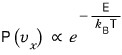
For a molecule in this system at temperature $T$, write the probability density of its x-component of velocity,  , as
, as  . The Boltzmann factor supplies the energy dependence:
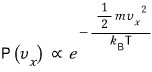
Put the x-component’s kinetic energy in the exponent, and we get
Now what if we put $N$ gas molecules into that system?
The fraction per unit x-velocity at is proportional to

Multiply by $N$ to get the number of molecules per unit x-velocity near :
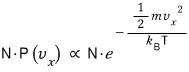
So that number-density expression is
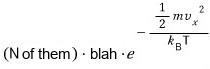
I don’t know what to call the proportionality constant, so as usual, let’s call it blah.
That leaves this density factor:
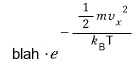
Across all possible velocities, the total probability must be 1. We could list values such as

and try adding the expressions:

Ugh, let’s not do it that way. These are density values, and velocity is continuous, so we need an integral:
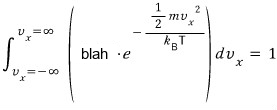
How do we do this integral?
This is where the Gaussian integral comes in:
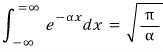
Using it, with $\alpha=m/(2k_B T)$, gives
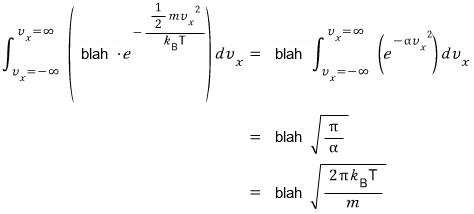
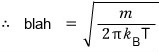
Yay! Now we’ve pinned down blah in the velocity distribution:
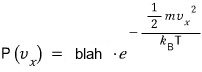
We can give this whole expression a shorter name,  .
.
In other words, is our normalized velocity probability density.
For $N$ molecules, the expected number with x-velocities between and $v_x+dv_x$ is $N g(v_x)\,dv_x$. The picture writes the number-density factor as 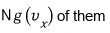 ; multiply it by the little interval width $dv_x$ to get an expected count.
Alright, we’re done exploring the x-component. What about y and z?
Ugh, apart from replacing with  or
or  , everything is the same, so the conclusions will be the same too.
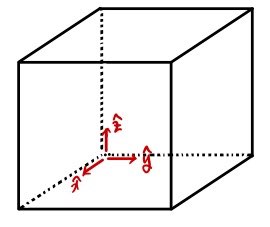
So here’s what we want to know next.
Of the $N$ molecules at temperature $T$, how many fall into small ranges around all three components of this velocity, 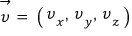 ?
?
Here’s how we’ll sift them out:
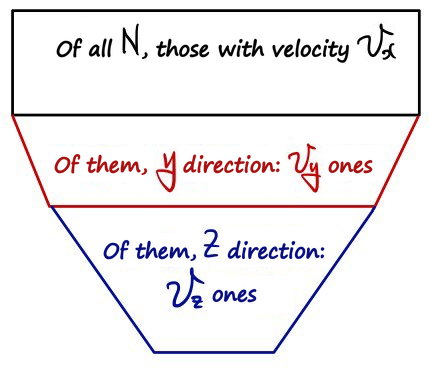
First select the x-range, then the y-range within that group, then the z-range. That way, we account for every molecule in the little velocity box around .
The component distributions are independent in this model, so following the picture’s order gives this product:
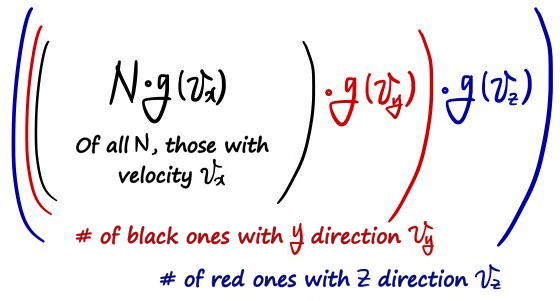
To turn the pictured density into an expected count, include all three interval widths, $dv_x\,dv_y\,dv_z$. Does that make sense? I hope so… heh.
By exactly the same logic as in the one-dimensional case, 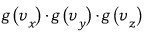 is the joint probability density that divides up our whole collection of $N$ molecules. Across all possible combinations, like these,
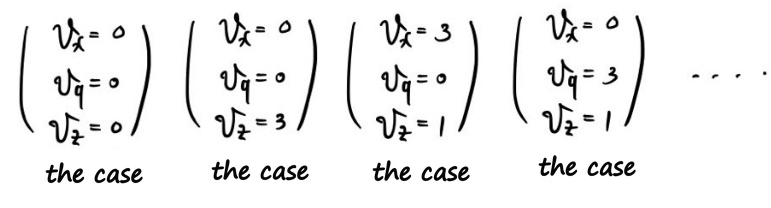
The total probability must be 1. Velocity is continuous, so we integrate the density over all three components instead of adding isolated values:

There we go. That does it!
Heads-up. The figures here are the original notes, slips and all. A few things to watch for:
- In the Gaussian-integral picture, the exponent should be $-\alpha x^2$ and the upper limit $\infty$: $\int_{-\infty}^{\infty} e^{-\alpha x^2}\,dx = \sqrt{\pi/\alpha}$ (the picture writes $e^{-\alpha x}$ and “$=\infty$”). The next picture uses $e^{-\alpha v_x^2}$ correctly.
- The pictures count “the molecules with velocity $v_x$” ($Ng(v_x)$ of them). Velocity is continuous, so strictly $g$ is a density: the expected number with an $x$-velocity between $v_x$ and $v_x + dv_x$ is $Ng(v_x)\,dv_x$.
Comments
Discussion happens via GitHub Discussions. You'll need a GitHub account to comment.