Maxwell-Boltzmann Speed Distribution
We ditch direction entirely and dive into velocity space to figure out the Maxwell-Boltzmann speed distribution — because who cares which way the gas is flying lol.
Originally, I was going to put all of this in the previous post as one article. But the scroll would have been absurdly long, so reluctantly, the speed distribution gets its own post.
This continues from the previous post. Let us go!
Alright, this time it’s speed. Direction isn’t what we’re trying to keep track of here.
I mean, which way is the gas flying? We can’t even see it, lol.
We learned about velocity first because it was easier to start there. Now we’ll use it to get the speed distribution: what fraction of the molecules falls in a given speed range, regardless of direction? To answer that, it’s more convenient to look in velocity space than in real space.
Suppose we’re after molecules moving at speed $v=2$. The sketch lists some possible velocity vectors:
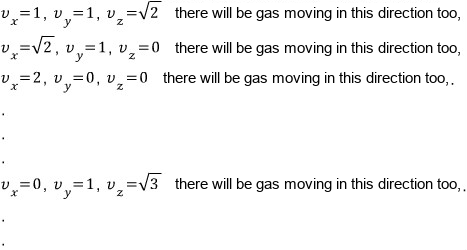
For speed 2, the squared components must add up to 4. In general, the sum on the left below is the squared speed, $v^2$:
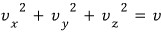
So we need all the velocity vectors that share the same squared magnitude:
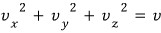
That’s why velocity space makes this easier to see. Listen carefully to this bit!
Take a system at temperature $T$ containing $N$ gas molecules. Among the velocities with speed  , one possible direction is
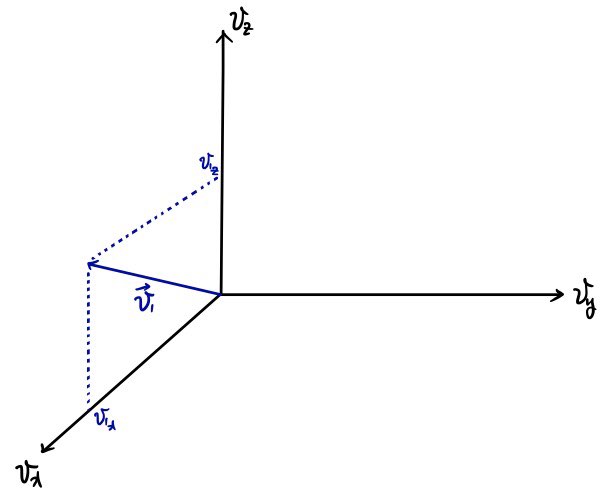
with components 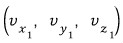 .
.
How many molecules do we expect near that velocity?
Using the normalized component density from the previous post, the number per unit velocity-space volume is $N g(v_{x_1})g(v_{y_1})g(v_{z_1})$. The final exponential line here gives that density:
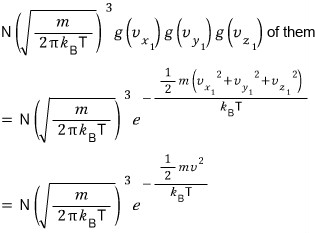
Multiply by a little velocity-space volume $dv_x\,dv_y\,dv_z$ to get the expected count. The normalization constant came from the previous post.
In the same system, another direction with speed  looks like this:
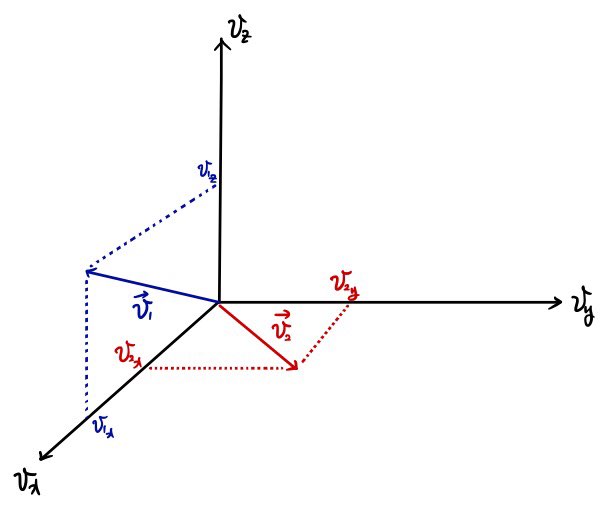
Its components are 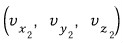 . The same calculation gives the number density in the final line:
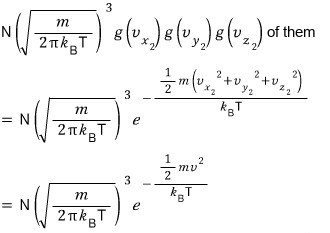
Again, an expected count needs the little interval widths. And here’s a third direction with that same speed,  :
:
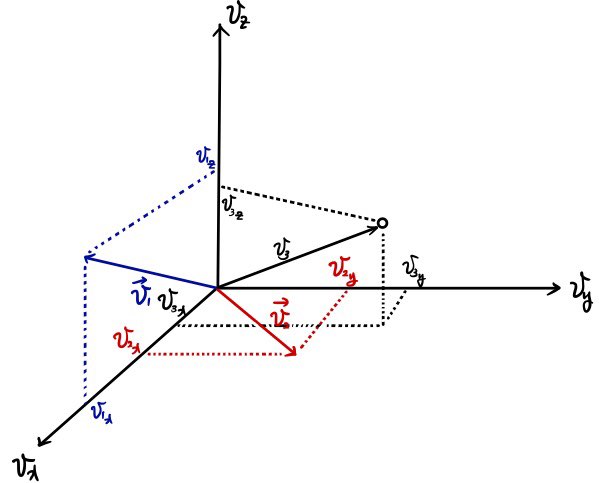
The components are 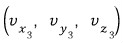 , and its number density is the final line here:
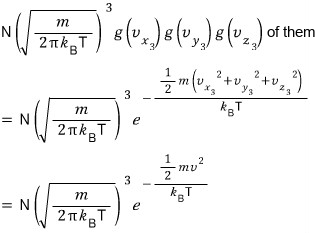
Notice that all three final expressions are the same. Only the speed matters there, not the direction.
What happens if we plot every velocity vector with speed as a point in velocity space?
They form a sphere! To count molecules in a tiny speed interval around , we have to collect directions all around that sphere. This is the number density at each point on it:
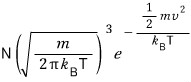
So “add them up around the sphere” means account for the sphere’s surface area. Its radius is

and its surface area is  . Multiply the number density by that area, and we get the number per unit speed:
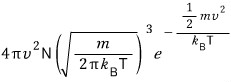
For the expected number with speed between and $v+dv$, multiply this by $dv$. Geometrically, that tiny speed range is a thin spherical shell.
Okay, refresh! Let’s wrap things up.
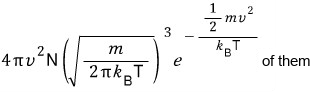
In our system at temperature $T$, this expression is the number per unit speed:
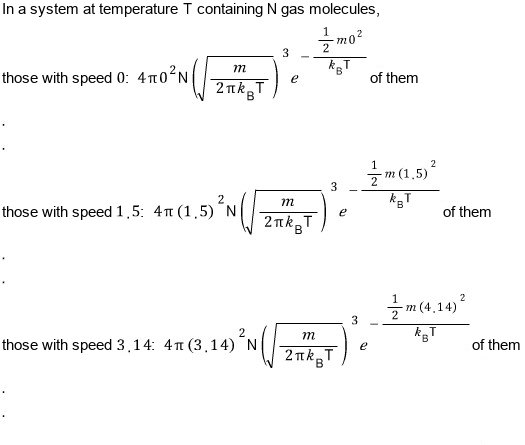
The next picture plugs some speed values into that expression:
Do these expected counts add back up to all $N$ molecules?
We need to check! The pictured integral contains $N$, so it should give $N$:
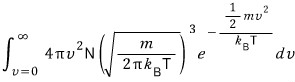
Equivalently, divide out $N$ and check that the probability density integrates to 1. Using the Gaussian integral, the normalized part gives 1:
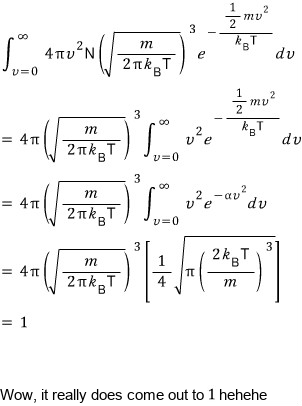
I’ll put the integral derivation in the next post. Writing it all here would eat up the page, lol.
So what is the physical meaning of this expression?
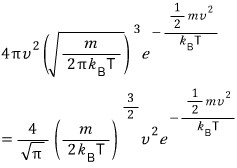
It’s a speed probability density. Multiply it by a tiny speed interval to get a fraction of the molecules, or express that fraction as a percentage. This is the Maxwell-Boltzmann speed distribution.
We used  for one component of velocity. For the speed density, we’ll use
  .
.
So $f(v)\,dv$ is the fraction with speeds between $v$ and $v+dv$, and $N f(v)\,dv$ is the expected number in that little range!
Heads-up. The figures here are the original notes, slips and all. A few things to watch for:
- In the list of velocity vectors for speed 2, the second one, $(\sqrt{2}, 1, 0)$, has speed $\sqrt{3}$; a speed-2 vector with $v_y = 1$ and $v_z = 0$ has $v_x = \sqrt{3}$. The other examples have speed 2.
- The pictures of the component sum write $v_x^2 + v_y^2 + v_z^2 = v$; the right side should be $v^2$.
- In the three direction pictures, the first line multiplies $g(v_x)g(v_y)g(v_z)$ by $\left(\sqrt{m/(2\pi k_B T)}\right)^3$ again, although $g$ from the previous post already contains that factor; the exponential lines below it are right.
- In the picture with sample speeds, the speed-3.14 line should have $(3.14)^2$ in the exponent, not $(4.14)^2$.
- The normalization pictures start from an integral that contains $N$, so it equals $N$; the lines after it drop $N$ and show that the probability density integrates to 1.
- The pictures count molecules “of them” at a velocity or a speed. These are densities: $Nf(v)\,dv$ is the expected number with a speed between $v$ and $v + dv$.
Comments
Discussion happens via GitHub Discussions. You'll need a GitHub account to comment.