Ideal Gas Equation of State and Pressure
Diving into Chapter 6 to microscopically derive PV=nRT, kicking things off with the definition of pressure and then wrestling with the surprisingly weird world of solid angles.
We’re about to dive into ‘Chapter 6. Pressure’ now. Rather than learning about pressure, it’s more like just $pV = nRT$. I think I can say that the goal of this chapter is to derive the ideal gas equation of state by treating it microscopically!
Before diving in, let me transcribe the ‘definition of pressure’ as introduced in the book, and then dive in. Pressure $p$ is defined as ’the ratio of the perpendicular contact force to the contact area.’ Therefore, the unit is force ($\mathrm{N}$) divided by area ($\mathrm{m}^2$), and that unit is called Pa (pascal). [$\mathrm{Pa} = \mathrm{N/m}^2$]
The direction in which pressure acts is perpendicular to the surface (on which it is always acting). Right, the word ‘perpendicular’ seems to be somewhat important. So now let’s get into it.
Solid angle
The concept we need to equip ourselves with first here is the solid angle.
The Korean word for it feels kind of clunky….
Anyway, I did equip myself with it a little bit in mathematical physics class, but I’ll just handle it briefly and move on. First, a solid angle is
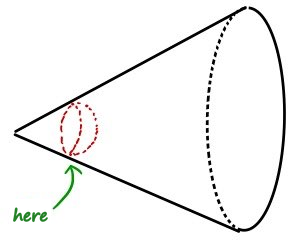
this kind of angle…. some kind of strange…. angle…. kinda a hopeless-looking angle? lol
Anyway, how do we define this solid angle?
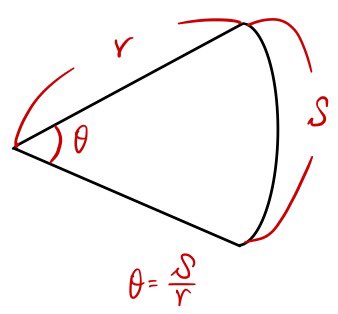
Since  , we can say
  .
.
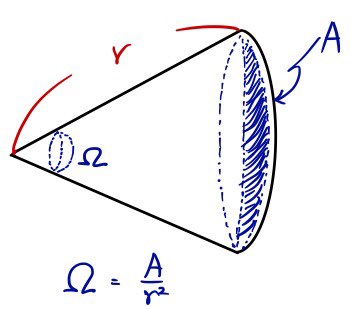
Just as we divided what $\theta$ is looking at by the radius, we divide the curved circular surface(?) that $\Omega$ is looking at by the square of the radius!
Okay, now we need to think about this.
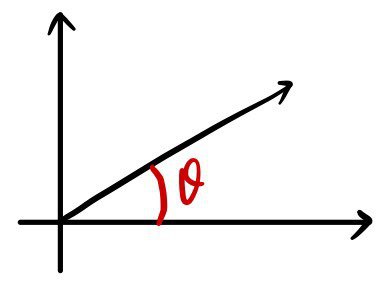
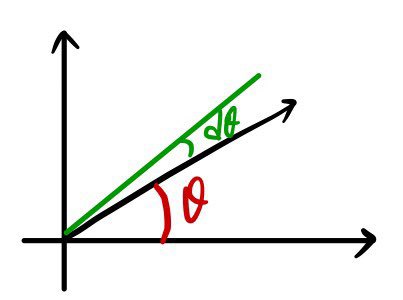
For $\theta$, we expressed $d\theta$ like this, and we thought about it without much difficulty,
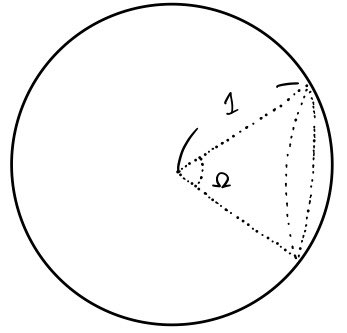
but then, for the solid angle $\Omega$, $d\Omega$ is!!! At first I couldn’t quite get a feel for it, but let me try thinking about it carefully
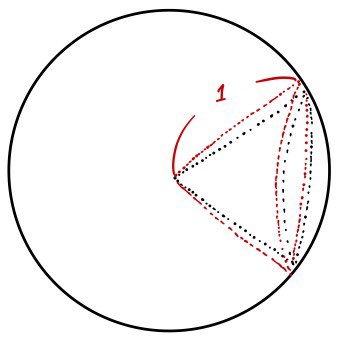
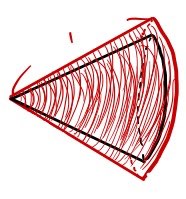
this red part would be $d\Omega$, right???
Drawing pictures is really…. hard…
Anyway, in that picture, the solid angle of the space between the outer cone and the inner cone is $d\Omega$, right???!
Saying “cone” is wrong, since the base isn’t a circle, but there’s no proper way to express it…. yikes
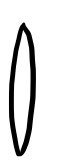
Ah, then the area that the angle $d\Omega$ is looking at needs to be divided by the square of the radius, so that we can express $d\Omega$ in terms of radius and area. Let me examine the area!!! that the solid angle $d\Omega$ is looking at.
&&&

First picture — circumference of the circle:  . Second picture — multiplied by its thickness too:
 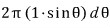 .
.
Then the ‘area’ that the solid angle is looking at is  , and since the solid angle is that area divided again by the square of the radius,

Holy crap. “Why are we learning this?”
Let me explain why we use this solid angle, and with the power of that concept, I’ll derive pressure.
A gas in a sphere
Let’s think like this.
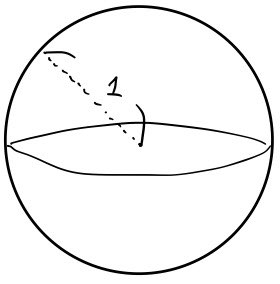
A ‘sphere’ of radius 1 shaped like this is the system, and the system’s temperature is $T$. There will definitely be an enormous number of gas molecules here with tens of thousands of directions and tens of thousands of speeds. Let’s say there are a total of $N$ of them.
Out of these total $N$, let’s pick out only the particles whose ‘speed’ is  .
.
How many get picked out?!
Yes, that’s right.
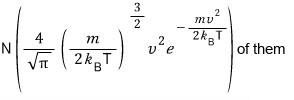
This many got picked out. (Strictly speaking that’s per unit of speed: the thin slice of speeds between $v$ and $v+dv$ gets its $dv$ in the integral at the end.)
These ones, as many as this number, have the same speed, but each of their directions was different. So what I’m going to do is take just these picked-out ones and put them into an EXACT!~ly identical sphere of radius 1. BUT!!! We rearrange them so that their direction of motion is the same as the sphere’s radial direction.
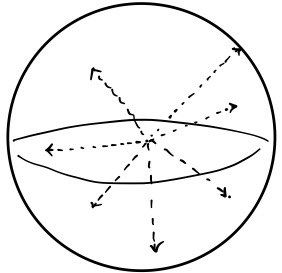
Well… what’s the wisest way to draw this… T_T
Please think of it as: here, the molecules have been rearranged so that their direction of motion is the same as the sphere’s radius vector.
The reason we learned the solid angle is to use $d\Omega$. Why do we use it? Because the molecules inside $d\Omega$ after rearrangement have something in common!!!
Along the → direction, the molecules inside that $d\Omega$ all have the same value of $\cos\theta$!!!
(Let’s say it’s to the right.) The rightward-advancing component is the same. That’s what I mean!!!
Then of the
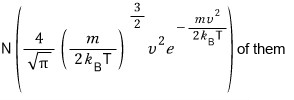
that we picked out, for a specific direction (→), how many are there whose speed in that component (value obtained by taking $\cos\theta$) is the same? Let me check!
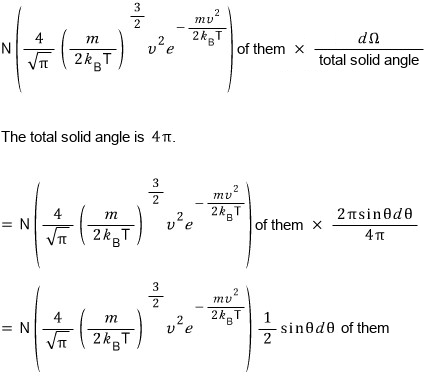
Okay now let’s go back to before we picked them out.
Gas molecules with jumbled, various speeds and directions are tangled together, and we go back to a completely lawless, sphere-shaped system. If the gas inside that sphere doesn’t prefer any particular direction (whatever the speed), then within the unit volume of that sphere, the number of those whose speed is $v$ and whose speed value in that (→: rightward direction) component is the same, is

I just said $n = N/V$~
Counting the hits on a slab
Then let’s install a slab with area $A$ (unit area) at an appropriate position inside that sphere.
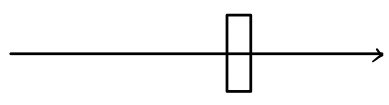
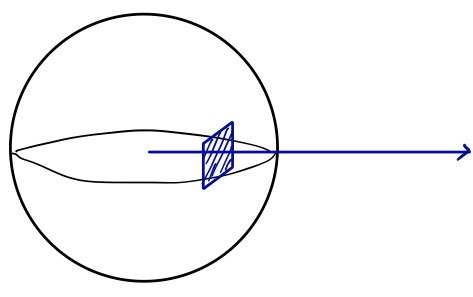
And let me count the number of molecules hitting that slab.
To do that, I counted the number of guys whose speed is $v$ and whose → component velocity is the same, within the unit volume above.
That slab must be getting hit by molecules at tens of thousands of speeds, from tens of thousands of directions. Here’s the question coming in.
“During unit time $dt$, how many gas molecules hit the plate of unit area $A$?”
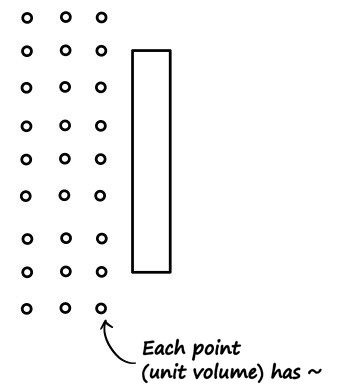
At each point (unit volume), the speed is  and the (→) component with respect to the plate is
  , and the number of such molecules is
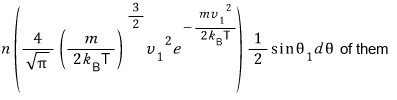
this many per point, and the molecules hitting during time $dt$ can be counted by bundling up those points.
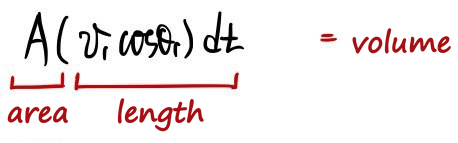
That is,

This is how we count the number. So, “the number of gas molecules hitting a plate of unit area $A$ during unit time $dt$ with speed $v_1$” is

But what hits the slab isn’t only $v_1$: there are tens of thousands of various velocities, and besides $\theta_1$, they’ll fly in at tens of various angles and hit it. Summing up those numbers across alllll the $v_1$, $v_2$, $v_3$ casesss and across alllll angles, totalllled up — that would really be the number of gas molecules hitting the slab during $dt$????
Time for the integral
Now we can find the pressure during unit time on unit area. By counting the number with an integral over all angles $\theta$ and all speeds $v$, multiplying by the change in momentum that each impact causes, and then summing, we can calculate “something related to force.”
By the ideal gas assumption, we assume they undergo perfectly elastic collisions, so each individual momentum change is $2mv\cos\theta$. We multiply by that value and sum over alllll cases! The change in momentum is the impulse, and that means $F\cdot dt$.
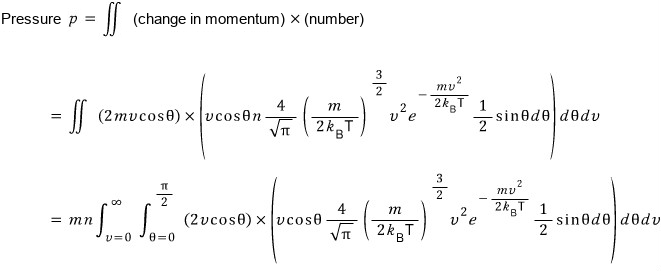
Since $dt$ and $A$ are 1, we can just add up all of this. The reason the range of $\theta$ is from $0$ to $\pi/2$ is that considering angles beyond this would mean considering even the molecules that don’t hit! Considering up to $\pi/2$ is correct!! Luckily, the above integral has no mutually dependent terms, so it can be split into separate integrals.
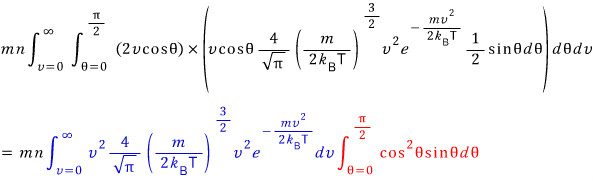
Wait!! Before hitting the integral, in the above expression the blue part means $\langle v^2 \rangle$ and the red part’s integral result is $1/3$, so
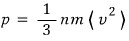
let me organize this and move on~~~ haha. And the specific integral calculation is as follows.
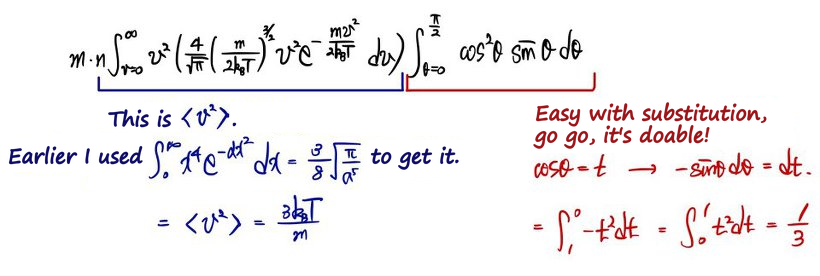
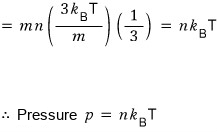

So pressure only depends on the variables $n$, the number of gas particles per volume, and the temperature $T$!!!
If we rewrite the equation with $n=N/V$,

What about the pV = nRT from chemistry class?
Huh?!?! We learned $pV = nRT$ in chemistry class?!?!
The $n$ in the ideal gas equation we did in chemistry class is different from the $n$ we’ve been using here. We wrote ’number per unit volume’ as $n$. The $n$ in the ideal gas equation from chemistry class should properly be written as  .
.
Why?! In chemistry class, we counted not the number, but the number of moles. Well, it’s the same “number” I guess, but the units are different!!
In the subscript $m$ is not mass but mol! That is,
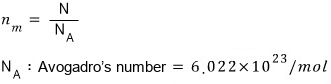
It’s roughly that the unit of number has changed to the unit of mol. Based on this, if we refine the above expression further,

Damn…. $pV = nRT$ still doesn’t come out -_-
The gas constant $R$ we used in chemistry class was a meeting of two constants, Avogadro’s number and the Boltzmann constant!!!
That is, the gas constant was defined as the product of Avogadro’s number and the Boltzmann constant.

I’m switching majors. I give uuup.
Heads-up. The figures here are the original notes, slips and all. A few things to watch for:
- In the pressure integral, $d\theta$ is written twice: once inside the brackets, in $\frac{1}{2}\sin\theta\,d\theta$, and again in $d\theta\,dv$ after them. There is only one: the integrand ends in $\frac{1}{2}\sin\theta\,d\theta\,dv$. The result $p = nk_BT$ is right.
Comments
Discussion happens via GitHub Discussions. You'll need a GitHub account to comment.