Chapter 7 Practice Problems
Working through Chapter 7 problems on particle flux for nitrogen at STP and the average kinetic energy of molecules escaping through a tiny hole.
Ex 7.3
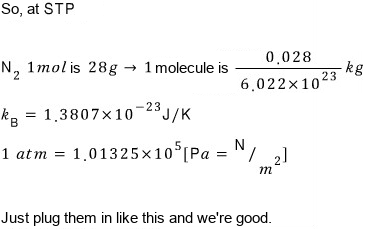
Find the particle flux of nitrogen gas in the STP (standard Temperature & Pressure) state.

The way we computed the flux was: we wrote the number of gas molecules hitting a unit area per unit time as
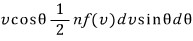
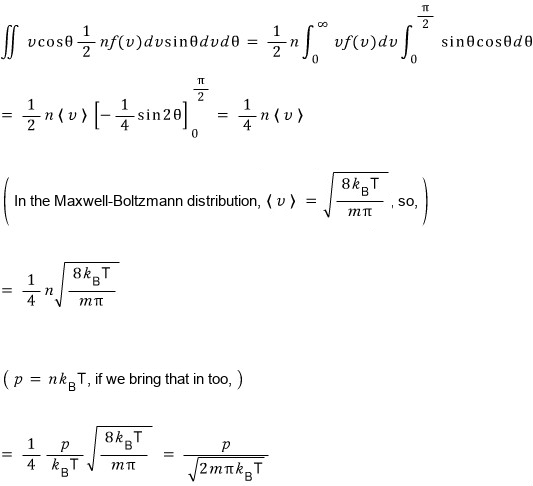
and then, thinking of that number as being equal to the number passing through a unit area per unit time, if we add up~~ all of them for all $v$ and all $\theta$,
Ex 7.5
What is the average kinetic energy of the gas molecules effusing through a small hole?
We have to solve the problem with the same idea as in Chapter 6. Multiply the gas molecules at each $v$ and $\theta$ by a weight KE, and add them all up, then just divide it all by the total count, and we can call that the average energy.
The number of molecules hitting the wall per unit area, per unit time = the number of molecules going out per unit area, per unit time, since they’re the same, so the number of molecules going out per unit area, per unit time =
That is,
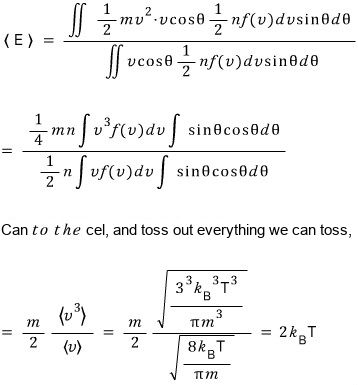
Because effusion preferentially selects molecules with higher energy, it ends up a bit bigger than the overall average kinetic energy  , they say.
Prob 7.1
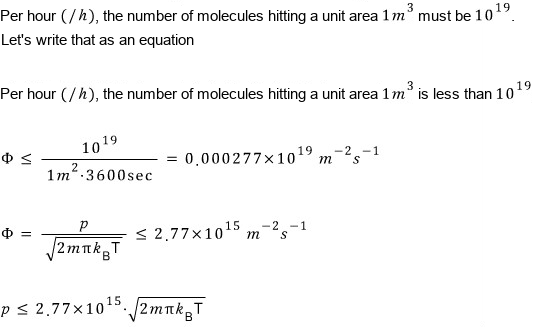
Inside a vacuum chamber designed for surface science experiments, in order to keep the surface clean, the pressure of the remaining gas is made as low as possible. Covering the surface with just a single layer requires $10^{19}$ atoms per square meter.
What pressure is needed so that, from the remaining gas, less than one layer is covered per hour (/h)?
You may assume that once a molecule strikes the surface, it sticks to it.
Prob 7.3
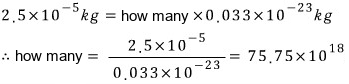
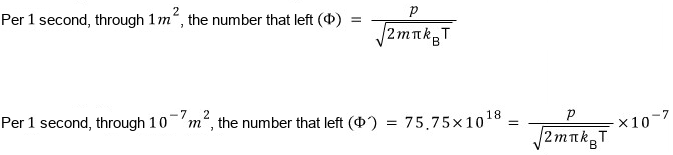
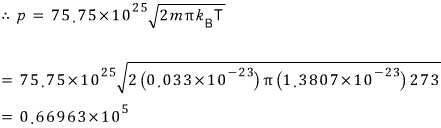
A closed vessel is partially filled with liquid mercury, and above the liquid surface there is a hole of area $10^{-7}$ square meters. This vessel is placed in a high-vacuum region at a temperature of 273 K, and after 30 days have passed it was found to have lost $2.5\times10^{-5}$ kg in weight.
Estimate roughly the vapor pressure of mercury at 273 K (the relative molecular mass of mercury is 200.59).

Prob 7.5
Gas is effusing into a vacuum through a small hole of area $A$. These particles are adjusted nicely so that they pass through a very small circular hole of radius $a$ on a screen located a distance $d$ away from the first hole.
Show that the rate at which particles come out from the second hole is 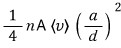 .
.
(Assume that after the gas has passed through the second hole no collisions occur, and that the relation $d \gg a$ holds.)
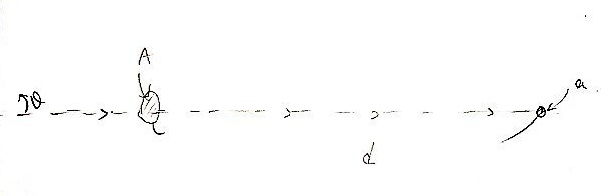
So we have to work out the number of gas molecules that go through $A$ and then through $a$ like this, meaning we need to count the gas molecules passing through $A$ at al~most  , but we don’t know that $\theta$ value…..
Let’s set it as an unknown and go go go
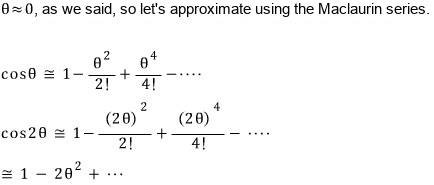
(It’ll soon turn out $\theta = a/d$, no worries no worries)

Let’s count this number for all~~~ the kinds.
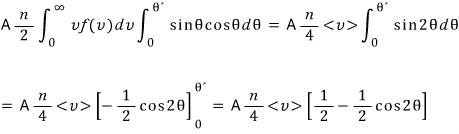
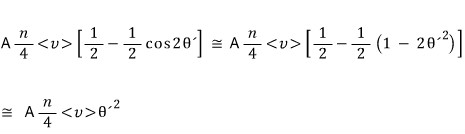
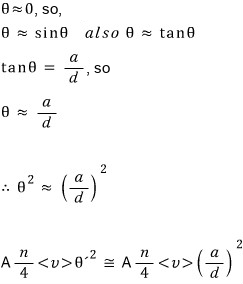
Heads-up. The figures here are the original notes, slips and all. A few things to watch for:
- In the effusion-rate integral, $dv$ appears twice in the first line (there is only one), and the antiderivative should be $\left[-\frac{1}{4}\cos 2\theta\right]$, not $\sin 2\theta$; from $0$ to $\pi/2$ it gives $\frac{1}{2}$, as used.
- Under the square root of $\langle v^3\rangle$ the numerator should be $2^7 k_B^3T^3$ ($=128\,k_B^3T^3$), not $3^3 k_B^3T^3$, since $\langle v^3\rangle = \frac{4}{\sqrt\pi}\left(\frac{2k_BT}{m}\right)^{3/2}$. With it, $\frac{m}{2}\frac{\langle v^3\rangle}{\langle v\rangle} = 2k_BT$, as shown.
- In the vacuum problem, the unit area is $1\ \mathrm{m^2}$, not $1\ \mathrm{m^3}$; the formula below it uses $\mathrm{m^2}$.
- In the mercury problem, $75.75\times10^{18}$ is the number of atoms lost in the whole 30 days, not per second. Per second it is $75.75\times10^{18}/(30\times24\times3600\ \mathrm{s}) \approx 2.92\times10^{13}$, so the vapor pressure comes out at about $0.026\ \mathrm{Pa}$, not $0.66963\times10^{5}\ \mathrm{Pa}$.
Comments
Discussion happens via GitHub Discussions. You'll need a GitHub account to comment.