Mean Free Path Between Molecules
A casual, self-reconstructed walkthrough of mean free path derivation — expect some controversy, but the author breaks down molecular collisions and relative velocity in their own way.
This posting is probably going to stir up a lot of controversy. I just couldn’t accept the book’s explanation, so I reconstructed it in my own way using ideas from the internet and the book. It might not even make sense, so please do point things out.
The content of Chapter 8 is — collisions between gases! But rather than acknowledging the effect of those collisions and then gent~ly~ gent~ly~ lifting the ideal gas assumption, the goal is to find “the time between collisions” along with “the free distance between collisions.”
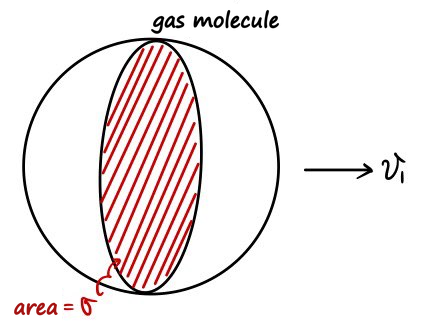
One spherical gas molecule with cross section $\sigma$ is flying along at speed $v_1$.
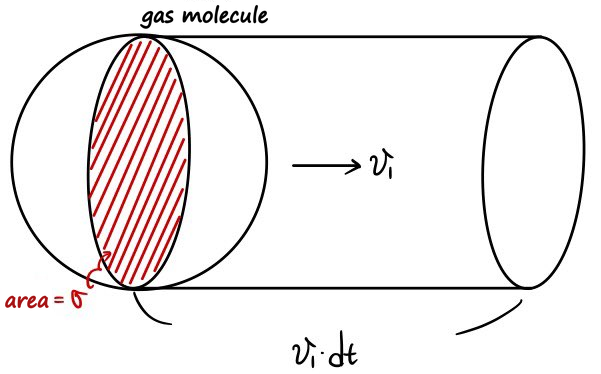
During time $dt$ this guy.. will sweep through a volume of $\sigma v_1 dt$.
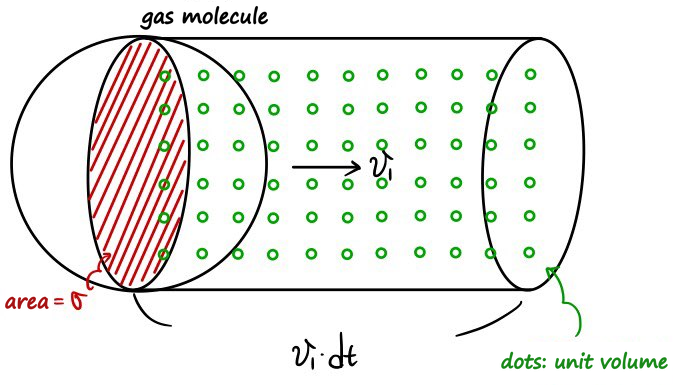
Let’s say the number of molecules in unit volume (the dots) inside that cylinder is $n$. That’s the basic setting done.
The length of the cylinder that the gas sweeps through during those $dt$ seconds is $v_1 dt$. Let me reinterpret that length $v_1 dt$ in a different way.

I think we could write it like this.
Now now now now, but the other molecules are also moving around as they please, so this is a bit confusing.
So we introduce the concept of relative velocity: calling those other ones  , we think of them as standing still, and instead let the moving gas molecule move with
  . Then let’s count the ’number of collisions during $dt$ seconds’ again.
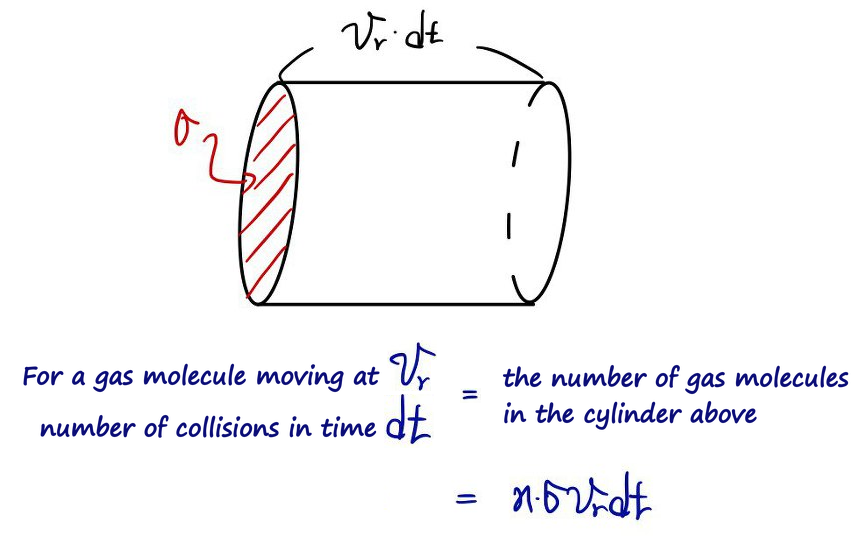
So let’s look at the equation above again.

Ah but, the distances between molecules aren’t all the same, so let me rewrite it like this.
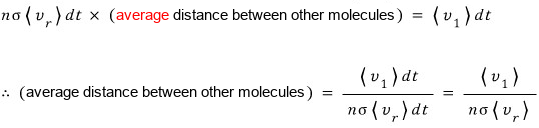
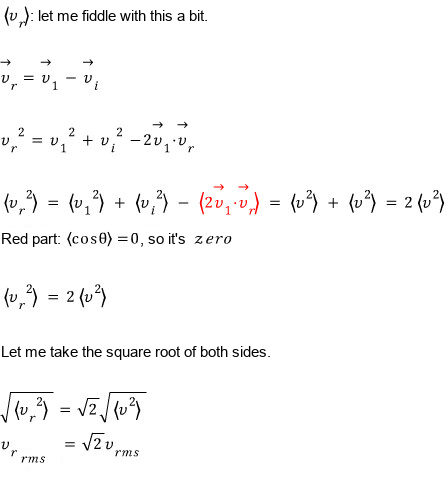
Ah damn it, what we need is  — I mean, the mean of
  — but what came out was the root-mean-square.
Earlier we had
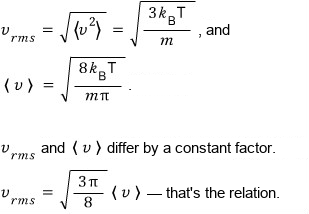
Again,
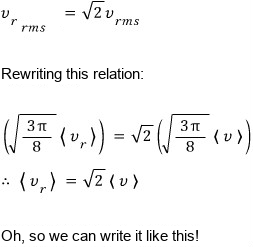
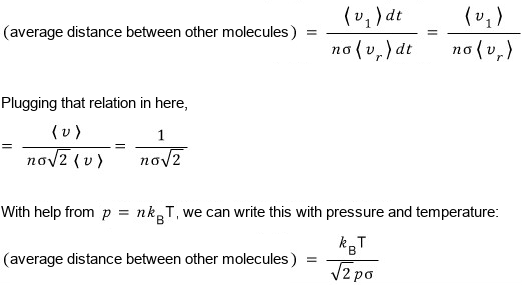
Now… let me reveal my trick.
The reason we were able to get here was, it just so happened that,
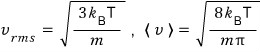
because of this. It was because the rms and mean values just happened to be related by a constant factor.
The reason they were related by a constant factor like that is because the gases followed the Maxwell-Boltzmann distribution!!! If it had been a different distribution, that constant-factor relation might not have held~ So we might not have arrived at our conclusion~
That is, we juuust quietly, sneakily slipped in the assumption that they follow the Maxwell-Boltzmann distribution….hehe
Ex 8.1
At room temperature and atmospheric pressure, calculate the mean free path of  gas. (For , use a molecular diameter of $d = 0.37\ \mathrm{nm}$.)
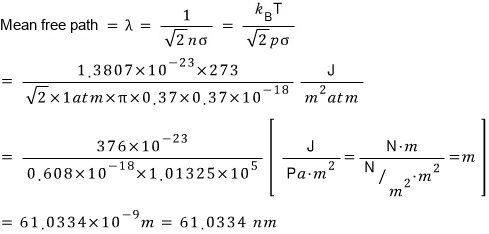
Prob 8.1
With the pressure at  and the temperature at room temperature, what is the mean free path of the nitrogen molecules inside an ultra-high vacuum chamber? What is the average collision time?
The diameter of the chamber is $0.5\ \mathrm{m}$. Compared to collisions between molecules, at what ratio do molecules collide with the chamber walls?
If the pressure were suddenly increased to  , how do these results change?
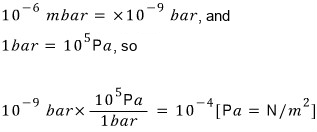
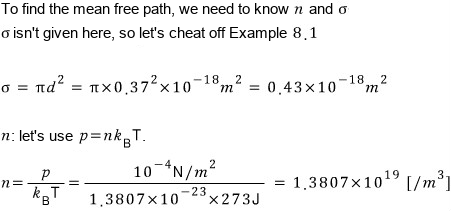
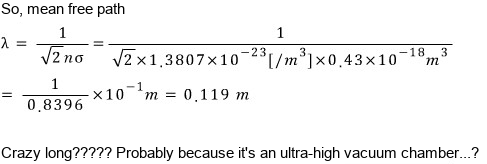
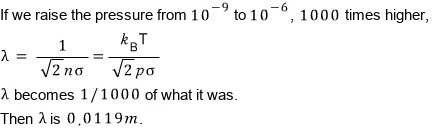
Heads-up. The figures here are the original notes, slips and all. A few things to watch for:
- In the relative-speed picture, the cross term is $2\vec v_1\cdot\vec v_i$, not $2\vec v_1\cdot\vec v_r$: $v_r^2 = v_1^2 + v_i^2 - 2\vec v_1\cdot\vec v_i$, and its average is zero. The result $\langle v_r^2\rangle = 2\langle v^2\rangle$ is right.
- In the vacuum-chamber problem, the number density at $10^{-4}\ \mathrm{Pa}$ ($10^{-6}\ \mathrm{mbar}$) is $n = p/(k_BT) \approx 2.65\times10^{16}\ \mathrm{m^{-3}}$, not $1.3807\times10^{19}$, and $\sigma = 0.43\times10^{-18}\ \mathrm{m^2}$ is an area. So $\lambda = 1/(\sqrt2\,n\sigma) \approx 62\ \mathrm{m}$ at $10^{-6}\ \mathrm{mbar}$ and about $6.2\times10^{5}\ \mathrm{m}$ at the problem’s $10^{-10}\ \mathrm{mbar}$ ($\lambda \propto 1/p$, a factor of $10^4$ between the two), instead of the pictures’ $0.119\ \mathrm{m}$ and $0.0119\ \mathrm{m}$. These use $T = 273\ \mathrm{K}$ as the pictures do; at room temperature they are about 7% larger.
Comments
Discussion happens via GitHub Discussions. You'll need a GitHub account to comment.