Chapter 11 Practice Problems
Working through Chapter 11 thermo problems — isothermal expansion of a monatomic ideal gas and showing those Cv/Cp identities with γ, step by step.
Prob 11.1
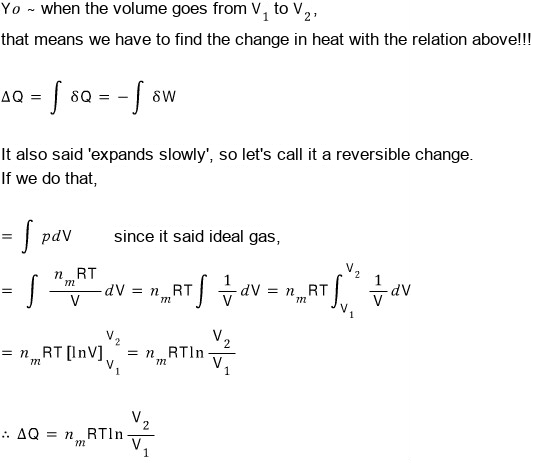
1 mole of monatomic ideal gas is trapped in a cylinder by a piston, and is kept at constant temperature $T_0$ by being in contact with a heat reservoir. This gas expands slowly while being kept at the same temperature $T_0$, and its volume changes from $V_1$ to $V_2$.
Why does the internal energy of the gas not change? Calculate the work done by the gas and the heat that flowed into the gas.

Here $\delta W$ means work done on the gas, so it is negative during expansion. For the logarithm below, we also assume a frictionless, reversible expansion; slow by itself is not enough. Then the work done by the gas and the heat supplied are both $n_mRT_0\ln(V_2/V_1)$.

Prob 11.2
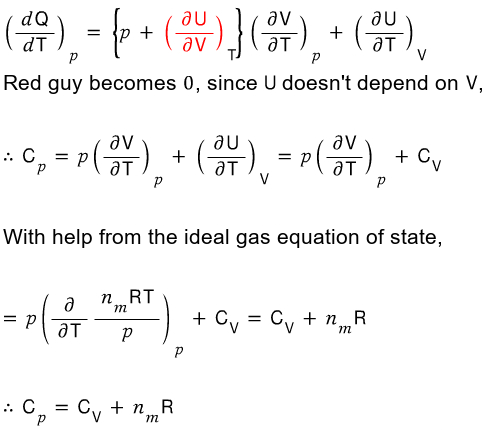
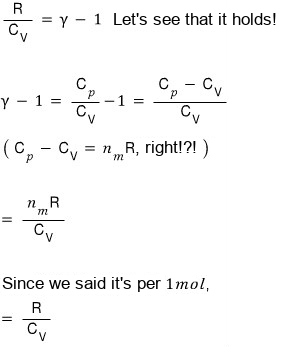
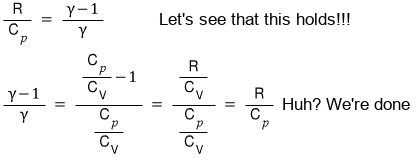
Show that for an ideal gas, the following holds.

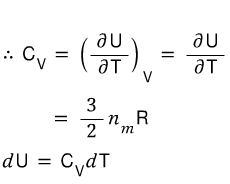
For these two identities, use molar heat capacities, so $C_p-C_V=R$ and $\gamma=C_p/C_V$. The notes below also show total capacities for $n_m$ moles; those instead satisfy $C_p-C_V=n_mR$. The $3/2$ line uses the monatomic example; the heat-capacity difference above holds for any ideal gas. Here’s how I wrapped it up in the last post.
Prob 11.3
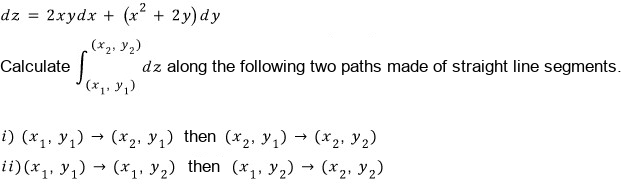
Consider the following differential.
Huh, it doesn’t depend on the path.
Prob 11.4
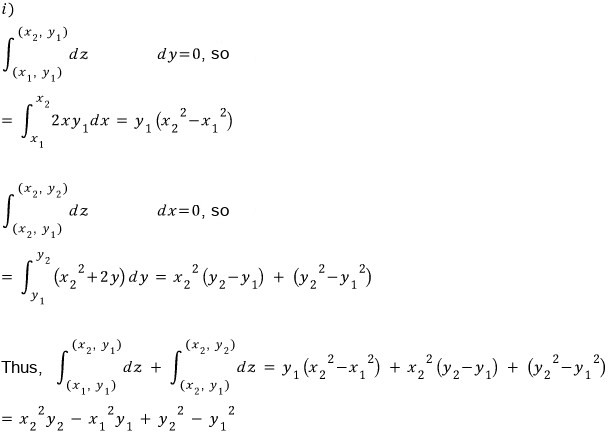
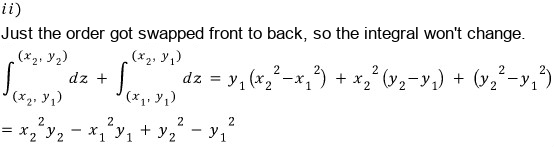
Heads-up. The figures here are the original notes, slips and all. A few things to watch for:
- For path ii), the picture repeats the two pieces of path i) in the other order. Path ii) has its own pieces: along $x = x_1$, $\int_{y_1}^{y_2}(x_1^2 + 2y)\,dy = x_1^2(y_2 - y_1) + (y_2^2 - y_1^2)$, and along $y = y_2$, $\int_{x_1}^{x_2} 2xy_2\,dx = y_2(x_2^2 - x_1^2)$. They add up to the same $x_2^2y_2 - x_1^2y_1 + y_2^2 - y_1^2$, because $dz$ is exact.
- The isothermal logarithm assumes a reversible expansion; slow alone does not guarantee it. Here $\delta W$ is work on the gas. The identities with $R/C_V$ and $R/C_p$ use molar capacities; the $3/2$ heat capacity is the monatomic example.
Comments
Discussion happens via GitHub Discussions. You'll need a GitHub account to comment.