Chapter 12 Practice Problems
Chapter 12 practice problems working through adiabatic expansion, ideal gas state equations, and partial derivative relations for heat capacity — some surprisingly simple!
Prob 12.1
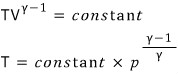
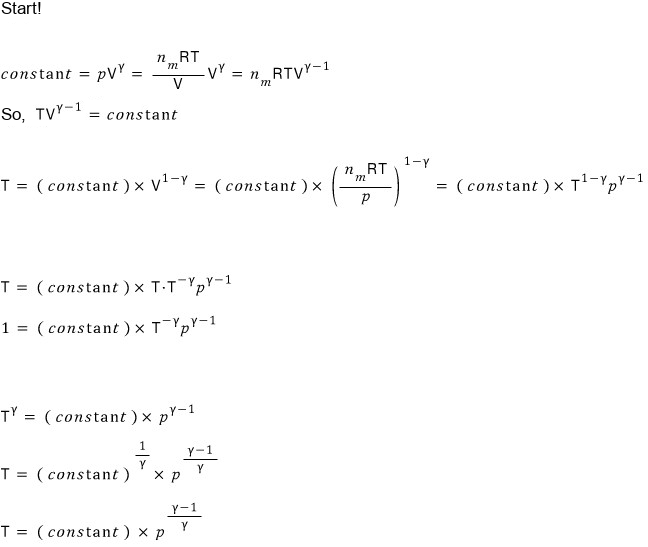
In adiabatic expansion of an ideal gas,  is a constant. Show that the following equation holds.
Prob 12.2
Suppose a gas behaves according to the law given by $pV = f(T)$. Here $f(T)$ is a function of temperature. From this, show the following equation.

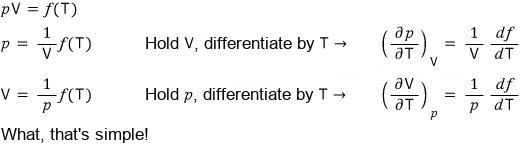
Also show that the following equation holds.

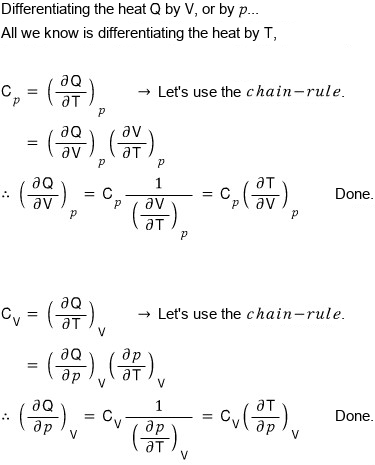
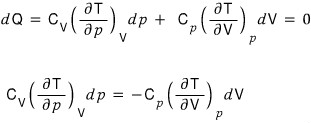
In an adiabatic change, the following equation is satisfied.

Therefore, show that is a constant.
The equation above is the one where $Q$ is thought of as a function defined by the two variables $p$ and $V$.
Earlier we proved

and now I’ll substitute it into the equation above.
And I’ll substitute in what we proved before:

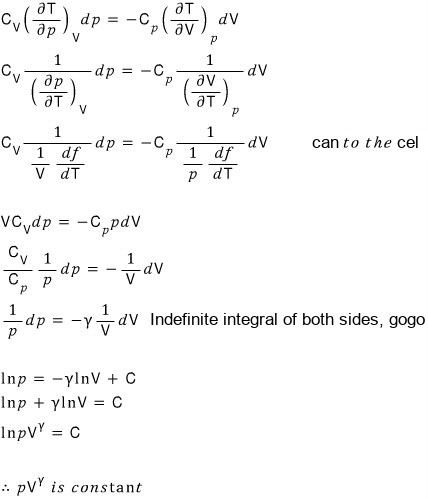
Prob 12.3
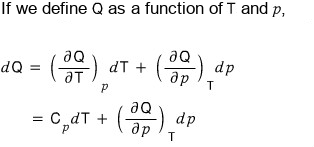
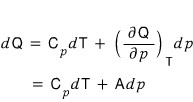
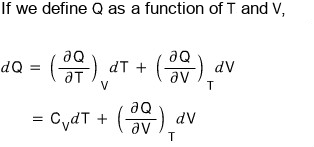
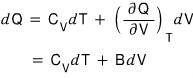
Explain why the following can be written as such.

Here $A$ and $B$ are just coefficients (they can change from state to state of the gas, but each is a plain number at a given state). From these equations,

show that this holds.
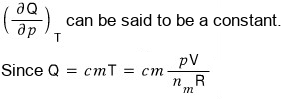
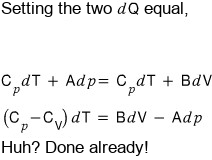
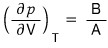
When the temperature is a constant, show that the following is satisfied.
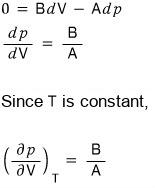
Above we had
but $T$ being constant means $dT = 0$, i.e.
Show that in an adiabatic change the following equation holds.
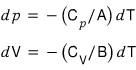
This one is easy.
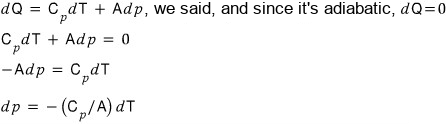
The one below too:
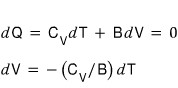
Therefore, show that in an adiabatic change the following equation is satisfied.
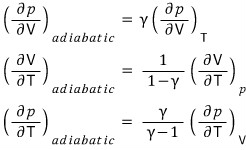
First,
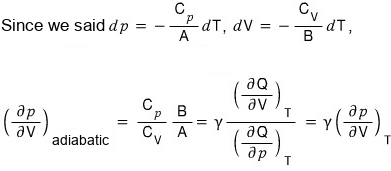
Diving into the second.
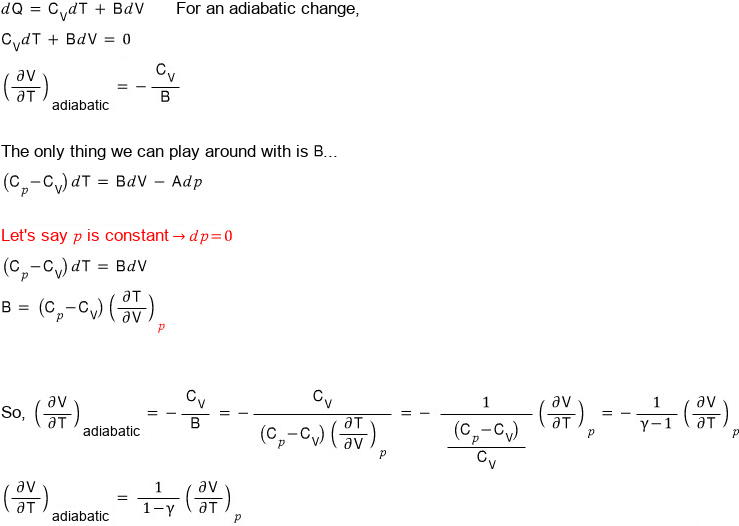
Let’s cook up the last equation too.
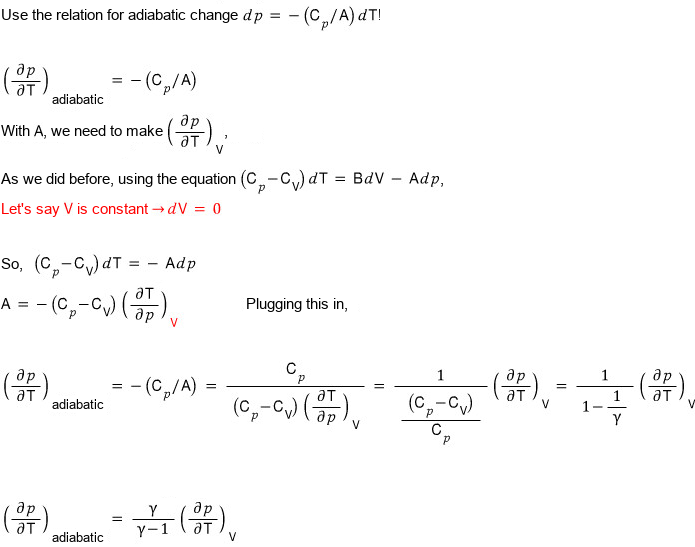
Prob 12.4

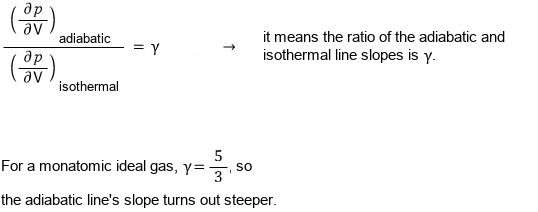
Using this, explain the slopes of adiabatic and isothermal on the $p$-$V$ graph in relation to each other.
Prob 12.5
Two thermally insulated cylinders A and B of equal volume, each having a piston, are connected by a valve. Initially A has its piston completely pulled out and contains a monatomic gas inside the cylinder at temperature $T$; B has its piston pushed completely in, and the valve is closed.
After the operation described below is carried out, calculate the final temperature of the gas in each case.
In each operation the initial arrangement starts from the same state, and the heat capacity of the cylinder is neglected.
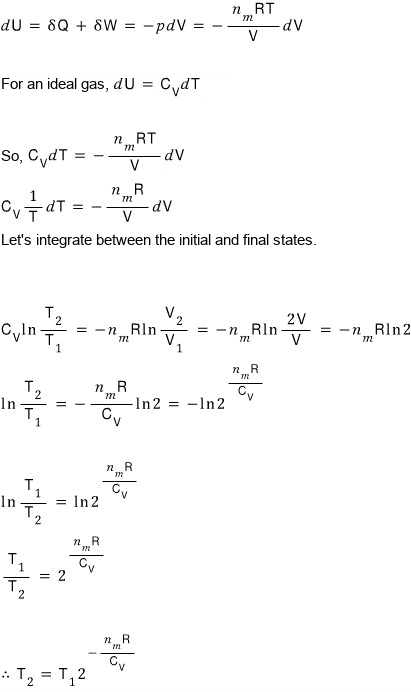
a) Fully open the valve and pull B’s piston all the way out so that the gas slowly enters into B. A’s piston is fixed so that it doesn’t move.

Since it was said to be completely thermally insulated, $\delta Q = 0$.
The reason they emphasize that it moves slowly is that the change is reversible, which I take to mean that we can write $\delta W = -p\,dV$.
Heads-up. The figures here are the original notes, slips and all. A few things to watch for:
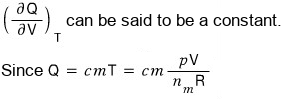
- The two pictures that call $\left(\frac{\partial Q}{\partial p}\right)_T$ and $\left(\frac{\partial Q}{\partial V}\right)_T$ constants are wrong there: heat is not a function of state, so $Q = cmT$ does not apply. For an ideal gas at constant $T$, $\delta Q = p\,dV = -V\,dp$, so $A = -V$ and $B = p$. Nothing later needs them to be constant.
- In the picture that sets the two $dQ$ equal, the right side should be $C_V\,dT + B\,dV$; the next line, $(C_p - C_V)\,dT = B\,dV - A\,dp$, has it right.
Comments
Discussion happens via GitHub Discussions. You'll need a GitHub account to comment.