Chapter 13 Practice Problems
Working through Chapter 13 problems on refrigerator efficiency, Carnot engines, and why perpetual motion machines just don't exist in this universe.
Ex 13.4: Efficiency of a refrigerator?!
A typical engine or system takes in heat from a hot reservoir, scarfs it down nicely, and the usual thing is to dump the rest into a (relatively) cold reservoir.
But a refrigerator is the opposite: it takes heat from a cold reservoir. (artificially….)
Here’s a refrigerator, like so.
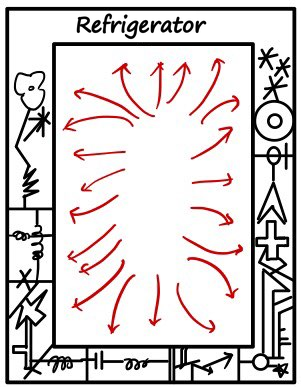
The refrigerator “does work.”
What kind of work does it do?
It does the work of pulling out the heat inside. By doing $W$ of work, it extracts  of heat and spits out an even bigger
  of heat, let’s say. If we sketch that out roughly
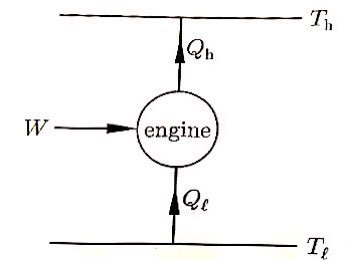
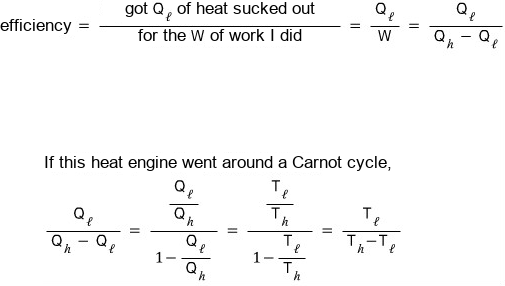
Alright, now let’s think about the efficiency. The efficiency here is 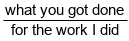 — this kind of ratio is what we should call efficiency, right?!
That is!!
Prob 13.2
What is the maximum possible efficiency of an engine operating between two reservoirs?
One reservoir is at 100°C, the other reservoir is at 0°C. The strongest heat engine in the universe is the Carnot engine, and the thermal efficiency of the Carnot engine is

Prob 13.3
i) Perpetual motion machine of the first kind: it violates the first law of thermodynamics, the law of conservation of energy.
ii) Perpetual motion machine of the second kind: the Carnot engine, a heat engine that follows the Carnot cycle, has the strongest thermal efficiency in the universe.
Since even the strongest engine in the universe has less than 100% efficiency, a perpetual motion machine of the second kind, that is, a heat engine with 100% efficiency, does not exist, at least in the universe.
Prob 13.4
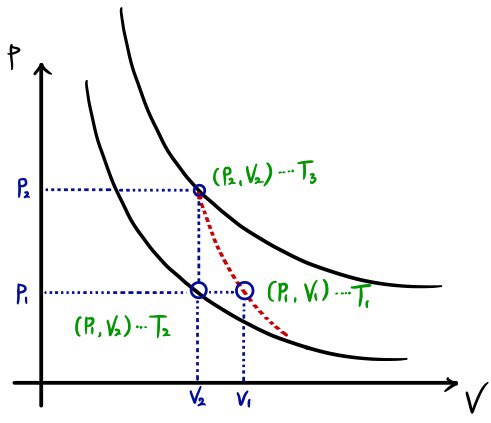
A possible ideal gas cycle operates as follows.
i) From the initial state $(p_1, V_1)$, the gas is cooled at constant pressure to $(p_1, V_2)$.
ii) The gas is heated at constant volume to $(p_2, V_2)$.
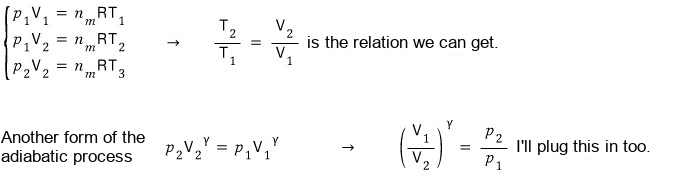
iii) The gas expands adiabatically and returns to $(p_1, V_1)$.
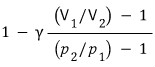
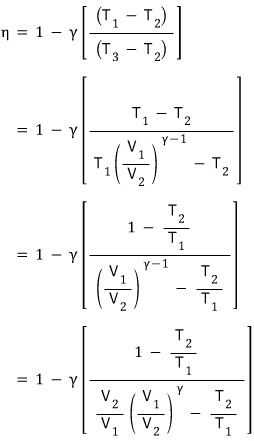
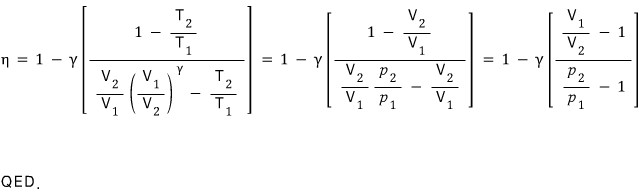
Assuming the heat capacity is constant (with respect to temperature), show that the efficiency is as follows.
First, since this is a problem of finding efficiency, 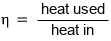 we need to head in the direction of getting this.
That means we need to calculate the heat taken in and the heat released!!!

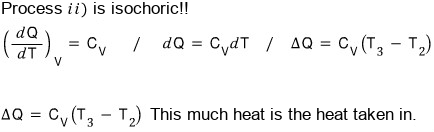

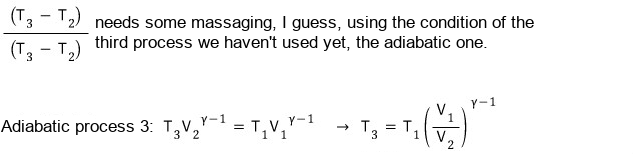
If we plug this in!!!!!
Here let me list out the ideal gas equation of state
Prob 13.5
Show that the efficiency of the standard Otto cycle is  . (The Otto cycle is a 4-stroke cycle used in internal combustion engines for cars, trucks, etc.) Here $r$ is
  , the compression ratio.
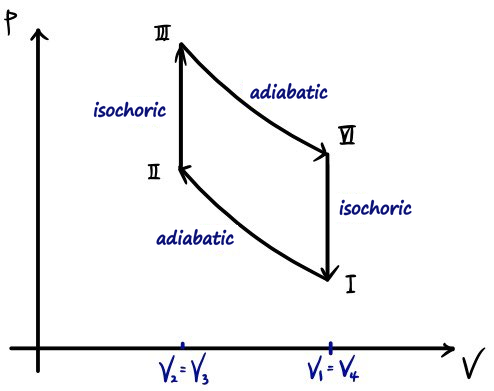
This problem is also about calculating efficiency. Ⅰ → Ⅱ and Ⅲ → Ⅳ are adiabatic processes, so there’s no heat exchange, while in the isochoric process parts, Ⅱ → Ⅲ and Ⅳ → Ⅰ, there will be heat exchange.
the old equation editor doesn’t support Roman numerals so….. T_T I’ll go with Arabic numerals T_T
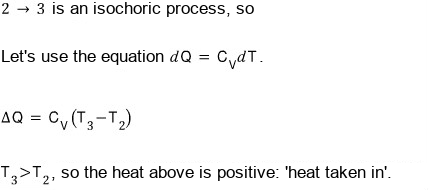
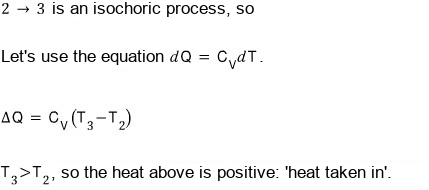
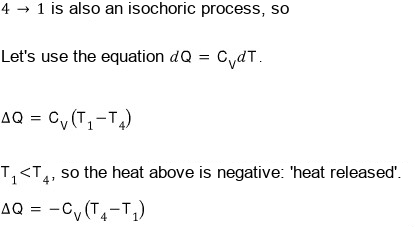
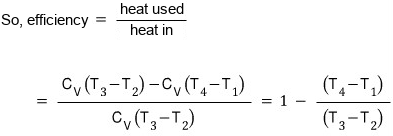
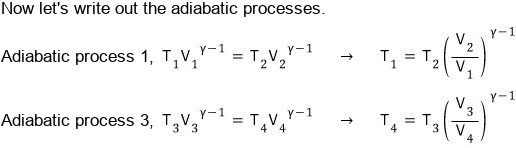
Alright, now let’s plug them in and unify things a bit.
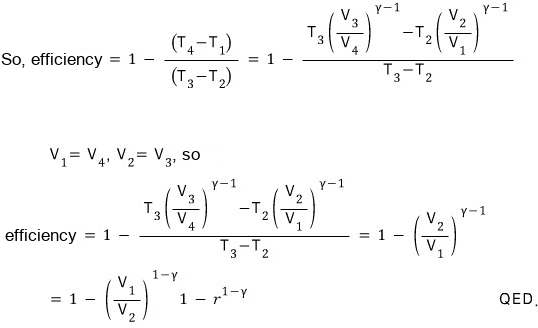
Prob 13.6
An ideal air conditioner absorbs heat $Q_2$ from the house at temperature $T_2$ and releases heat $Q_1$ to the outside at temperature $T_1$, operating while consuming electrical energy $E$. The heat loss leaking from the house follows Newton’s law of cooling, ![Q = A\left[T_1 - T_2\right]](eq_082.jpg) , where $A$ is a constant.
, where $A$ is a constant.
When steady state is reached, express $T_2$ in terms of $T_1$, $E$, $A$ for continuous operation… The air conditioner is controlled by a thermostat. It is designed so that, with the thermostat set to 20°C and the outside temperature at 30°C, it operates at 30% of its maximum electrical input.
What is the highest outside temperature at which the house can still be kept at 20°C?
This problem is kinda the same principle as the refrigerator we did earlier hehe
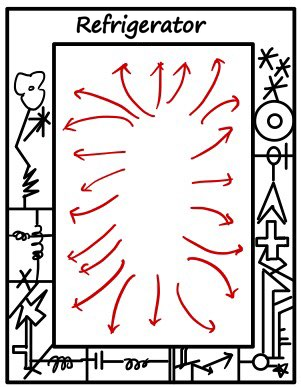
We can think of it as a refrigerator that uses energy $E$ to extract heat $Q_2$ at the house’s temperature $T_2$ and throws $Q_1$ to the outside at temperature $T_1$. Ah… since this is an air conditioner, I drew another picture.
Whisen, let’s go!
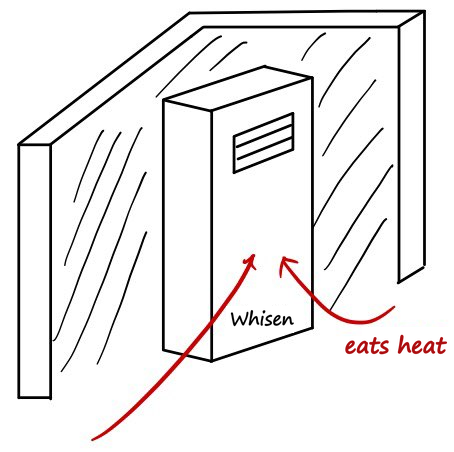
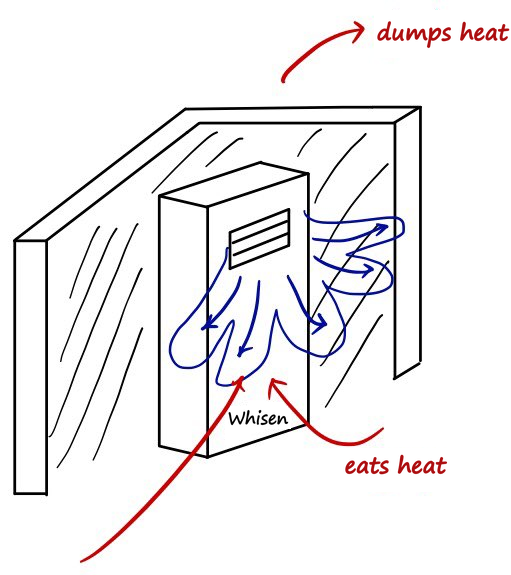
The air conditioner runs on energy $E$, that is, it uses energy $E$ to pull out $Q_2$ and throw heat to the outside, and since we’re told it’s an ideal air conditioner (engine),  should hold!!!
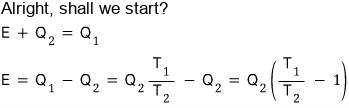
Here we need to consider the loss.
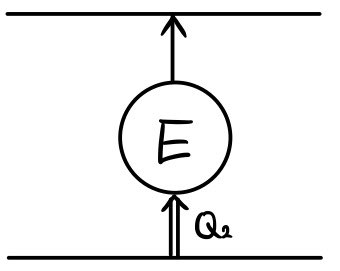
In the middle of pulling the heat up
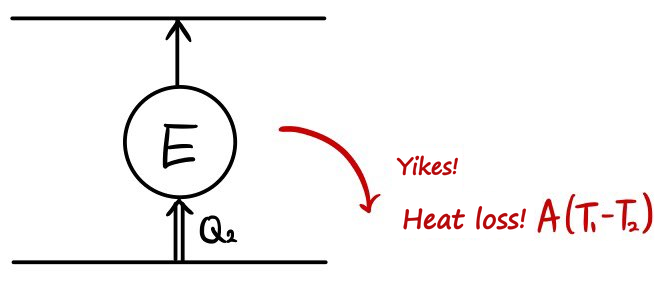
Yikes!!! Heat loss occurs.
So in the end, we pull out $Q_2$ only to have that much leak right back in. That is, ![Q_2 = A\left[T_1 - T_2\right]](eq_110.jpg) balances it out!!?
balances it out!!?
An equilibrium — well, a steady state — will be reached! Ah ah, the heat will balance out!!! That is!

If we first organize this equation,…
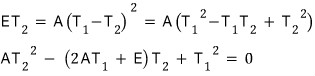
We can find $T_2$ with the quadratic formula, and express it in terms of $T_1$, $E$, $A$!!!

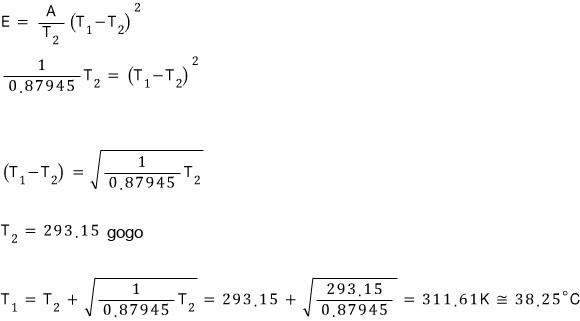
Since the air conditioner is designed at 0.3 of the maximum input for 20°C ($T_2$) and 30°C ($T_1$), we can get the relation between $E$ and $A$ from this!!!
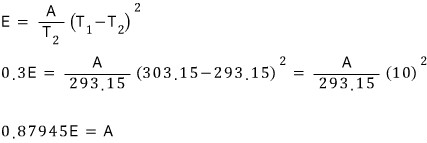
For the maximum outside temperature at which the house can be kept at 20°C, we just need to find $T_1$ when the air conditioner runs at 100% of its maximum input.
Prob 13.7
Two identical objects with constant heat capacity $C_p$ serve as the two heat reservoirs of a heat engine, at temperatures $T_1$ and $T_2$. If the objects are under constant pressure, show that the obtainable work is as follows.
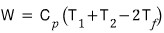
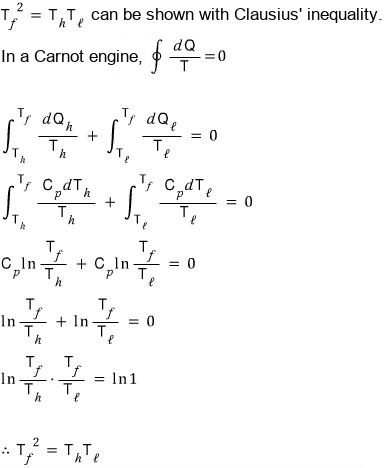
If the most efficient engine is used,  holds.
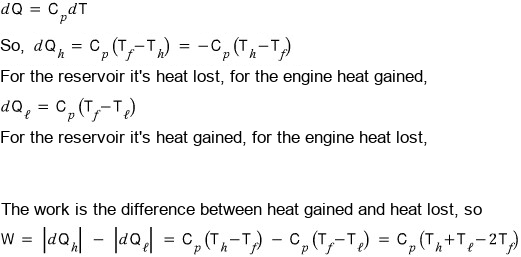
Under constant pressure, the heat gained and the heat lost are
Heads-up. The figures here are the original notes, slips and all. A few things to watch for:
- In the picture that starts the massaging, the fraction to rewrite is $\frac{T_1 - T_2}{T_3 - T_2}$ from the efficiency line above; the picture writes $T_3 - T_2$ in the numerator too.
- In the Otto-cycle diagram, the corner at the top right is IV, not VI.
- In the air-conditioner algebra, $A(T_1 - T_2)^2 = A(T_1^2 - 2T_1T_2 + T_2^2)$, so the quadratic is $AT_2^2 - (2AT_1 + E)T_2 + AT_1^2 = 0$ and its discriminant is $(2AT_1 + E)^2 - 4A^2T_1^2$; the pictures drop the 2 in the first line and one $A$ in the constant term and in the discriminant.
- In the last numerical picture, $T_1 = 293.15 + \sqrt{\frac{293.15}{0.87945}} = 311.41$ K, about 38.26 degrees Celsius; the picture writes 311.61 K.
Comments
Discussion happens via GitHub Discussions. You'll need a GitHub account to comment.