Reciprocal Theorem and Reciprocity Theorem
Derive the reciprocal and cyclic partial-derivative rules by substituting total differentials, then check the minus sign with the ideal-gas equation.
As promised in the previous post, let’s prove the reciprocal and reciprocity rules! They’re little tools we’ll keep reaching for in thermodynamics, so I want to see why they work once, rather than just swap symbols around and hope. Hehehe.
Set up the differentials
Say $x=x(y,z)$. These three variables are related: we can choose two locally and the relation determines the third. The subscript on a partial derivative tells us which variable stays fixed. It isn’t decoration!
We use smooth functions in a region where the variables can be solved for one another. Whenever we divide by a derivative, it must be nonzero; at a turning point we may need a different choice of independent variables.

That says a small change in $x$ has two contributions: change $y$ while holding $z$ fixed, or change $z$ while holding $y$ fixed. Add them and we have the total differential.
Conversely, write the same relation as $z=z(x,y)$:

Now I’m gonna plug this expression for $dz$ into the first equation. No new physics — just substitution:

Why can we suddenly turn that long line into two separate conditions?
Because $x$ and $y$ can be varied independently in this local description. First choose $dy=0$: the coefficient multiplying $dx$ on the right must be 1. Then choose $dx=0$: the coefficient multiplying $dy$ must be zero. The identity has to work for both choices, not just one specially chosen change.

1. Reciprocal theorem
The first condition gives
$$\left(\frac{\partial x}{\partial z}\right)_y =\frac{1}{\left(\frac{\partial z}{\partial x}\right)_y}.$$
Hold $y$ fixed and we’re moving along the same one-dimensional curve, once using $z$ to describe it and once using $x$. The slopes are inverse slopes. That’s all the reciprocal rule is saying.
Flip the derivative, keep the held-fixed variable the same. Changing that subscript changes the experiment.
2. Reciprocity theorem — the cyclic rule
Now use the second condition. To make the algebra less crowded for a moment, call
$$A=\left(\frac{\partial x}{\partial y}\right)_z, \qquad B=\left(\frac{\partial x}{\partial z}\right)_y.$$At fixed $x$, the first differential becomes $0=A\,dy+B\,dz$. So, provided $A\ne0$,
$$\left(\frac{\partial y}{\partial z}\right)_x=-\frac{B}{A}.$$And the reciprocal theorem gives $(\partial z/\partial x)_y=1/B$. Multiply the three derivatives in the cyclic order and the coefficients cancel:
$$\left(\frac{\partial x}{\partial y}\right)_z \left(\frac{\partial y}{\partial z}\right)_x \left(\frac{\partial z}{\partial x}\right)_y =A\left(-\frac{B}{A}\right)\frac1B=-1.$$The minus sign comes from keeping $x$ fixed: one contribution has to offset the other. The original notes work through the same cancellation by repeatedly using the reciprocal rule:
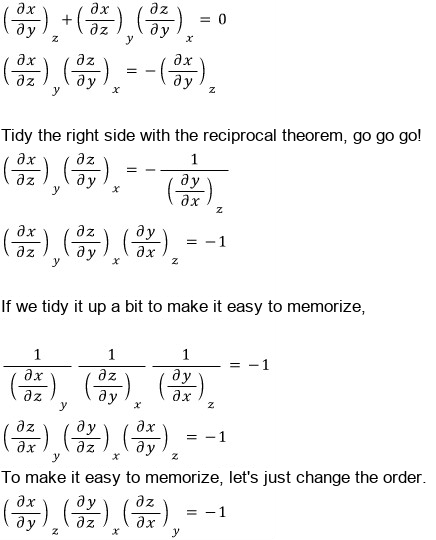
For remembering the order, replace $x,y,z$ by $1,2,3$:
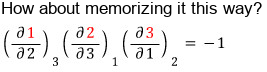
I picture the cycle going around a right-handed coordinate system. That’s my memory aid, not the proof of the minus sign! The reliable check is that each variable appears once upstairs, once downstairs and once as the held-fixed subscript.
A quick thermodynamics check
Take a fixed amount of ideal gas, $PV=nRT$, with $P,V,T>0$. The three derivatives are
$$\left(\frac{\partial P}{\partial V}\right)_T=-\frac{P}{V}, \qquad\left(\frac{\partial V}{\partial T}\right)_P=\frac{V}{T},$$$$\left(\frac{\partial T}{\partial P}\right)_V=\frac{T}{P}.$$Multiply them: $(-P/V)(V/T)(T/P)=-1$. It works! And the inverse of the first slope is $(\partial V/\partial P)_T=-V/P$ — with the same fixed temperature.
So when we use these rules later, don’t just cancel the letters as if the derivatives were ordinary fractions. Read the subscripts, make sure the local inverse exists, and then do the swapping. That’s the little check that saves a lot of confusion.
Comments
Discussion happens via GitHub Discussions. You'll need a GitHub account to comment.