Entropy Practice Problems
Working through entropy practice problems—cooling tea and bathtub heat sources—to confirm the second law of thermodynamics (dS ≥ 0) holds up in real scenarios!
Prob 14.1
A mug of tea was left to cool from 90℃ to 18℃. If there is 0.2kg of tea in the cup and the specific heat capacity at constant pressure is 4200 J/K·kg, show that the entropy of the tea decreases by 185.7 J/K. Explain the sign of this result.
I’ll interpret this problem as the contact between a small system and a big reservoir.
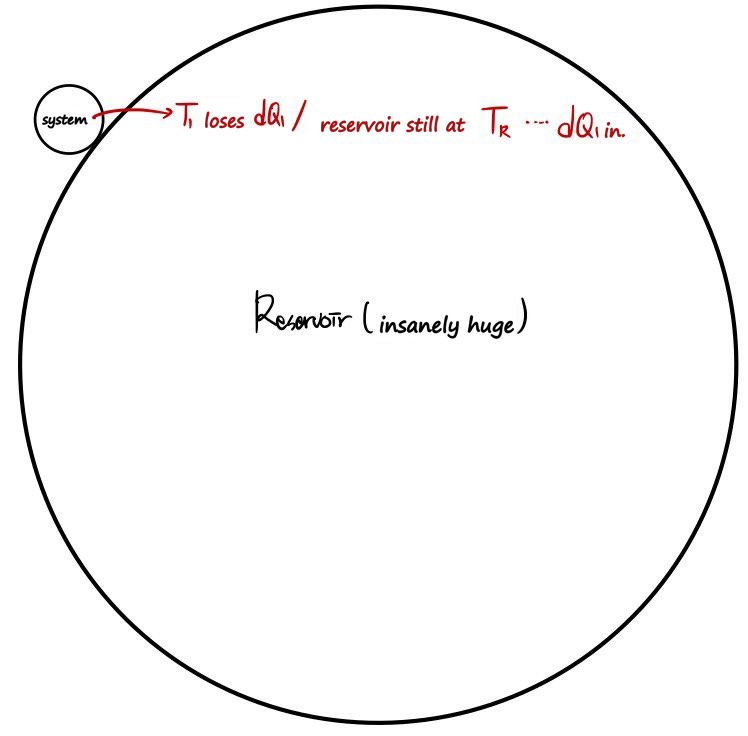
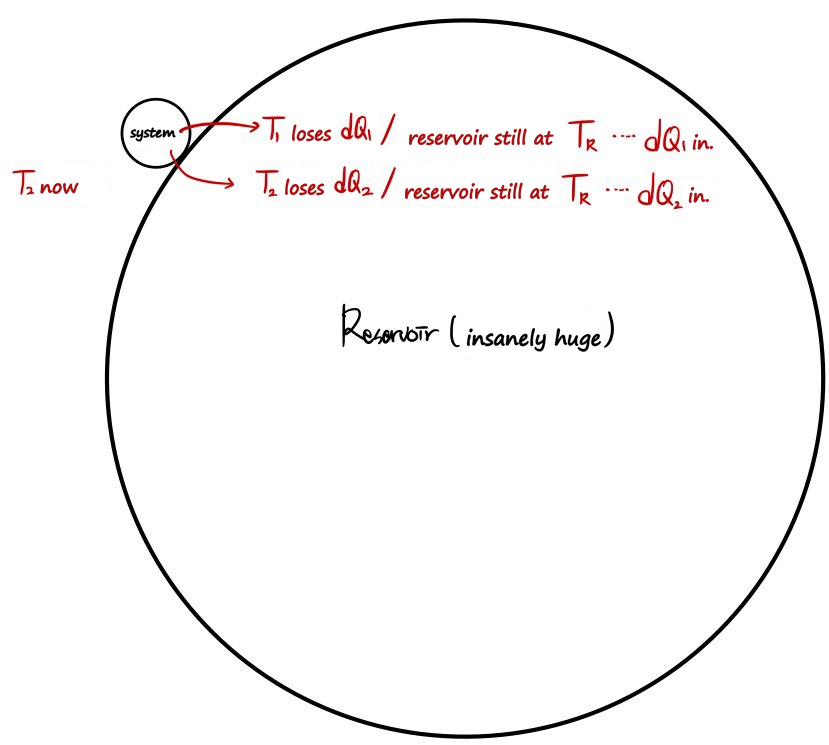
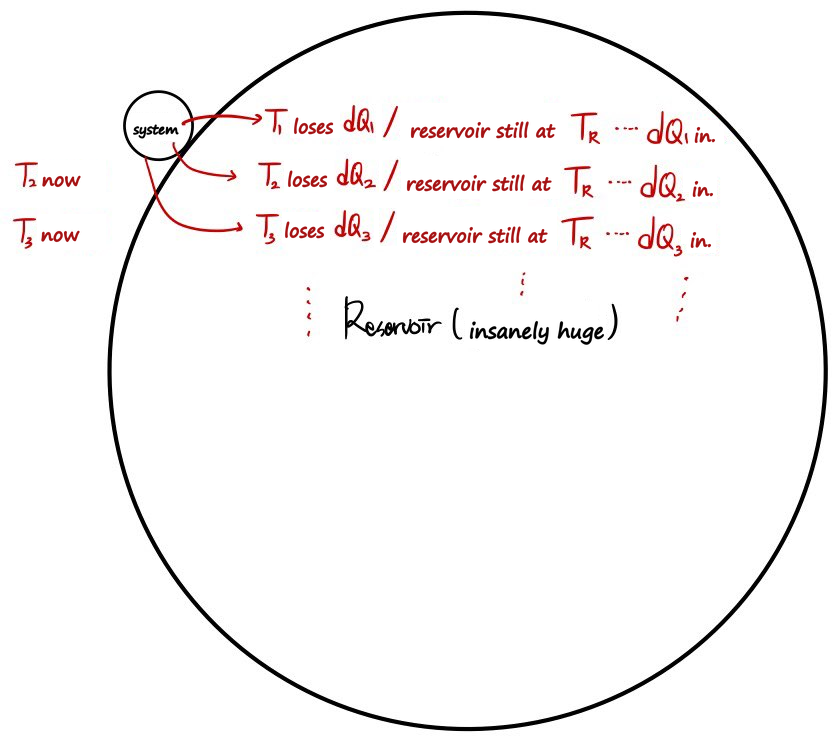
Since calculating the entropy of the system and calculating the entropy of the surroundings are slightly different, I tried drawing it as a picture.
So if I do the system entropy calculation first, the system has its temperature T changing from moment to moment: in  , T keeeeps changing.
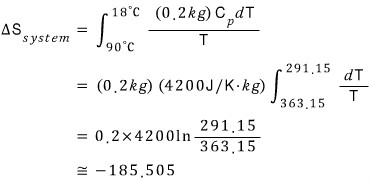
Now, the situation in the problem above is one where the pressure is constant, so the change in heat $\delta Q$ can be calculated as $(0.2\,\text{kg})\,C_p\,dT$. That is,
If I also calculate the entropy of the reservoir, then when I go to do , the temperature T of the reservoir is constant at 18℃. So it can come out of the integral~
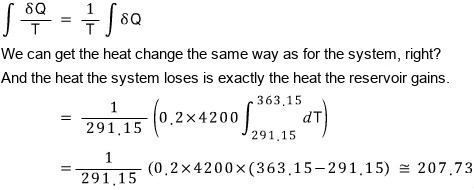
That is, the change in total entropy is $207.73 - 185.62 = 22.11$. Yesss!!! It doesn’t violate the second law of thermodynamics, $dS \geq 0$.
And why does the entropy of the system decrease, then?
The thing about entropy increasing,,…. that was when we assumed it was a thermally isolated system.
So for systems that aren’t thermally isolated, it doesn’t always have to be positive…!!!
OK OK
Prob 14.4
a) A bath of water initially at 20℃ is put in contact with a heat reservoir at 80℃. Find the change in entropy.
b) Find the change in entropy of the heat reservoir when process a) happens.
The bathroom and its contents have a heat capacity of $10^4$ J/K.
Should I read that as a bathtub? Anyway, the entropy change of the bathtub is

The bathroom (our reservoir) will be at 80℃ the whoooole time, so
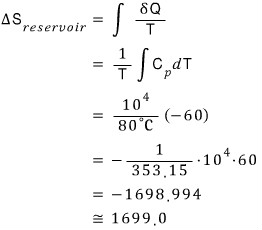
That is, the change in total entropy is $1862.08 - 1699.0 = 163$.
I did solve part c, but I’m not confident…. T_T lol
Prob 14.5
A lead block with a heat capacity of 1 kilo J/K is cooled from 200K to 100K in two ways.
a) Drop it into a large fluid at 100K.
b) Cool it down to 150K in one fluid at 150K, then cool it down to 100K in another fluid at 100K.
For both cases, calculate the entropy change of the system made up of the block and the baths, when it cools from 200K to 100K. Prove that in the limit of infinitely many intermediate baths, the change in total entropy is zero.
a) The entropy change of the lead block is

The entropy change of that fluid is

That is, the change in total entropy is $1000 - 693.147 = 306.853$ J/K.
Now I’ll do the cooling in two stages.
The entropy change of the lead in round 1

The fluid entropy change in round 1

The entropy change of the lead in round 2

The fluid entropy change in round 2

Therefore the change in total entropy is

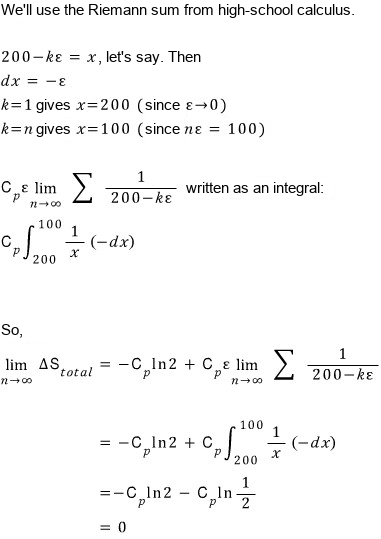
c) Now I’ll try doing it infinitely many times.
Looking at the entropy change of the lead, the integrals have this property of merging into one?!
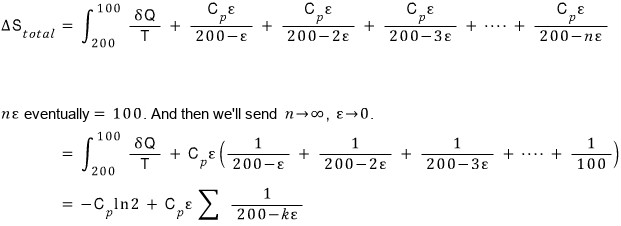
Then if I set the temperature step between the fluids as $\varepsilon$: plop into $200-\varepsilon$, plop into $200-2\varepsilon$, plop into $200-3\varepsilon$, …., plop into $200-n\varepsilon$. Then the change in total entropy is

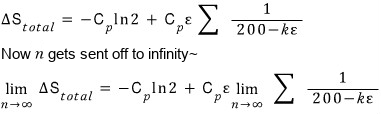
That is, the change in total entropy is
Prob 14.7
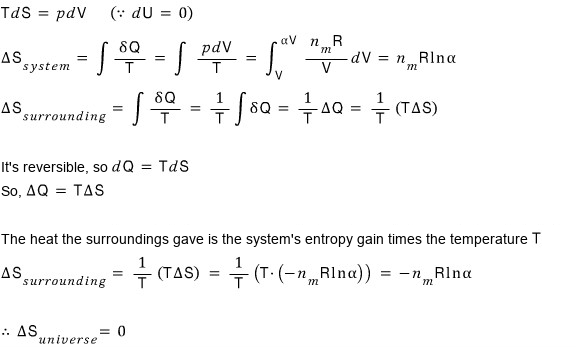
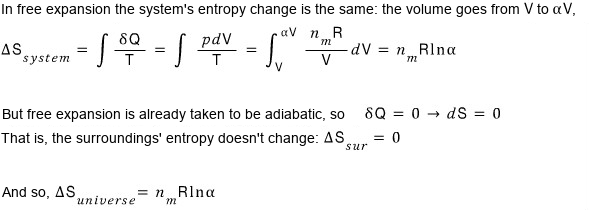
$n$ moles of gas are confined at temperature $T$ and volume $V$. Derive the expression for the entropy change
a) when it becomes $\alpha V$ through a reversible isothermal expansion, and
b) when the partition is removed and it undergoes free expansion into a vacuum.
i) Isothermal expansion necessarily requires heat to be supplied.
ii)
Heads-up. The figures here are the original notes, slips and all. A few things to watch for:
- In the tea’s entropy change, $0.2 \times 4200 \ln\frac{291.15}{363.15} \approx -185.62$ (the picture’s $-185.505$ is off), so the total in the text is $207.73 - 185.62 \approx 22.11$.
- In the bathtub reservoir’s entropy change, the temperature goes in as $353.15$ K (not 80 °C), and the result keeps its minus sign: $\approx -1699.0$.
- In the limit pictures, $\varepsilon = 100/n$ shrinks with $n$, so it belongs inside the limit: $C_p \lim_{n\to\infty}\sum_k \frac{\varepsilon}{200 - k\varepsilon} = C_p\int_{200}^{100}\frac{1}{x}(-dx)$.
Comments
Discussion happens via GitHub Discussions. You'll need a GitHub account to comment.