Gibbs' Expression for the Entropy
A casual (and slightly reluctant) walkthrough of Gibbs' entropy formula, showing how entropy gets re-expressed through probability over macrostates and microstates.
Now it’s the last one on entropy. I was going to skip this concept, but I’m writing it down just to record that I did try it at least once…. Ha.. seriously, entropy, seriously…. lol
Let’s go!
Building on the concepts we learned before, they say we’re now going to express entropy not thermodynamically, and not by counting the number of ways either, but with probability. Apparently we can do that.
Say~~ there’s a system that can be measured in one of a few macrostates, and for each of those macrostates, let’s assume there really are several microstates that share that same macrostate. (This is the “micro entropy” I’m talking about~)
Then  macrostates are possible, and for a specific $i$-th macrostate, let’s say
 microstates represent that macrostate.
That is, if we say the number of all~~~ the ‘microstates’ that the system can have is $N$,

then this holds. So the probability that the $i$-th macrostate shows up can be written down automatically.

If we write it like that,
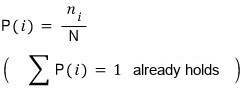
And so, using the definition  , writing the entropy of the system we set up as
 gives the entropy that takes every possible microstate into account.
The entropy that only counts the macrostates would be  , and figuring out this one is the goal!!! What we can find out by experiment isn’t the microscopic stuff… it’s the macroscopic stuff….
So is this value the truth~~~?!
Nope. In the previous example we got a glimpse of a possible extra entropy, and we said that this possibility, $S + S_{micro}$ (the value with the micro entropy added), would be the total entropy.
Computing $S_{micro}$ makes no sense!!! No sense at all!!! But we did assume that there really are several microstates that share the same macrostate…..

Ha…. since there’s no way to know this guy, the idea is: let’s at least compute its expectation value!

That is,
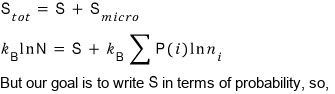
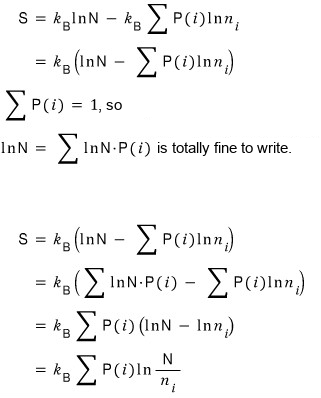
Since we already said earlier that  ,

Like this, entropy can also be written in terms of the probability of being in each macrostate.
This expression for the entropy is called Gibbs’ expression for the entropy, apparently.
Prob 14.8
The probability that a system is in the $i$-th microstate is  .
 is the energy of the $i$-th microstate, and β and Z are constants.
Show that the entropy is given by 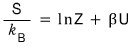 . Here $U$ is

the internal energy.
Hmm, Gibbs’ expression for the entropy,
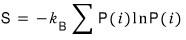
let’s plug the $P_i$ from above into it.
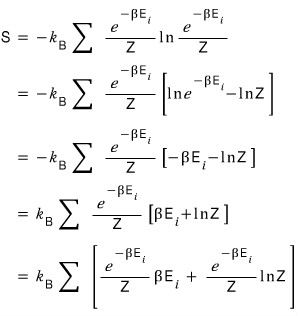
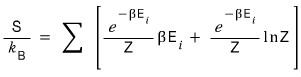
Got this far. Let’s run toward the answer.
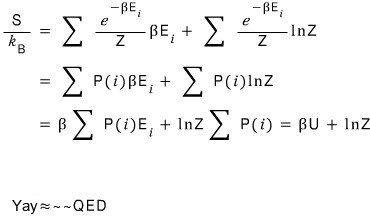
Comments
Discussion happens via GitHub Discussions. You'll need a GitHub account to comment.