Enthalpy, Helmholtz Free Energy, and Gibbs Free Energy
Starting from dU = TdS - pdV, we add clever terms to both sides to cook up enthalpy, Helmholtz, and Gibbs — basically just a change of variables to make life easier.
Alright then, now, finally, we take that ‘conservation of energy’ equation, $dU = TdS - pdV$, and add the same extra $\Delta(\ldots)$ to both sides, and that way we’ll look at other kinds(?) of energy. Calling them “other kinds” is a bit off… um…? More like a change of variables? Something like that, I think.
As you’ve all probably guessed, I’m about to define the enthalpy, Helmholtz, and Gibbs functions. And after we’ve defined all~~ of these functions!!
-
Why on earth did we define these functions?
-
What on earth does each function mean?
We’ll dig into that. (A little spoiler first: it’s stuff like “in this case, in that case… and so on, this kind of energy equation is more convenient, easier to handle, actually means something.”) Let’s just get going.
① The enthalpy function
$p$ times $V$ has the units of ’energy’. Right!!! So take the equation of the first law of thermodynamics, $dU = TdS - pdV$, and let’s add $\Delta(pV)$ to both sides, the same on each.
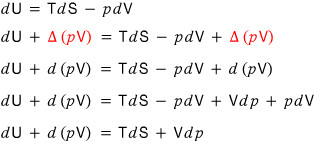
Now I’ll write the left side as $d(U + pV)$. That’s allowed, right?!
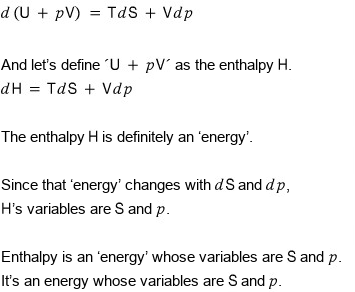
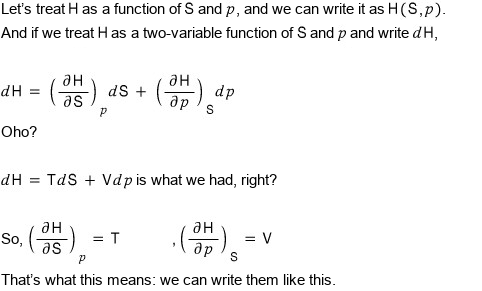
② The Helmholtz function
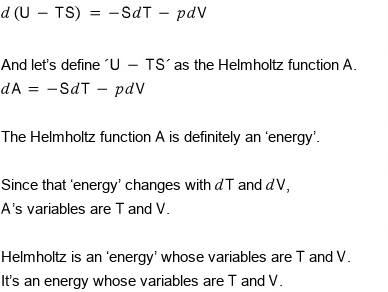
Before, we added $d(pV)$ to both sides of the $dU$ equation. This time we’ll add $-d(TS)$!!!!
Is $TS$ really an energy, units-wise????
In  , $S$ has units of J/K. And the statistical-mechanics definition of entropy, too,
  : the Boltzmann constant there has units of J/K.
(Why the constant has units of that goofy shape: you’ll see it if you think back to how the statistical-mechanics entropy was derived.)
Anyway, there’s no doubt that $TS$ has units of energy, so let’s look at $dU - d(TS)$.
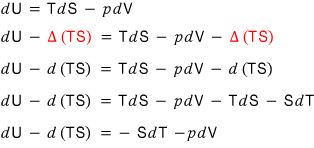
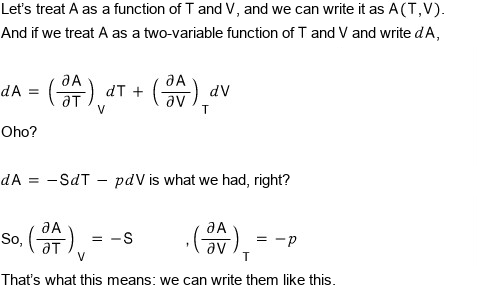
Now take the left side, $dU - d(TS)$, write it as $d(U - TS)$, and on to the definition!!!
③ The Gibbs function
This time, let’s pull the trick we played on $dU$ for the enthalpy and the trick we played on $dU$ for the Helmholtz function, both at once!!! That is, let’s hit $dU$ with $+d(pV) - d(TS)$!!!!!
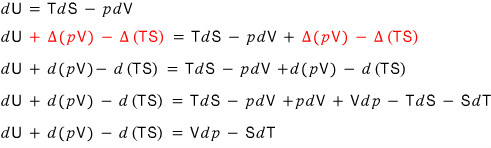
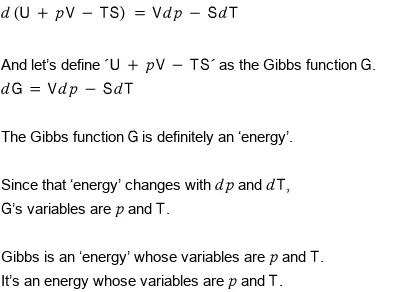
Now take the left side, $dU + d(pV) - d(TS)$, write it as $d(U + pV - TS)$, and on to the definition!!!
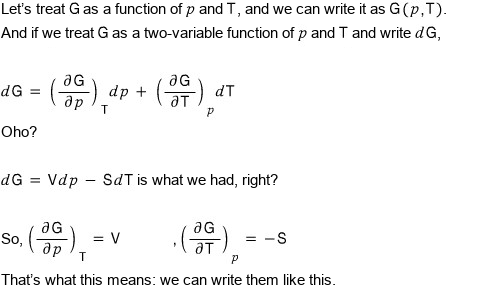
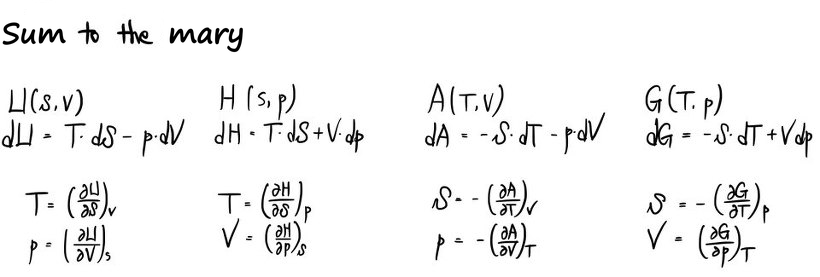
We sure did something just now, we even went all the way to the sum-to-the-mary, but what on earth did we do? What do those things actually mean?
Why do we have to look at the same energy in four whole flavors like this, $U$, $H$, $A$, $G$…. Why are we even learning this?
Let’s think about it. First, let me copy out the definition of ‘free energy’ the way it’s introduced:
‘Free energy’: a physical quantity that depends on the available, useful amount of work a system can give.
Big underline under “available”, pig-tail squiggle, dot dot~, and let’s move on.
And one more thing: let me introduce the concept of availability. It’s a concept for a sup~~er common situation, they say. The super common situation: when you do chemistry experiments, lots of them are run at constant temperature & constant pressure, they say.
So let’s say we’re doing an experiment where the temperature stays at  and the pressure at
  .
.
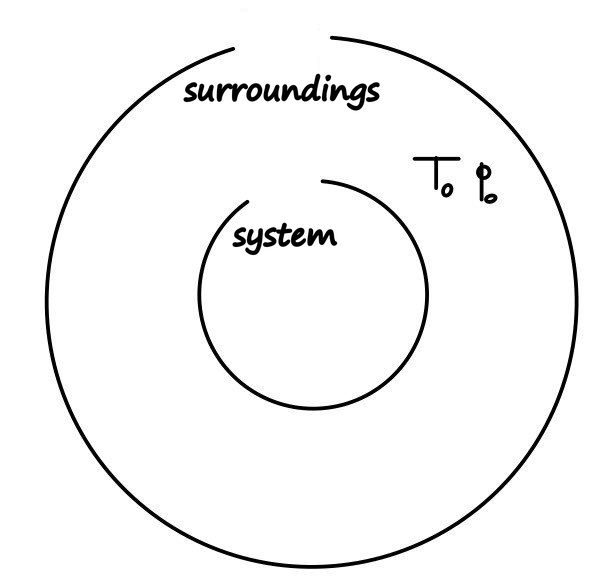
In this setup, let’s write out the first law of thermodynamics: $dU = \delta Q + \delta W$.
Now say heat $\delta Q$ comes into the system from the surroundings, and the system does work. The heat that flowed in from the surroundings: $\delta Q$. This much heat comes in, the system does work, and let’s say its volume changes by $dV$.
Then at least  of the work is done ‘in plain sight’ (we can see it, and we can measure it). So, as far as we can tell, out of the energy $\delta Q$,
  is already accounted for, so let’s take that much out:
 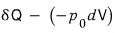 .
.
Since that takes the ‘work done’ out of the heat $\delta Q$ that came in, I’ll write the energy that’s left as  .
.
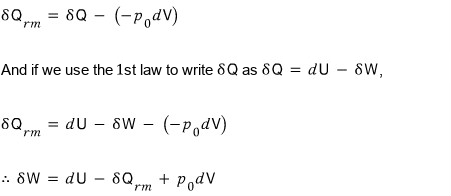
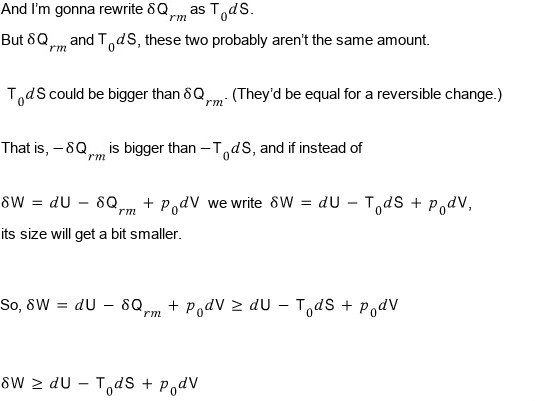
(If you just skim this, it’ll probably be hard to follow… T_T)
We played around with the remainder. So you can read the equation above as, roughly, “the amount that’s still left for doing work.”

And let’s understand this inequality like this.
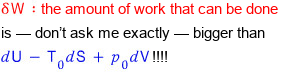
In other words!!!! The smallest value  can take is
  , this much! So this is what sets the limit on the ‘available’ work!!!!
This is the change of what’s called the availability, they say. I’ll write the availability as $F$.
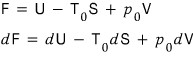
So,
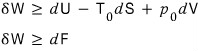
And on top of that, chemistry experiments are usually mechanically constrained, so  .
.
Let’s look at a few situations with this inequality. This inequality is said to express the ‘principle of minimum availability’.
But let’s not forget our assumption. We derived this assuming an experiment where the temperature stays at and the pressure at !
(So, I don’t know for sure, but I’m guessing it was the chemistry folks who came up with this availability thing.)
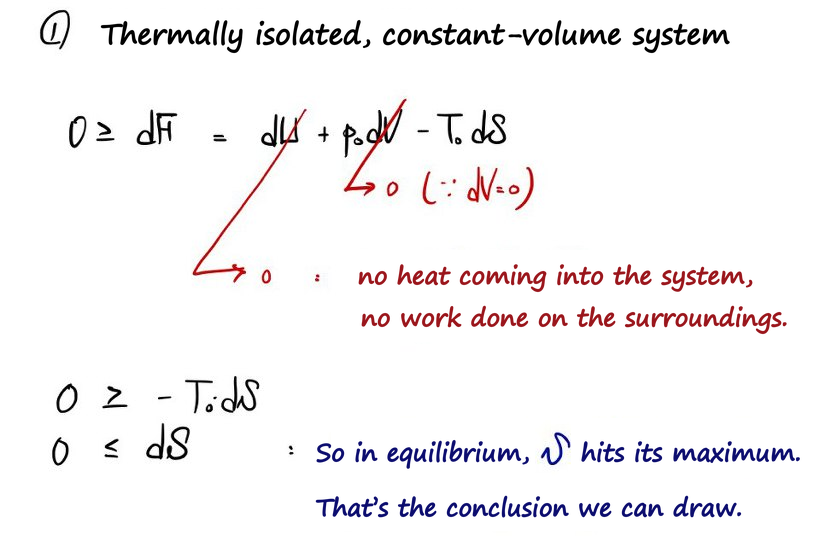
“So in equilibrium, $S$ hits its maximum.” That’s the conclusion we can draw.
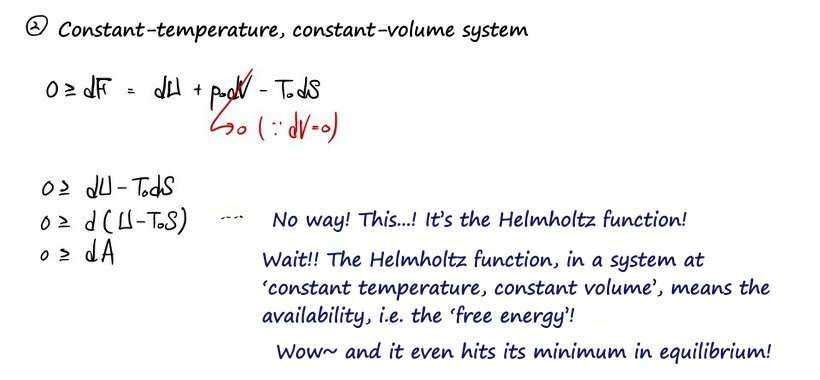
“No way, this…!!! It’s the Helmholtz function!”
//
“Wait!!! The Helmholtz function, in a system at ‘constant temperature, constant volume’, means the availability, that is, the free energy!!! Wow~~ And even that in equilibrium the Helmholtz function will be at its minimum!!!!”
Now I also see why it’s called the Helmholtz free energy.
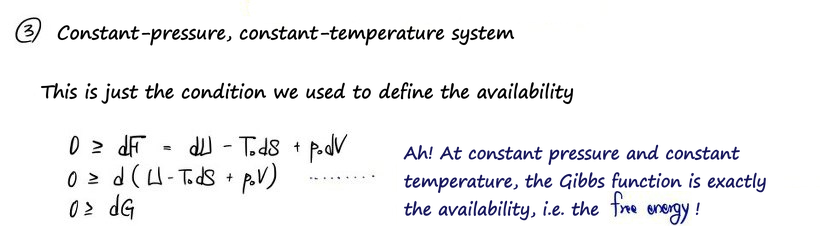
“Ah!!! In a system at constant pressure and constant temperature, it’s exactly the Gibbs function that’s the availability… that is, it means the free energy!!!”
Now I get what the Helmholtz function and the Gibbs function mean.
Then what about enthalpy!!!
Enthalpy, they say, really shines in a system at ‘constant pressure’.
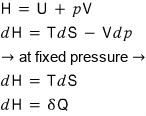

Let’s sum it up again!!!
Internal energy: the sum of the kinetic and potential energies of the particles that make up the system.
Helmholtz free energy: the useful work you can get out of a closed system at constant temperature and volume.
Gibbs free energy: at constant temperature and pressure, the non-mechanical work you can get out of the system, and spontaneity.
Enthalpy: the heat energy going into and out of the system at constant pressure.
From here on, it’s the Maxwell Relations!!! If I keep going in this post, people will start throwing rocks at me, right?!?! I’ll pick it up in the next post!
Heads-up. The figures here are the original notes, slips and all. A few things to watch for:
- In the summary table, the pressure from $U(S,V)$ is $p = -\left(\frac{\partial U}{\partial V}\right)_S$, since $dU = TdS - pdV$.
- In the availability derivation, the inequality to use is Clausius’, $T_0\,dS \ge \delta Q$, with $\delta Q$ the heat into the system. With $\delta W'$ the work done on the system besides the surroundings’ $-p_0\,dV$, the first law gives $\delta W' = dU - \delta Q + p_0\,dV \ge dU - T_0\,dS + p_0\,dV = dF$; read the other way round, the useful work you can get out is at most $-dF$.
- In the constant-pressure, constant-temperature case, the second line is $0 \ge d(U - T_0 S + p_0 V)$, with $T_0 S$ rather than $T_0\,dS$ inside.
- In the enthalpy picture, $dH = TdS + Vdp$ (as earlier in the post), so at fixed pressure $dH = TdS$.
Comments
Discussion happens via GitHub Discussions. You'll need a GitHub account to comment.