Isobaric Expansivity, Adiabatic Expansivity, Isothermal Compressibility, and Adiabatic Compressibility
Wrapping up the chapter with a casual intro to susceptibility — covering isochoric/isobaric heat capacities and all four flavors of expansivity and compressibility.
This post? It’s the wrap-up of this chapter. We came over here after doing the Maxwell relations, but, well, it’s not like there’s a direct connection…. Just think of it as sort of a wrap-up, please. As for the Maxwell relations, I’ll show how to put them to use later on, when we solve problems.
This time, we’re going to define a new concept called susceptibility. So first, we need to go over heat capacity. Actually, we could have gone over it earlier, but since this is where we use it, I’ll organize it here. And with that in hand, let’s go ahead and define this thing called susceptibility~
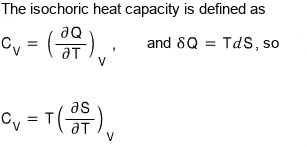
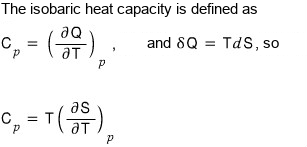

Let’s write that down and keep it handy~~
Alright, so now at last we’re going into susceptibility. If you look up the word susceptibility in a dictionary, it means ‘sensitivity’.
Huh?~?~?~ What’s sensitive??? No, no, let me put it this way:
What is sensitive to what?
The definition of susceptibility here is precisely: ‘the sensitivity of volume $V$’. It’s about how sensitively the volume $V$ reacts to some change~ that’s what it is.
Well then, what change does the volume $V$ react sensitively to!?
What we look at is the sensitivity of volume $V$ to changes in temperature $T$ and pressure $p$!
Again, again: “Depending on the substance, the volume’s sensitivity to a temperature change is different!!!” “Depending on the substance, the volume’s sensitivity to a pressure change is different!!!”
That’s the concept, and if we write it as a formula,
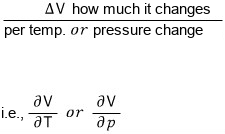
well, you could write it like this. For now we’ve only got a rough feel for the concept.
So now I’ll throw out the real 4 definitions of susceptibility:
- isobaric expansivity
- adiabatic expansivity
- isothermal compressibility
- adiabatic compressibility
Up above, a moment ago, I put it in this crude kind of way:  .
.
But the definitions coming in now aren’t the amount that $V$ changes by for a temperature or pressure change; they’re the “rate of change”, relative to $V$ itself.
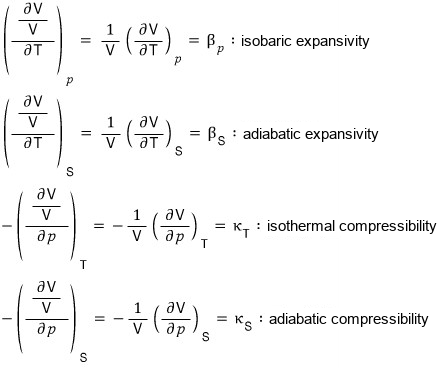
We’ve been playing with the 4 variables $T, V, S, p$ all along: when we differentiate $V$ with respect to $T$, the condition is that $S$ or $p$ is constant; when we differentiate $V$ with respect to $p$, the condition is that $S$ or $T$ is constant. That’s how they split into 4 in total.
And to add on: “adiabatic” means $\delta Q = 0$, that is, $TdS = 0$ (for a reversible change), that is, $dS = 0$ → $S$ is constant. So I’ve even added the bit about why “adiabatic” means you hold $S$ fixed when you differentiate.
Ex 16.5
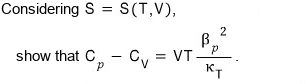
A quick look back at the real definitions above, the ones redone as ‘rates’:

doing it like this is what turns it into a rate of change! And then we wrote them with the meaning of ‘isobaric, adiabatic, isothermal’ packed in.
Since we were told to consider $S$ as a function of $T$ and $V$,
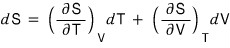
we can write this. If we differentiate both sides of that with respect to $T$, holding $p$ fixed,
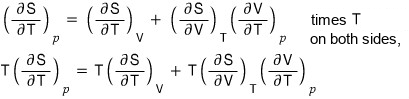

We organized this earlier, and if we apply it,
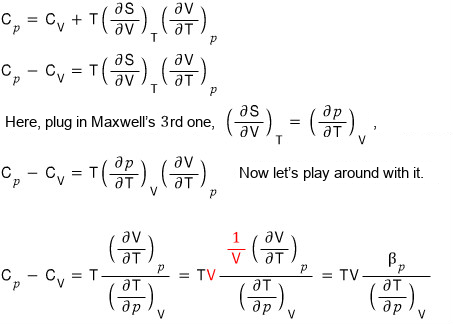
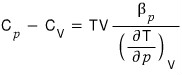
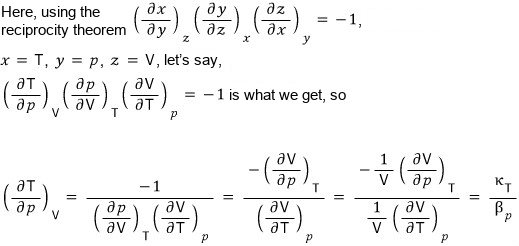
Therefore
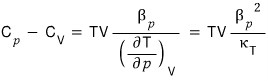
QED
Comments
Discussion happens via GitHub Discussions. You'll need a GitHub account to comment.