Chapter 16 Practice Problems
Working through Chapter 16 problems on the four thermodynamic potentials, Maxwell relations, and general identities using the reciprocity theorem.
Prob 16.1
a) Using the first law $dU = TdS - pdV$, write the definitions of the 4 thermodynamic potentials. That is, write the definitions of the 4 thermodynamic potentials $U, H, A, G$, and find $dU, dH, dA, dG$ in terms of $T, S, p, V$ and their differentials.
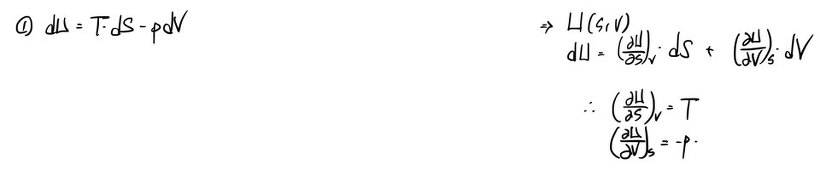
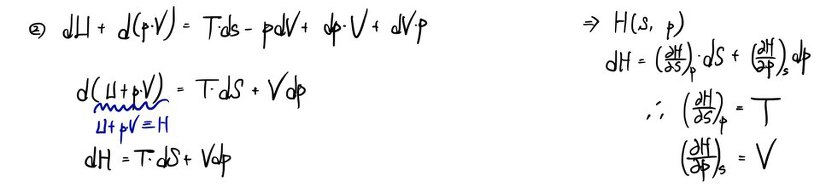
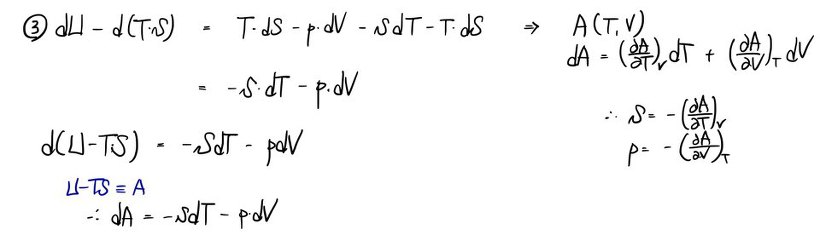
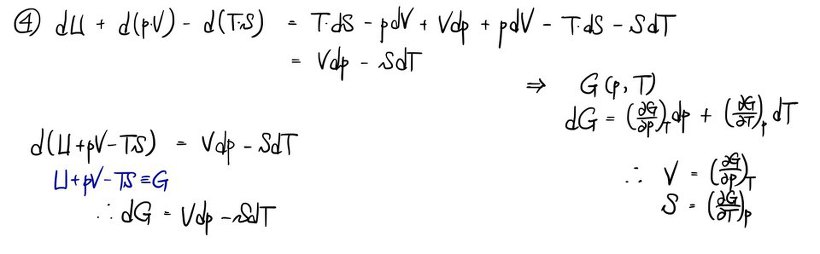
b) Derive all the Maxwell relations.
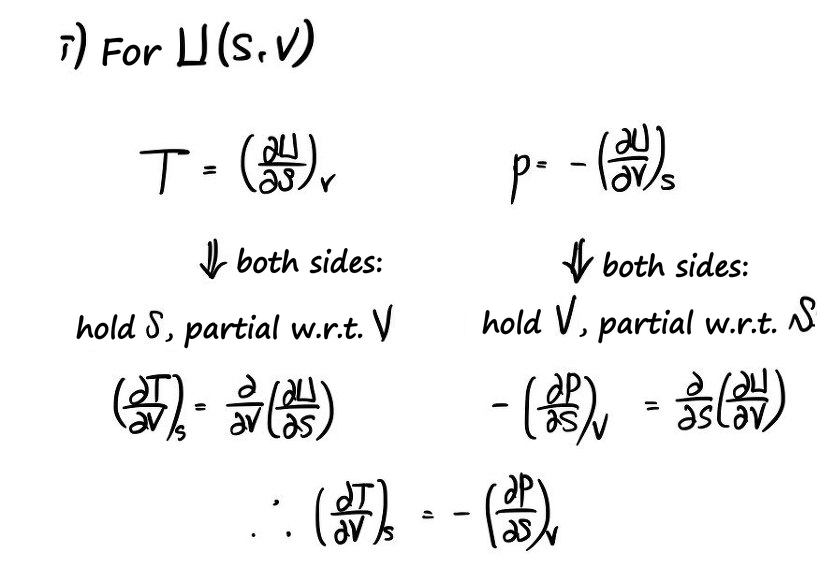
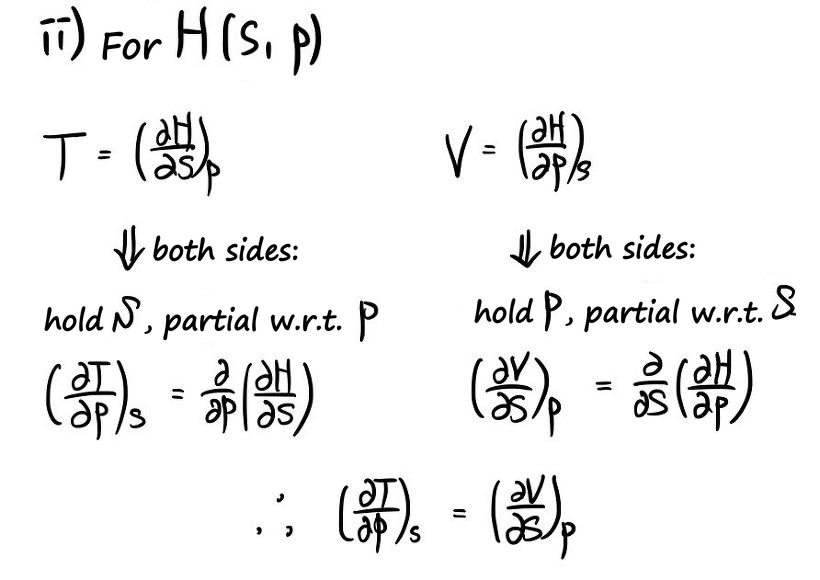
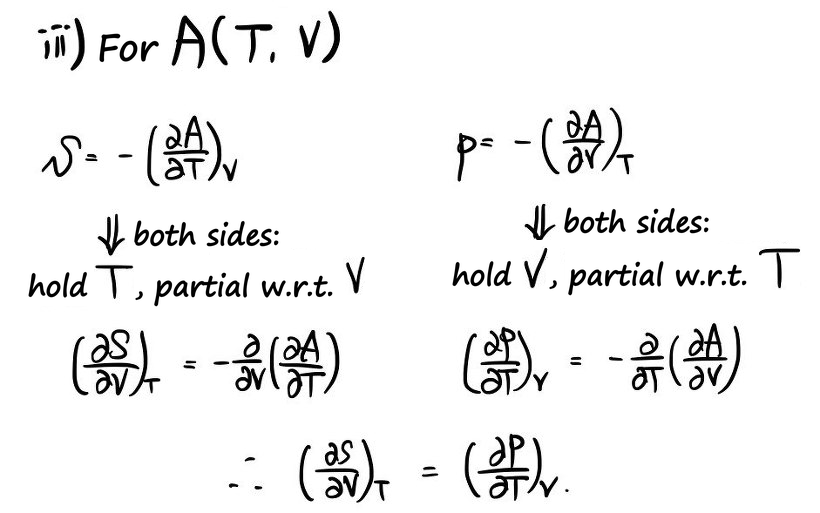
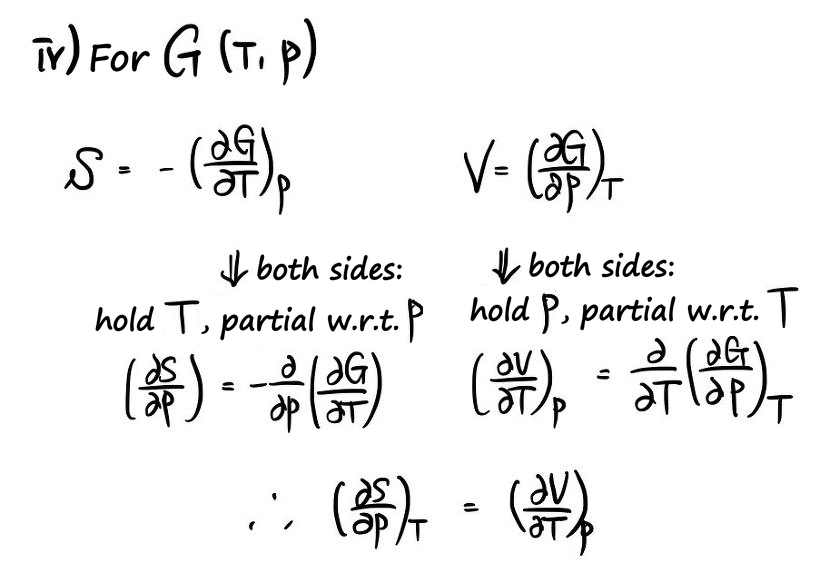
I derived these in detail in the Maxwell relations post, so I’ll just get away with photos here~
Prob 16.2
a) Derive the following general relation.
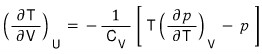
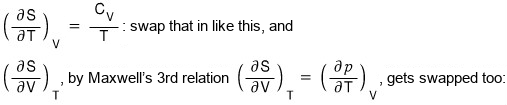
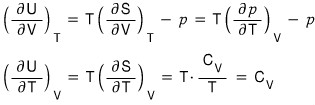
That is,
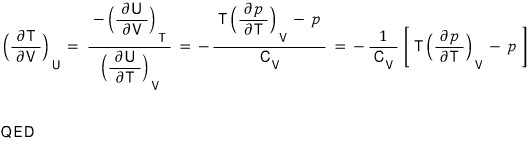
ii)

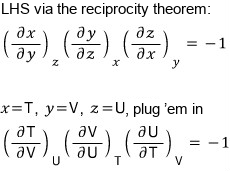
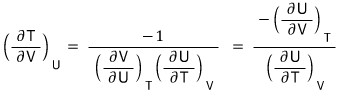
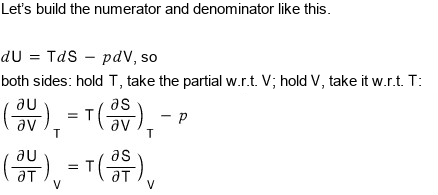
Let’s start by messing around a bit with the LHS,  , using the reciprocity theorem. (Because the RHS is a $pTV$ rotation, and Maxwell’s third relation connects a $pTV$ rotation with an $STV$ rotation, so I want to rotate the variables of the LHS first and then put the Maxwell relation to work!!!!)
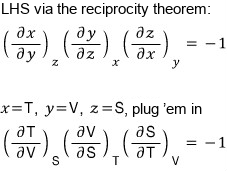
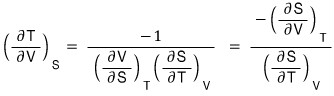

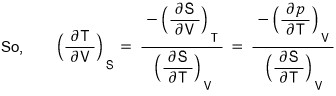
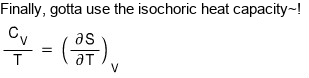
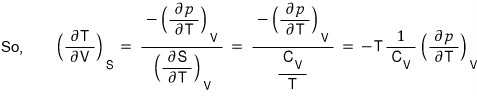
QED~
iii)

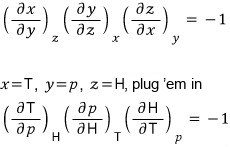
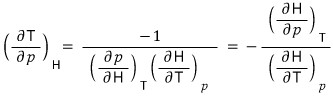
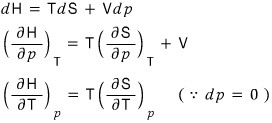
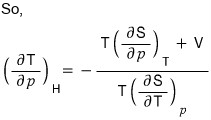
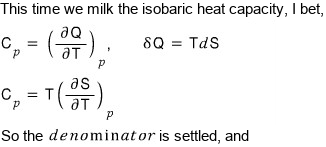
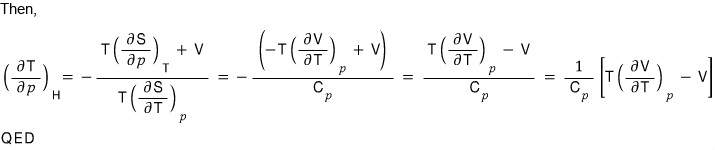
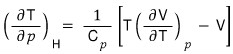
After doing a $T, p, H$ rotation, let’s use  , which come straight from $dH = TdS + Vdp$. So then, first let’s apply the reciprocity theorem to the LHS and rotate its variables a bit! (Not sure that’s a good way to put it) Rotate, rotate! hehehe

b) Using these relations, prove that for an ideal gas  and
and  .
.
(The 3rd problem,,,, what does it even mean to follow along an entropy line… T_T)
i)
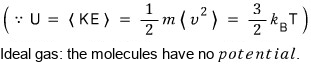
Holding $U$ constant means… for an ideal gas, $T$ is constant.
Therefore,
ii)
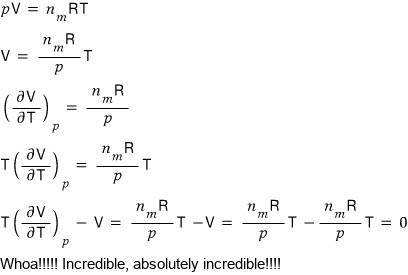
Since it’s an ideal gas, let’s use $pV = nRT$.
Prob 16.5
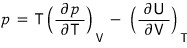
Using a thermodynamic argument, show that for any gas at temperature $T$, the pressure is given by
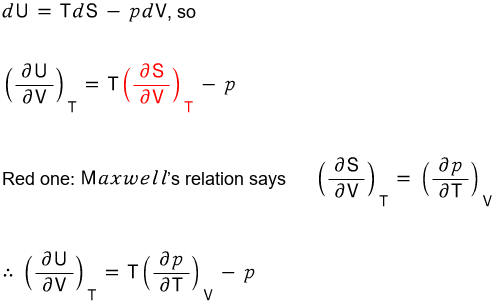
Huh?? It’s done???
Prob 16.3
Using the first law of thermodynamics, prove
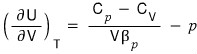
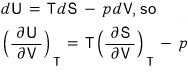

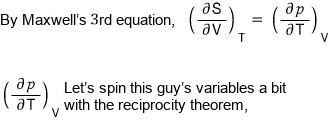
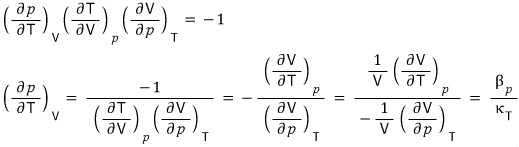
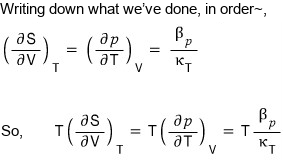

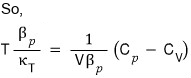

The proof is done, but,,, it feels unsatisfying….
Prob 16.4
The natural variables for $U$ are $S, V$. This means if we know $S$ and $V$, we can know $U(S,V)$. Show that this fact gives simple expressions for $T$ and $p$ as well.
Hmm? I don’t get what this problem wants…
Is it asking us to find $T$ and $p$ as functions of other variables too?
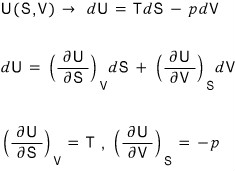
Or,
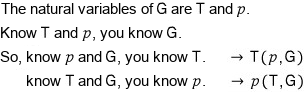
Is it this…?
b) Suppose instead that we know $V$, $T$ and the function $U(T,V)$ (that is, we have $U$ in variables that are not its natural variables). Show that from this we can derive an expression for $p$.
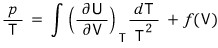
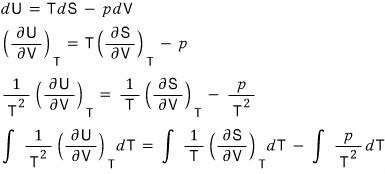
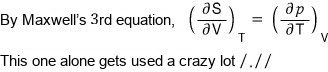
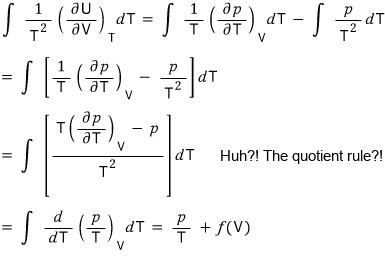
Since it’s the indefinite integral of something differentiated while holding $V$, what comes out is not a constant but a function of $V$~
Prob 16.6
For an ideal gas with constant molar heat capacity $C_p$, another expression for the molar entropy is

Show this.
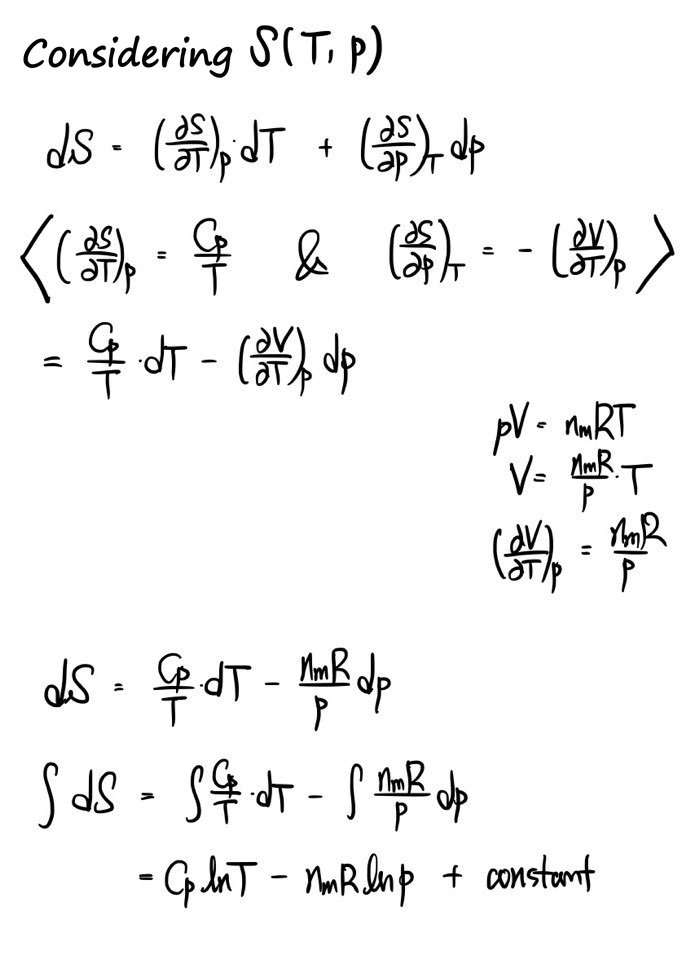
Heads-up. The figures here are the original notes, slips and all. A few things to watch for:
- In the handwritten derivation of $G$, the last line is $S = -\left(\frac{\partial G}{\partial T}\right)_p$, with a minus sign, since $dG = Vdp - SdT$.
- On the card for $G(T,p)$, the result is $\left(\frac{\partial S}{\partial p}\right)_T = -\left(\frac{\partial V}{\partial T}\right)_p$ (Maxwell’s 4th relation, as Prob 16.2 uses it later); the card drops the minus sign, and its left line also needs the subscript $T$.
- In Prob 16.2 b), $\frac{1}{2}m\langle v^2\rangle = \frac{3}{2}k_BT$ is the mean kinetic energy of one molecule; the whole gas has $U = \frac{3}{2}Nk_BT$, which still depends on $T$ alone.
- In Prob 16.2 iii), the intermediate line needs an overall minus: (∂T/∂p)_H = −[T(∂S/∂p)_T + V]/C_p. The final line032 has the right sign.
- In Prob 16.6, (∂S/∂p)_T = −(∂V/∂T)_p. The next differential already uses this minus. For molar entropy use molar C_p and R; for the whole gas use total C_p and n_m R. The log form assumes constant C_p.
Comments
Discussion happens via GitHub Discussions. You'll need a GitHub account to comment.