Bose-Einstein and Fermi-Dirac Distributions
Switching gears to talk about quantum distributions — what makes bosons and fermions different, and why spin and the Pauli exclusion principle totally change the game!
This time I’m going to switch up the order a bit and talk about distributions first. We’ve been dealing with ‘gases’ all this time, and we said gases follow the “Boltzmann Distribution”, right?!?! But in the quantum world, that distribution is a liiiittle different.
Bosons and fermions
First of all, for identical particles (particles that are the same, particles you can’t tell apart), quantum physics sorts them into two types: namely bosons and fermions.
So how do bosons and fermions get sorted?!?!!?!
A boson is a particle with integer spin. For example, the photon, with spin 1, or the spin-0 helium with two neutrons in its nucleus,  , are bosons.
And what’s called a fermion is a particle with half-integer spin: things like electrons, protons and neutrons, which have spin 1/2!!!!
Then the fundamental difference between having integer spin and having half-integer spin comes down to whether or not they follow the Pauli exclusion principle: bosons don’t follow the Pauli exclusion principle, and fermions do follow the Pauli exclusion principle!!!!
I’ll shoot the breeze about that for a bit, and then we’ll get into the real discussion!!!
Identical particles can’t be told apart
First off, identical particles are… identical, so you can’t tell them apart…. (well, duh… T_T) So what I mean is this → Two-Particle Systems and the Exchange Force (Quantum Mechanics I Studied #26)
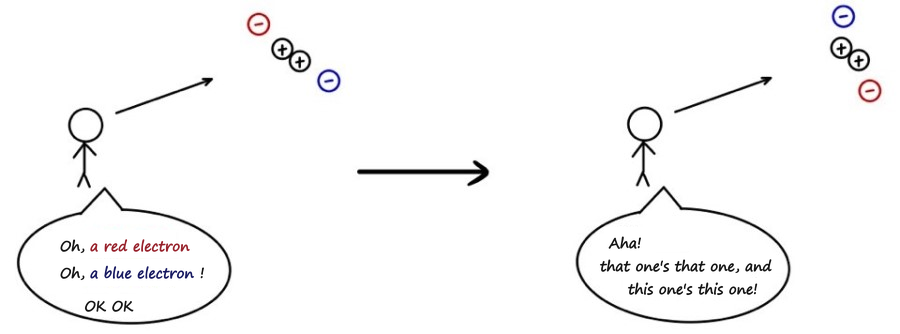
Not a situation like this,,,
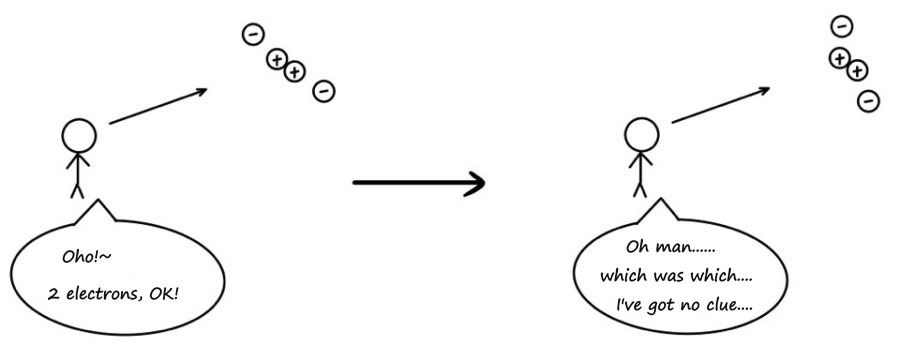
but a situation like this, is what I’m saying. That is,

this wavefunction and

these two wavefunctions just can’t be told apart at all.
Not being able to tell them apart means that the “probability density functions”, the squares of the two wavefunctions, are the same!!! That is,

that’s what it means, and therefore

is the conclusion we get.
You can also get to that equation with a different line of logic.
-
 and
and  being indistinguishable means
 -
the probability density functions of the two wavefunctions have to be equal, but
-
for that, do the two wavefunctions absolutely have to be the same?!?!?!
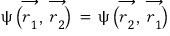
Do they have to be exactly equal like this?
-
No no, not at all. Even if the two wavefunctions only differ by a ‘phase’, we can still say the probability density functions are the same.
-
So

we can write an equation like this.
-
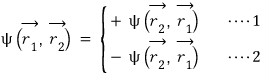
Exchanging twice must bring the same wavefunction back, so $e^{2i\delta}=1$. For the ordinary bosons and fermions here, the exchange factor is therefore $+1$ or $-1$.

That is, for the ’exchange’ that swaps the particles’ places, two things are possible.
Symmetric, antisymmetric and the Pauli exclusion principle
Equation 1 is called symmetric, and the particles with this property are exactly the bosons. Equation 2 is called antisymmetric, and the particles with this property are the fermions.
I won’t go into why bosons follow equation 1 and why fermions follow equation 2 here.
I’ll just point out how following equation 1 means not following the Pauli exclusion principle, and following equation 2 means following the Pauli exclusion principle.
Let’s say two particles can each be in $|0\rangle$ or $|1\rangle$. If the two particles can be told apart?!?!~~~ (distinguishable), then $|0\rangle|0\rangle$, $|0\rangle|1\rangle$, $|1\rangle|0\rangle$, $|1\rangle|1\rangle$, all 4 of these possible situations, will be a~ll ‘different’ states.
For two identical bosons, those 4 product configurations combine into 3 symmetric states. As occupation labels, we can write them as $|0\rangle|0\rangle$, $|0\rangle|1\rangle$, $|1\rangle|1\rangle$. But if those 3 follow the symmetric one, that is,
if they have to follow this, then $|0\rangle|0\rangle = |0\rangle|0\rangle$ and $|1\rangle|1\rangle = |1\rangle|1\rangle$ hold automatically, whereas $|0\rangle|1\rangle$ and $|1\rangle|0\rangle$ get fused into one state where both probabilities live together, $|0\rangle|1\rangle + |1\rangle|0\rangle$. Put in the normalization constant too, which makes the total probability add up to 1, and it’s $\frac{1}{\sqrt{2}}(|0\rangle|1\rangle + |1\rangle|0\rangle)$.
Alright alright alright, so the state functions of a two-level system that satisfy the symmetric wavefunction are these 3:
- $|0\rangle|0\rangle$
- $|1\rangle|1\rangle$
- $\frac{1}{\sqrt{2}}(|0\rangle|1\rangle + |1\rangle|0\rangle)$
Then what about the antisymmetric wavefunction,

if they have to follow this? $|0\rangle|0\rangle$ is impossible. For $|0\rangle|0\rangle = -|0\rangle|0\rangle$ to hold… um… what’s the only value of $A$ that makes $A = -A$ hold??? Only 0, right? So the antisymmetric combination $|0\rangle|0\rangle-|0\rangle|0\rangle$ is zero: two identical fermions cannot occupy that same single-particle state. It doesn’t exist. That’s what it means. Likewise, $|1\rangle|1\rangle$ doesn’t exist as an antisymmetric wavefunction either.
That is, this is what the Pauli exclusion principle, “no two of them can sit in the same quantum state”, was saying!
For two identical fermions in these two single-particle states, one must occupy each state. We subtract the probability amplitudes — not the probabilities — and normalize the result. The one allowed antisymmetric state is

just this one… hehe. That’s the end of the basic-concepts talk.
Into statistical physics
Now let’s go to statistical physics: on to the main topic, the Bose-Einstein distribution and the Fermi-Dirac distribution.
This difference has a huge effect on the statistics.
How does it make things different?!?!
Let’s see the difference by working out the partition function. To look at it in the mo~~st general way, we’ll consider it in the grand canonical ensemble. In the grand canonical ensemble, the partition function was defined as
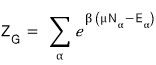
this. It’s important that α means an energy state.  you can think of as the number of particles in the α-state, and
  as the energy in the α-state.
<Don’t get mixed up about what α means. It’s not an energy level; it’s a state the system can be in, and $E_\alpha$ is that state’s whole energy, rotational energy terms, translational kinetic energy terms, quantum energy terms, the works~~!!!>
Alright, but first, let’s first consider one single-particle state of a noninteracting gas.
We have to count every case that single state can have. Let’s count every case: 1 particle in this one possible state, 2 particles, 3 particles,…. all of them. When there’s 1, $N$ is $N=1$, and the energy then is $E$. When there are 2, $N=2$, and since there are 2 of them the energy is $2E$. When there are $k$, $N=k$, and since there are $k$ of them the energy is $kE$. That is,
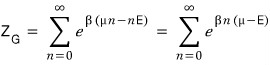
And the expected number of particles, $\langle n \rangle$, is

it tidies up like this, see?!?!?!
Alright, but if the particles are fermions, $n$ can only be 0 or 1: we said two or more can’t be in the same quantum state, right? So when the particles are fermions,
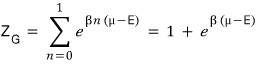
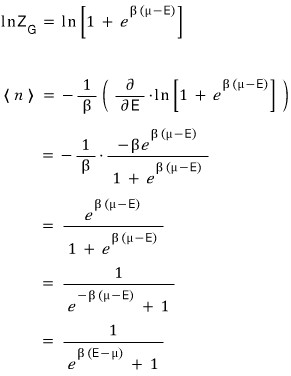
there’s the partition function for fermions!!!!! Now let’s find the expected number of particles.
On the other hand, when the particles are bosons, every $n$ is allowed, no discrimination. This geometric series needs $e^{\beta(\mu-E)}<1$, so $\mu\lt E$. So the partition function is
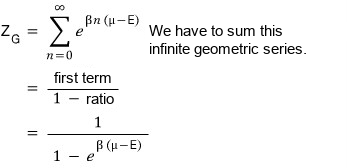
So now, to get the expected number of particles, I’ll take the log of that partition function, ~~~ hit it with a partial derivative with respect to $E$ ~~~~ and multiply by $-\frac{1}{\beta}$.
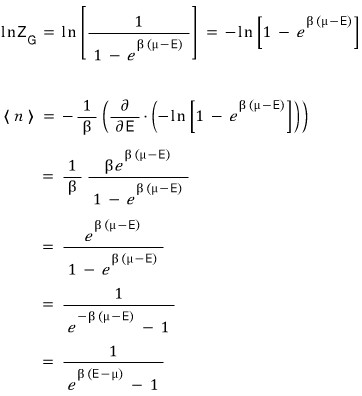
Eek!!! It came out almo~~st exactly the shape of the textbook Bose-Einstein & Fermi-Dirac distributions we already knew, right!??!?!!!
More generally: many states
Then this time let’s derive it a bit more generally!!~ I’m going to drop the assumption that there’s only 1 possible state and derive it again. The definition of the partition function
was this, and we said α means a state.
Now label the single-particle states independently of how many particles there are. A configuration has total particle number $N=\sum_i n_i$; $N$ fluctuates in this grand canonical ensemble. There’s state 1, state 2, state 3, . . . ., as many states as the model has, with  particles in state 1,
  particles in state 2,
  particles in state 3, and so o~~n down the line, and for any one configuration its total particle number is

that’s a true statement.
Alright, and a particle that goes into state 1 gets an energy of  , and there are particles there, so the energy from state 1 is
  . A particle that goes into state 2 gets an energy of
  , and there are particles there, so the energy from state 2 is
  . A particle that goes into state 3 gets an energy of
  , and there are particles there, so the energy from state 3 is
  , and so o~~~n down the line.
Thinking it through this far, the exponential in the partition function

will look like this kinda thing. But here’s the thing.
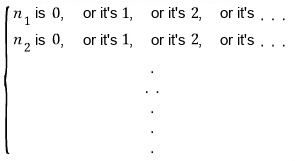
There are way too many cases to count~ Anyway….. there’s no escaping the fact that we have to count them all, so the partition function has to be written like this.

It’s not even a hard equation, but it’s so damn long it looks ready to smash your mental state to bits, when it’s nothing special at all -_- I’ll tidy the equation up so it looks nice, and then I’ll shut up and just drag the equations down the page.
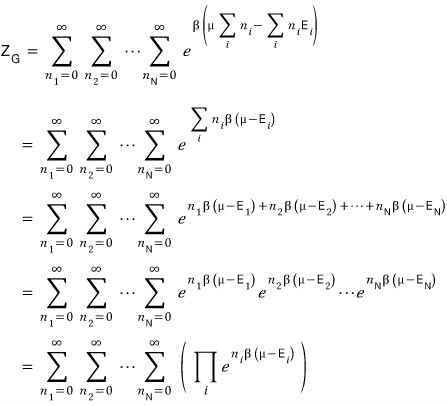
No problems so far, right….? T_T Then I’ll keep the shenanigans going. I’m not that bright, so I’ll go in as much detail as I can T_T
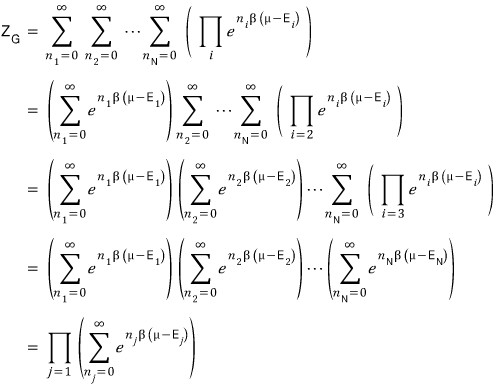
Done!!!!!! Once it’s tidied up like this, we’re done. Now all that’s left is to compute that complicated-looking thing above for fermions and for bosons. But it’s not complicated at all!!!~~
If the particles are fermions, the Pauli exclusion principle allows  to be only 0 or 1. So
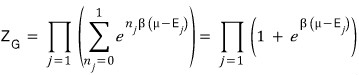
Then
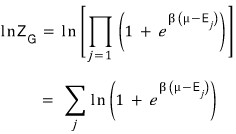
This time we don’t take the partial derivative with respect to $E$, but with respect to $E_j$. Out comes a relation for “the number of particles in each state”!!! lol
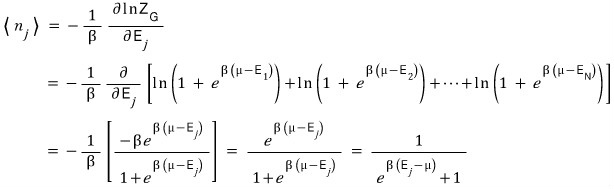
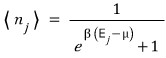
Reading off the meaning: for particles and a system at temperature $T$ with chemical potential $\mu$, we can say that on average there are that many fermions in the $j$-th state!!!!
Let’s do bosons too.
Bosons have no limit on the number of particles in each state, so the partition function has to go through this calculation.
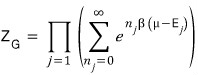
So we have to work out an infinite geometric series again.
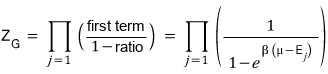
That is,

So the expected number of particles in each state is
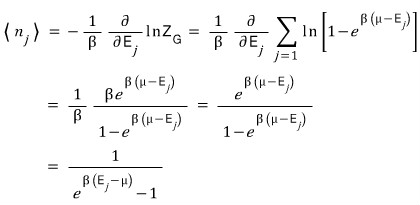
Reading off this one’s meaning too: for particles and a system at temperature $T$ with chemical potential $\mu$, we can say that on average there are that many bosons in the $j$-th state!!!!~~~
La-la-la~~~
Heads-up. The figures here are the original notes, slips and all. A few things to watch for:
- In the many-state derivation, the last state index is a count of single-particle states, not a fixed particle total. Each configuration has N = Σ_i n_i, and N fluctuates; the grand-canonical occupation sums are unrestricted. The Bose geometric series also requires μ below the lowest single-particle energy.
Comments
Discussion happens via GitHub Discussions. You'll need a GitHub account to comment.