Black-Body Radiation Energy and Spectral Radiance
Breaking down the blackbody energy formula to understand spectral radiance and why red-hot iron glows red while scorching-hot iron shifts to yellow.
Alright, time to wrap this up. Let’s finish it off quickly.
What are we doing this time? You all remember that Super Saiyan bit I pulled back in the intro of The Stefan-Boltzmann Law (Thermal & Statistical Mechanics I Studied #49), right?
High-temperature objects: why does the red-hot iron you can see at POSCO give off red light, and why does f-ing hot iron give off yellow light?
Let’s look at that with our formula and wrap things up.
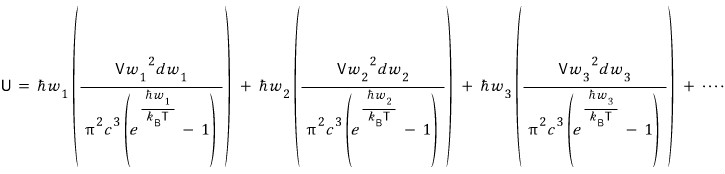
So, our formula…. Let me bring back the formula we derived in the previous post. The total energy of the thermal radiation inside a blackbody is
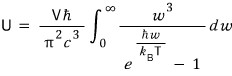
What this formula is saying right now is: the total energy $U$ of the thermal radiation is “some sum”. The bit whose angular frequency is  , the bit that’s
  , the bit that’s
  , . . . add up infinitely many of these and that’s the total energy.
So if I write it out just a little,

But let me write it like this:
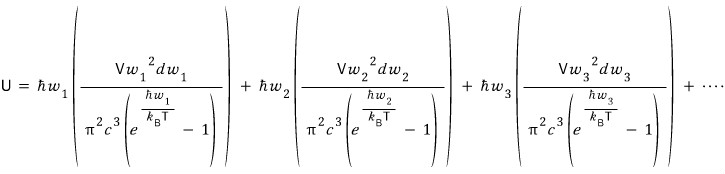
Written this way, what does it say?
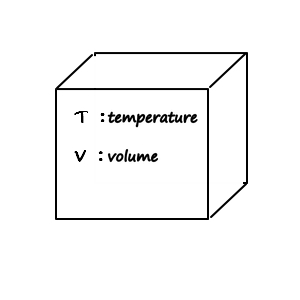
The total energy of the radiation in a blackbody of volume $V$ and temperature $T$ is
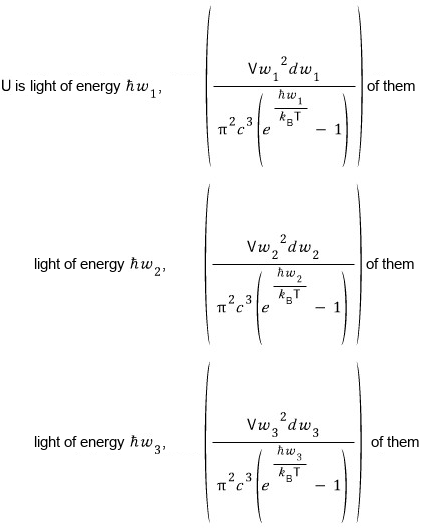
— it’s the sum total of things like these.
Then per unit volume, there’d be just those amounts with the $V$ taken out, right?!

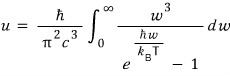
Writing it this way does the trick.
Switching w over to λ
But now let’s switch every $w$ over to $\lambda$.
What relations am I going to swap into the formula above?

These ones. I’m going to swap everything using these relations. Oh, and the range that went from 0 to infinity now goes from infinity to 0.
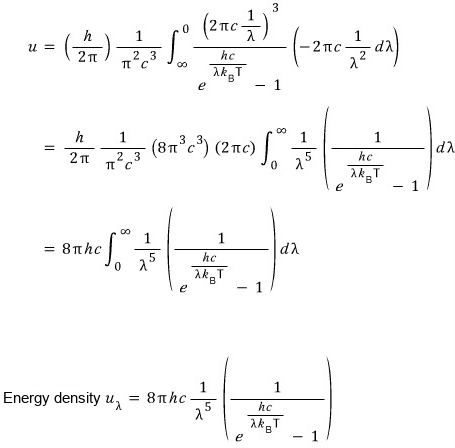
And if you graph this energy density formula, changing the temperature a little at a time, you get exactly this shape, the graph everyone has seen somewhere at least once.
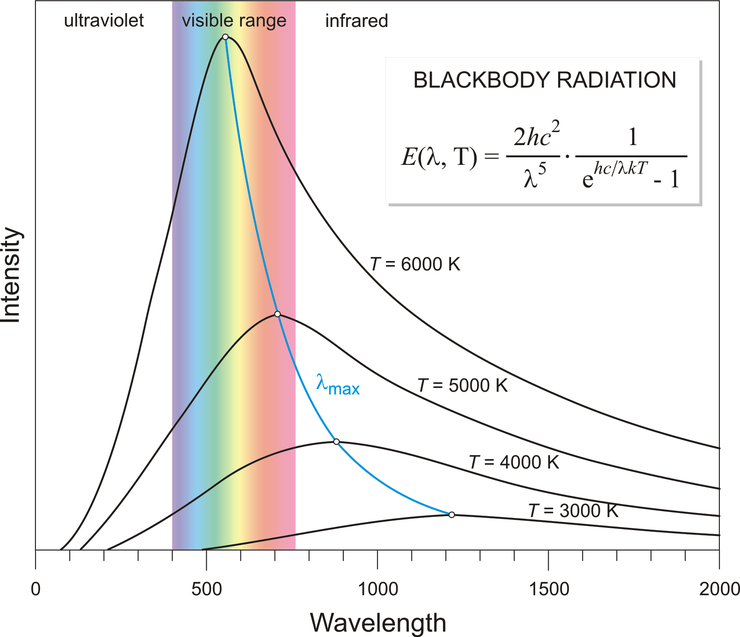
(source: http://glossary.periodni.com/glossary.php?en=blackbody+radiation )
The picture comes with a formula too, and it’s not the same as ours, right?! Now let me finish getting to that formula, explain the graph just a bit more, and wrap up.
One beam of light
Right now our formula is “per unit volume”.
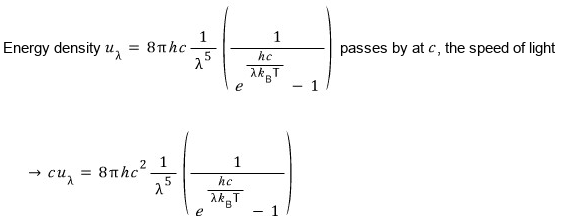
For isotropic cavity radiation, that amount is shared uniformly across directions. To get the value per unit solid angle — what our “one beam” picture is getting at — we divide by $4\pi$.
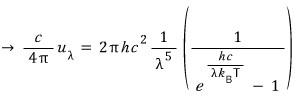
Here’s what “one beam of light” means, in a picture.

Out of all those many, many beams of light, out of all of them~~~~~
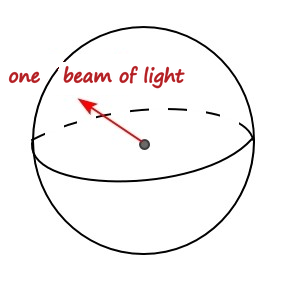
one single beam of light lol. Got it?!
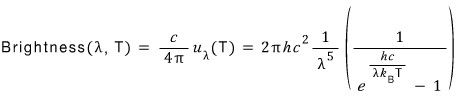
So that much, right there, is the surface brightness, or spectral radiance: power per projected area, per solid angle, per wavelength interval.
And this is the formula on that graph, so when we look at the blazing iron glowing at POSCO, the light we see should follow that formula… hehe?
Ahhhh, for reference, I covered solid angle in a bit more detail here: Ideal Gas Equation of State and Pressure (Thermal & Statistical Mechanics I Studied #11). Even that post’s very first picture is a solid angle lol
Reading the graph
So now I’ll do a quick reading of the graph, and then I’m off to fill out my application to switch majors. I think quitting physics is the answer lol. You smart kids can have it all to yourselves heh
If I sketch the graph above quickly in MS Paint,
what the heck, why does the red look like a sickly red -_- argh!!
Anyway. $T^*$ is the lower temperature, right?! What it’s saying is that at the lower temperature, the energy density has more of its light in the longer-wavelength band, so it holds the most light at $\lambda^*$. That’s why, to our eyes, the hot iron first looks re~~~d.
But according to the energy density formula, at a temperature $T^{**}$ higher than $T^*$, it holds the most light in a shorter-wavelength band.
So the light it holds the most of has the shorter wavelength $\lambda^{**}$, hehe. So to our eyes, the hot iron looks blu~~~e……. Huh?! Have you ever seen that?! It can look ye~~~llow as the visible mix broadens. We see that whole mix, not just the wavelength at the peak; still higher temperatures can look white or bluish-white.
I don’t need to tell you that the shorter the wavelength, the more energy per photon, right? Because if you’ve read this far, lol, you must be smarter than me….
I’m off to the department office now, bye-bye!
Heads-up. The figures here are the original notes, slips and all. A few things to watch for:
- In $\frac{c}{4\pi}u_\lambda$ and in Brightness$(\lambda, T)$, the $\pi$ in front of $hc^2$ should not be there: $\frac{c}{4\pi}\cdot 8\pi hc = 2hc^2$, so the radiance is $\frac{2hc^2}{\lambda^5}\cdot\frac{1}{e^{hc/\lambda k_BT} - 1}$, exactly the formula printed on the graph. The version with $2\pi hc^2$ is $\frac{c}{4}u_\lambda$, the power per unit area leaving a black surface.
- The borrowed graph is a sketch: by Wien’s law, $\lambda_{max}T = 2.898\times10^{-3}\ \mathrm{m\cdot K}$, the peaks for 6000, 5000, 4000 and 3000 K sit at about 483, 580, 724 and 966 nm, a little left of where they are drawn.
Comments
Discussion happens via GitHub Discussions. You'll need a GitHub account to comment.