The Bose Integral
Walking through the proof of the Bose integral — Taylor-expanding the tricky fraction, subbing variables, and tying it all together with the gamma function and the Riemann zeta function.
Anyway, I’ll now go ahead and prove the Bose integral, which was needed when deriving the Stefan-Boltzmann constant. Back then, I said I’d prove the integral later but just slammed it in straight from a table, so anyway, I’ll sort it out this time.
So what kind of integral did I need back then?

This was what I needed. We take real $n>0$, so the integral converges at zero too. First of all, I’ll Taylor-expand  .

I was going to use this, but it doesn’t work as is, so I’ll change the form a bit.

Yo, now I can do the Taylor series expansion.

So the Bose integral becomes
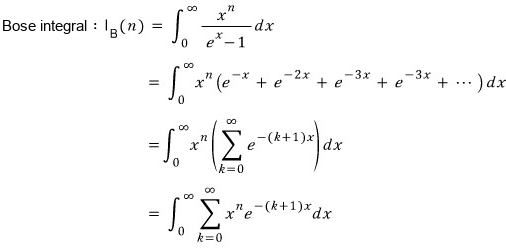
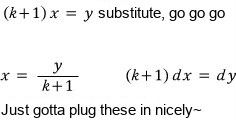

So it gets tidied up like this, and first off, the red part is the gamma function.
I wrote up the gamma function over here → Stirling’s Formula and Stirling’s Approximation (Thermal & Statistical Mechanics I Studied #1), nyah-nyah-nyah~~~

It had these properties~~~
And the blue part, the factor in front, is the Riemann zeta function.
The Riemann zeta function is

defined like so. If I write out a table of the Riemann zeta function,


that’s what it looks like, apparently.
I’ll post about the Riemann zeta function in more detail later.
I guess now we can just say it’s not even scary lol (they make undergrads do this, so it must be doable….)
Alright, so the Bose integral above now gets tidied up like this.

So the integral that was needed when deriving the Stefan-Boltzmann constant

ended up like this… hehehe
Heads-up. The figures here are the original notes, slips and all. A few things to watch for:
- In the expanded series (and the second line of the Bose-integral derivation), the fourth term is $e^{-4x}$, not a second $e^{-3x}$: $e^{-x} + e^{-2x} + e^{-3x} + e^{-4x} + \cdots = \sum_{k=0}^{\infty}e^{-(k+1)x}$.
- The gamma function is $\Gamma(n) = \int_0^\infty x^{n-1}e^{-x}\,dx = (n-1)!$, with a minus sign in the exponent (with $e^{+x}$ the integral would blow up); the derivation itself uses the right $e^{-y}$, and the result $\Gamma(n+1)\zeta(n+1)$ stands.
Comments
Discussion happens via GitHub Discussions. You'll need a GitHub account to comment.