Van der Waals Gas Equation of State
We crack open two ideal gas assumptions — molecular size and intermolecular forces — to build the Van der Waals equation of state from intuition up.
Now we’re going to step outside the ideal gas.
There’s a gas model that breaks two of the ideal gas’s assumptions. This model shows up in the high-school Chemistry II textbook, gets taught in freshman general chemistry in college, and lots of other fields teach and use it too: it’s the “van der Waals gas.”
So which 2 of the ideal gas’s 5 assumptions does it smash?
The first is the size of the gas molecules. The second is the interaction force between the gas molecules.
For reference, something I should say before we go in: here we are NOT saying we’ll deal with real gases. We’ll deal with the “van der Waals gas,” which isn’t a real gas: it’s the ideal gas with two of its assumptions opened up. But no need to be discouraged! Opening up just those two assumptions already lets us explain really important things that actually happen and that the ideal gas couldn’t explain ^^
So we’re going to think about how the original ideal gas equation of state,  , gets transformed.
Going by intuition
First, let’s go by intuition. To start with, was the equation for $n_m$ mol of ideal gas in a container of volume $V$, at temperature $T$ and pressure $p$.
But let me write it as  and think about
  first.
What does it mean to split the total volume $V$ into $n_m$ equal parts?
It’s the volume that 1 mol of the ideal gas takes up, out of the total volume $V$. This is called the molar volume, and  is how I’ll write it.
Now, the volume that 1 mol of ideal gas takes up, we can say, is set by  , and the van der Waals gas will take into account the size that the ideal gas ignored. So in the has to be read a bit larger, as you can see.
Think of it as taking the size into account and, at the same time, the repulsion that comes with it.
Because the bigger the gas molecules are, the more volume 1 mol takes up, even if only a little, y’know. So that was a quick look, by intuition, at how the ideal gas equation of state should change.
Now let’s think lightly about the interaction, by intuition too. Of attraction and repulsion, let’s do the attraction first.
At very short distances, repulsion dominates; farther apart, attraction can dominate. The power-law sketch  is only a rough picture — see the note at the end. For now, let’s isolate the attractive correction to the pressure.
So, looking at the attraction alone, in the ideal gas equation of state the $p$ has to be read a little smaller!!!! Right??? We’re suddenly switching on an attraction we’d assumed wasn’t there, so the kids will run wild a little less.
Okay, that’s it for this kind of intuition. Let’s think just a teeeeny~~~ bit more.
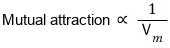
If the volume 1 mol takes up is large, do the gas molecules feel more mutual attraction?!
The molar volume tells us how much room each mole has, not how big the molecules themselves are. So let’s compare the same molecules spread out with the same molecules packed closer together. Read the two sketches as a reminder of that spacing, rather than a comparison of different molecular sizes.


With the same molecules packed closer together, the attractive pressure correction becomes larger.
That is, we’ve confirmed this:
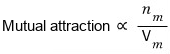
And doesn’t the mutual attraction have something to do with the “number of moles” too??
The bigger the crowd, the more mutual attraction they’ll feel.
Confirmed up to here. Also also also also also, the smaller the total volume, the more mutual attraction they’ll feel!!! (It’s like splitting density into two steps.)
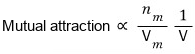
That’s as far as we’ve thought it through. Now let me tidy it up.
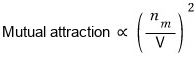
Now let’s call the coefficient that turns that proportionality into an equation $a$.
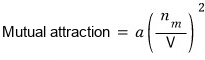
In the original ideal gas equation of state , the pressure $p$ is  , and let’s read the pressure smaller by subtracting the mutual attraction.
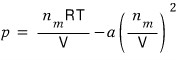
That’s our correction: reading the pressure smaller like this.
Let’s correct the volume for the repulsion too.
From what we’ve thought so far, the volume is
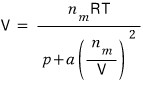
and here’s what I’m going to do to it: add the effect of $V$ getting a bit bigger because of the repulsion. As I said before, the repulsion only shows up when the molecules, the particles, get ridiculously close to each other, so we’ll say the repulsion depends only on the number of moles. And calling the coefficient $b$,
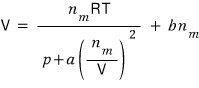
we correct it just like this.
※Caution※ We are not discussing a real gas right now; we’re discussing the van der Waals gas.
So the van der Waals equation of state is
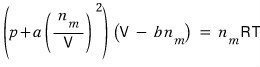
or
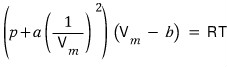
— two equivalent ways to write it, apparently!!! hehe
The statistical-mechanics way
Since this is statistical mechanics class, let’s also derive the van der Waals equation of state the statistical-mechanics way before we move on. The partition function of $N$ ideal-gas molecules is

But here, just like the correction above, I’ll replace $V$ with $V - bn_m$.
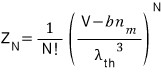
But this partition function only speaks for the “translational motion”!!!
Unlike the ideal gas, the van der Waals gas doesn’t only have the kinetic part; it has a force of its own. (That force definitely means there’s an energy, and that energy will show up in the Hamiltonian!) That force is the mutual attraction!!!

Yup, we did take this into account, didn’t we~
Huh, but?! It’s still a “force” (a pressure, really), so it isn’t an energy. Let’s integrate it over volume. Since pressure × volume → energy, the volume integral of the mutual attraction “force” can be called an energy.
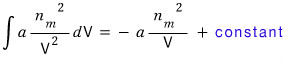
Argh, the constant term I colored blue is the energy when the volume goes to infinity (the molecules infinitely far apart). Let’s say that energy is zero and not think about it… (to protect our mental health)
So it holds  worth of energy, and by the definition of the partition function, the partition function for this energy is
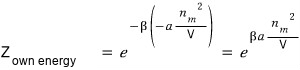
That is!!! The total partition function is the product of the partition functions of each part!!!
You remember, right?!
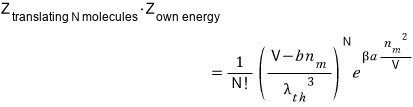
Now let’s play with that partition function a bit and derive our way to the van der Waals equation of state!
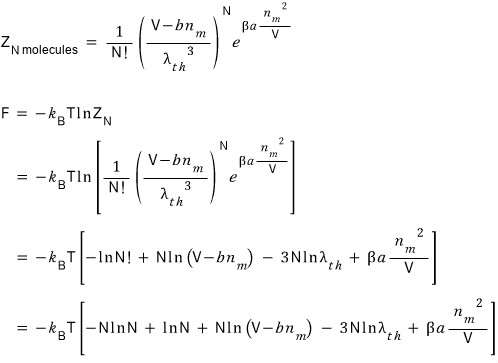
Back when we did the Maxwell relations, we had 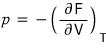 , remember~?
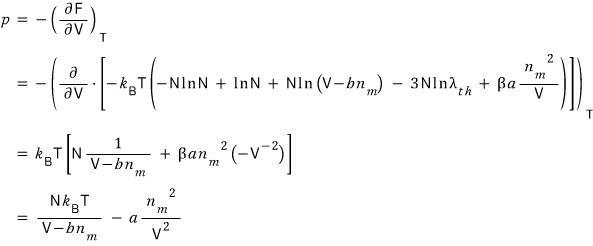
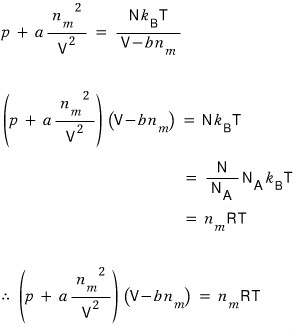
Yololo~~~~~
Heads-up. The figures here are the original notes, slips and all. A few things to watch for:
- In the picture of the intermolecular potential, the repulsion is drawn as $1/r^4$ to $1/r^8$; the usual model (Lennard-Jones) takes the repulsion as $1/r^{12}$ and the van der Waals attraction as $1/r^6$.
- By Stirling’s approximation, $-\ln N! \approx -N\ln N + N$, not $-N\ln N + \ln N$; the term does not depend on $V$, so the pressure that follows is unaffected.
Comments
Discussion happens via GitHub Discussions. You'll need a GitHub account to comment.