Critical Temperature, Volume, and Pressure of the Van der Waals Gas
We hunt down the van der Waals critical point, where two turning points merge and that wild dented p-V curve first begins to appear!
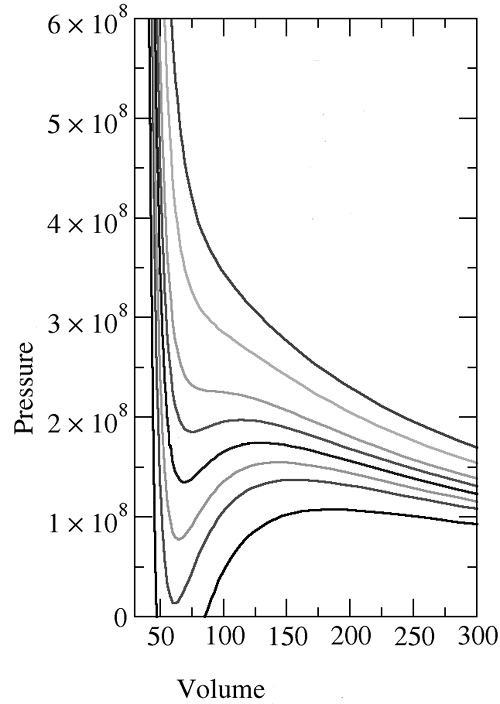
(source: http://www.fisicamente.net/A/index-1784.htm)
As you all probably know, for a van der Waals gas the p-V graph comes out like this as the temperature goes up.
Wait, but!!?!
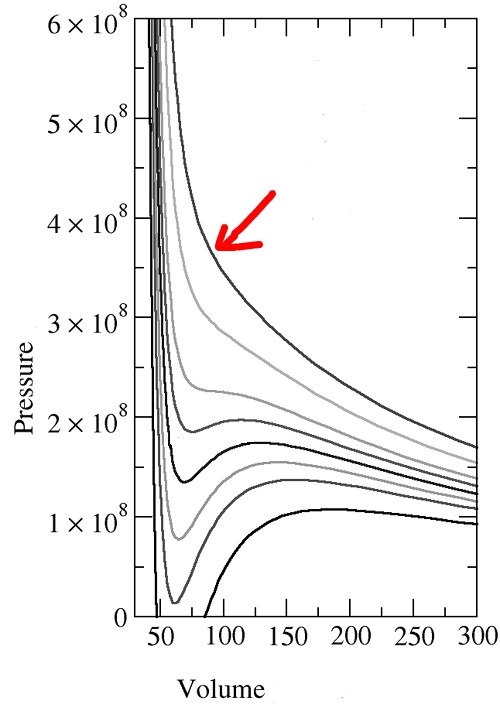
Of those, please look at the p-V line at the highest temperature!!!
This!!?! Doesn’t its downward-sloping shape look like the p-V graph of an ideal gas?!?! It is not exactly the same equation, though.
Behaving like an ideal gas means
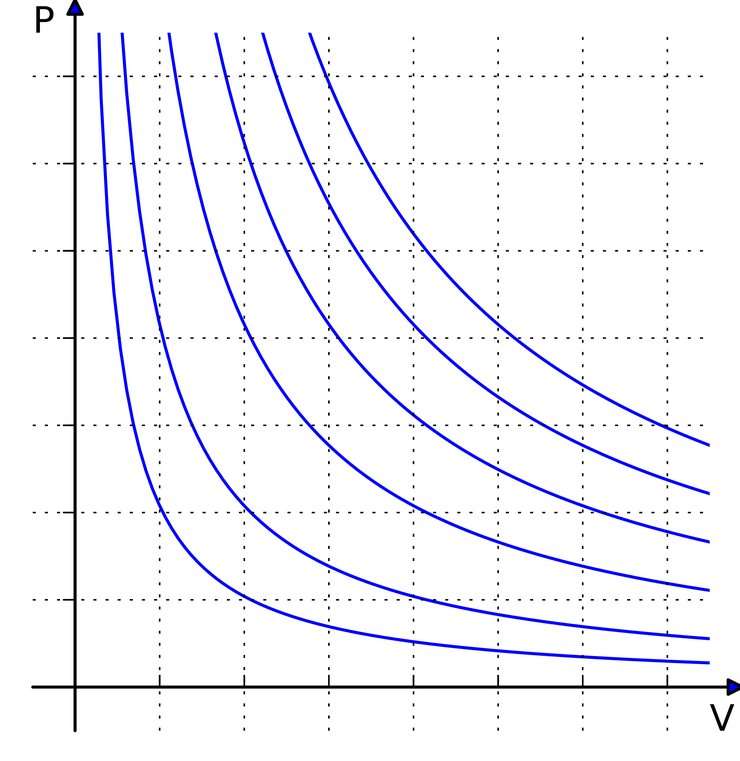
(source: https://en.wikipedia.org/wiki/Ideal_gas_law )
that the graph of $p$ against $V$ is an inverse proportion, which means the bigger the pressure gets, that is, the harder you push, the smaller the volume of the gas gets. That is,
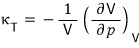
the “isothermal compressibility,” the percentage rate at which $V$ shrinks as the pressure goes up, is always positive.
But the van der Waals gas at not-so-high temperatures is different. There are stretches where $V$ gets smaller the harder you push, and there are stretches where $V$ gets bigger.
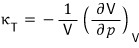
That is, the isothermal compressibility  has stretches where it is positive and stretches where it is negative. That negative-compressibility stretch is mechanically unstable; an equilibrium sample does not follow it as a stable uniform gas.
Its physical meaning gets revealed at the tail end of all this. But yes, it’s exactly what you’re all expecting.
So, what we’re going to look for from now on is this:
At what temperature do the two turning points first merge, before the low-temperature loop appears?!
We’re going to find that temperature!!!
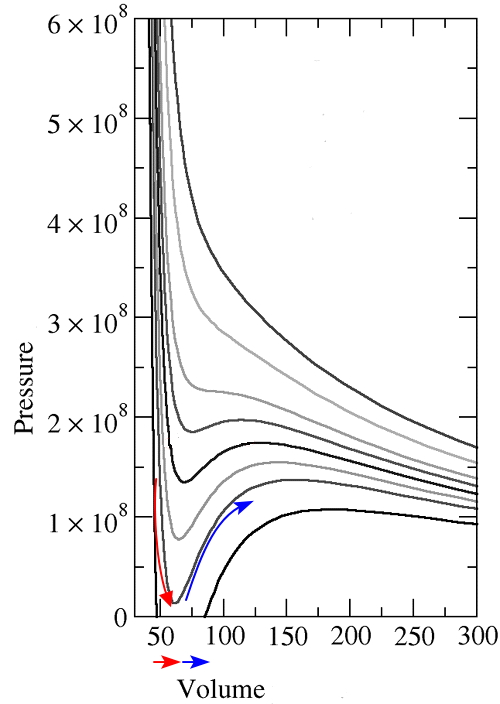
At sufficiently low density and high enough temperature, the van der Waals gas approaches ideal-gas behavior. Raising T alone does not force both p and V to become large.

What we need is bn_m ≪ V, so the excluded volume is small, and a(n_m/V)² ≪ n_mRT/V, so the attractive pressure correction is small too. Then both corrections can be neglected.
So it boiled down to $(p + {\sim}0)(V + {\sim}0) = n_mRT$.
Alright, and now let’s say the temperature goes down, down, down.
Then something like
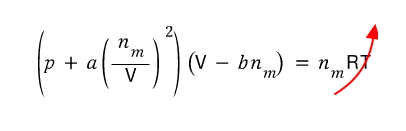
this dented part starts to appear at some temperature:  . A temperature like that is bound to come along.
Okay… for this one I figured a hand drawing would beat drawing it on the computer, so
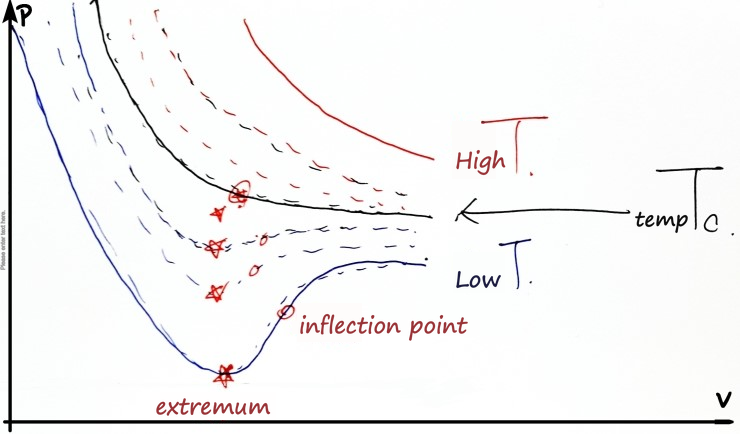
I composited it with the computer lol
Alright, anyway, we’re going to find that $T_c$. In the graph above, please start from the lowest temperature $T$, the one that shows van der Waals behavior.
At the temperature $T_c$, the local maximum and minimum merge into one horizontal inflection point!!!
That’s the condition I’ll use to find $T_c$. (When the inflection point and the extremum become the same, I’ll call that point $(V, p) = (V_c, p_c)$.)
Riiight at $V = V_c$, $p = p_c$, the first and second derivatives vanish together. That temperature is $T_c$: the boundary for this loop, not a switch to an exact ideal gas hehe
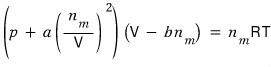
This one’s the van der Waals gas equation of state, and the extremum will be where  . So first I rewrite the equation for $p$, then smack it with a derivative in $V$.
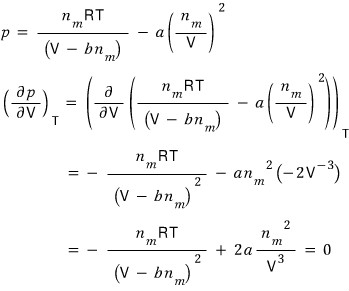
The inflection point will be where 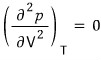 .
.
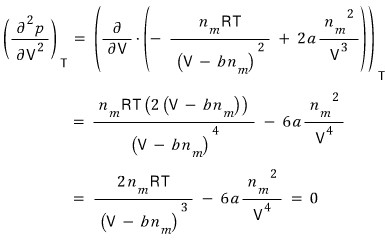
On the curve at temperature  , the point where the first derivative and the second derivative both become zero, we said, is
  .
.
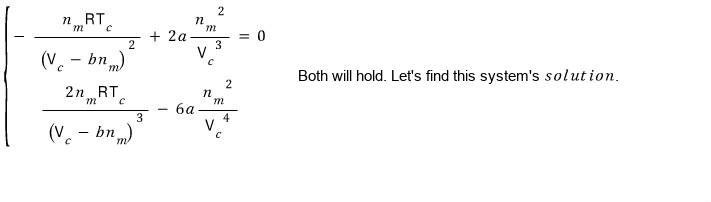
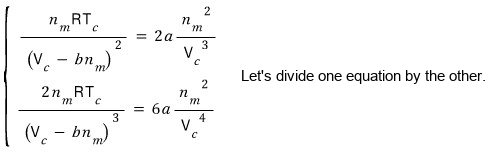
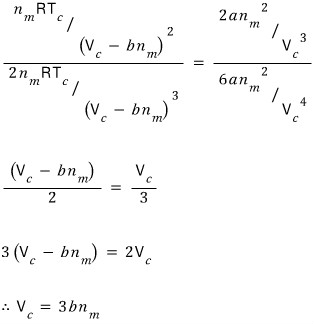
We got the critical volume $V_c$. Using it, we can find the critical pressure and the critical temperature too~
Where should we plug it in? Let’s plug it into the first-derivative equation.
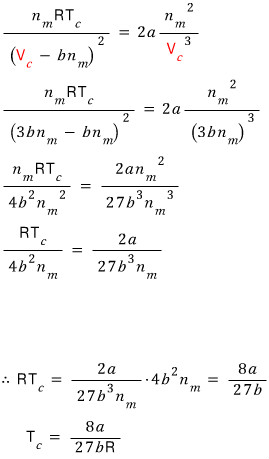
With the expressions for $T_c$ and $V_c$ we just got, let’s plug them into the van der Waals gas equation of state and find the critical pressure $p_c$ as well.
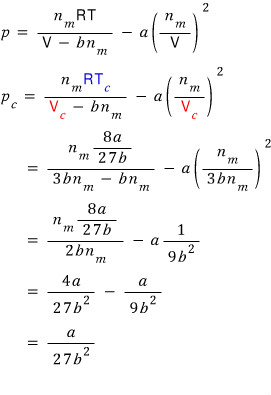
Wo~~~ow fwound them awl~~~ (sowwy)
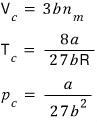
Ooh la la?!?! Looks like we could somehow tie these together into one?!?!
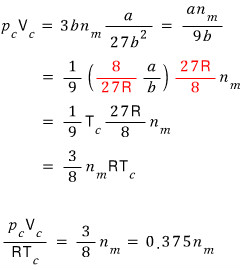
Heads-up. The figures here are the original notes, slips and all. A few things to watch for:
- The isothermal compressibility is $\kappa_T = -\frac{1}{V}\left(\frac{\partial V}{\partial p}\right)_T$, with the derivative at constant $T$, not $V$.
- In the system for the critical point, the second equation also ends in $= 0$: $\frac{2n_mRT_c}{(V_c - bn_m)^3} - 6a\frac{n_m^2}{V_c^4} = 0$.
Comments
Discussion happens via GitHub Discussions. You'll need a GitHub account to comment.