Superheating and Supercooling
We dig into what actually happens below T_c — using Gibbs free energy to figure out which state a system really lands in when the P-V curve gets all weird and dented.
We’ve been looking at where some system goes through its drastic change… So we found the “critical temperature”: the temperature where the two turning points of the van der Waals isotherm merge. It is not a switch between an ideal gas and a different gas. (Check out the previous post for that.)
And we got to guess that at temperatures lower than that temperature ($T_c$), some strange phenomenon happens that you’d never see if you thought of it as an ideal gas. So now let’s think about it like this.
Alright, fine. At temperatures below $T_c$, we get something we’ve never seen before:
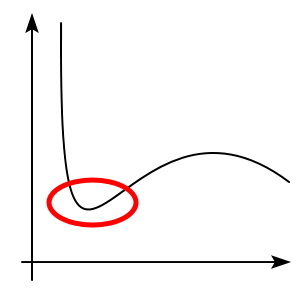
this sort of dented stretch shows up,…. But then, hold on??? This is a real head-scratcher.
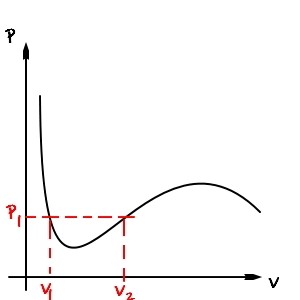
At “some given pressure,” is it supposed to be at $V_1$? Or at $V_2$?!
I doubt we’re talking about the mixed state from quantum mechanics here…..
At pressure $p_1$, which state should it pick?! The sketch is incomplete: $V_2$ is on the unstable rising branch, and the full curve also has a larger-volume gas branch. We need to compare the possible stable phases.
Looking at the Gibbs free energy
Here’s how we think about it! The question of “where the state of a system heads” is usually discussed with free energy, and that free energy heads to its minimum: isn’t that how we’ve been discussing it???? So I’m going to look at the Gibbs free energy.
First, what we have is the van der Waals equation of state,
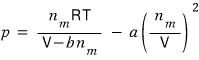
that’s what it is. From this equation I’ll derive the Helmholtz function, and then get the Gibbs function out of it.
(Wait, why derive Helmholtz and then look at Gibbs??? Because the Gibbs function is a function of $T$ and $p$: at a given temperature and pressure, it’s $G$ that heads to its minimum.)
How do we derive the Helmholtz function? Using the relation 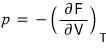 , we’ll get $F$ by integrating both sides. And we’ll get $G$ from $G = F + pV$.
Here we go.
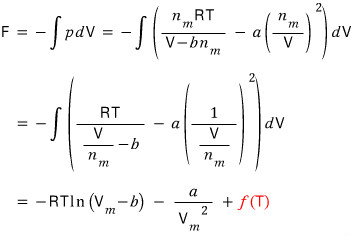
The red $f(T)$: since we integrated a partial derivative, there’d be a term in $T$ left over, so I just slapped it in there!! And $G$ is
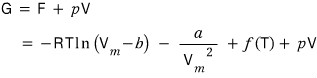
Now I’ve turned this equation into one that means “per 1 mol~”. And I’ll let $T$ be a temperature lower than $T_c$: $T = \alpha T_c$ $(0 \lt \alpha \lt 1)$.

(The red function isn’t important, so it usually gets ignored, apparently.)
If we express this function as a function of $p$, it gets drawn like this, apparently.
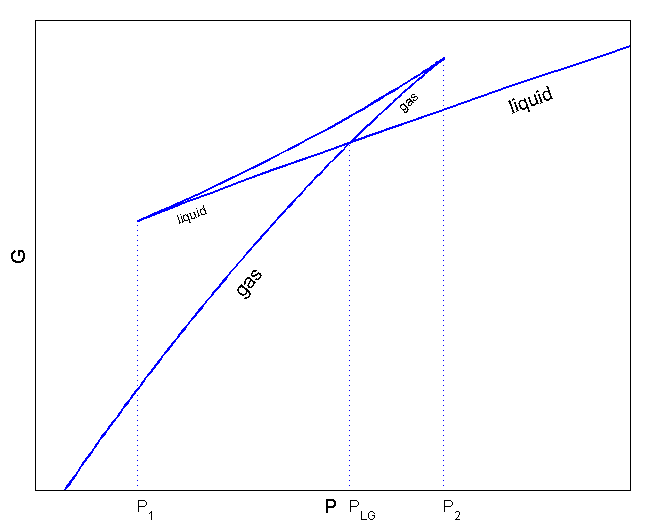
(source: Wikimedia Commons, Van der Waals GibbsP.png)

Ahh…… now we have to interpret this graph,…. um…. I’ll just keep it simple, heh heh heh heh. We have to put this side by side with the graph we drew above and talk while comparing the two.
But I went and found some good material. For the case $\alpha = 0.9$, I got hold of $G(p)$ and the $p$-$V$ graph, drawn in reduced variables!! hehe
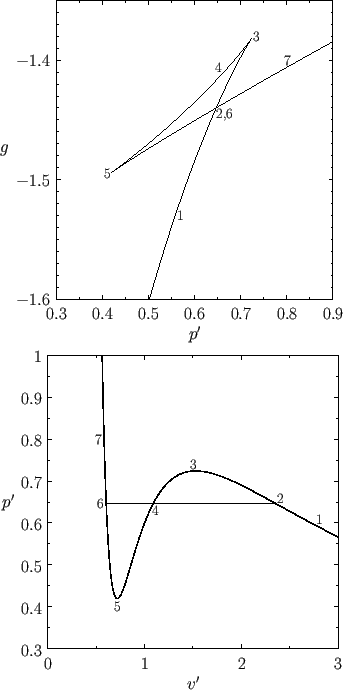
(source: UT Austin lecture notes on thermal physics)
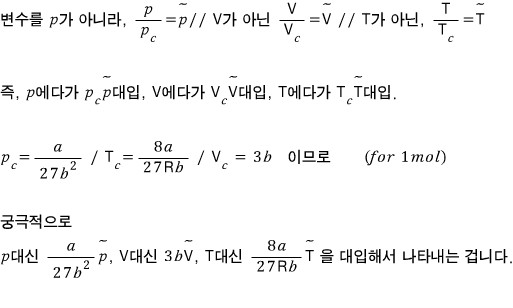
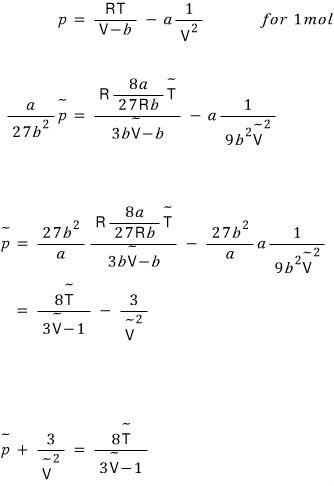
Here’s how you put in the reduced variables.
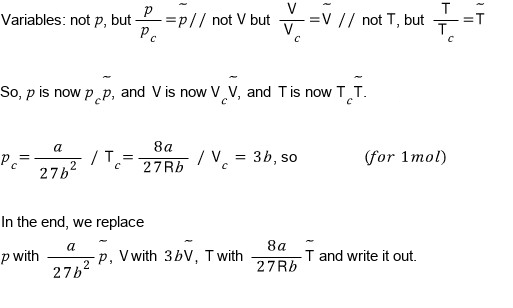
The van der Waals equation of state becomes this.
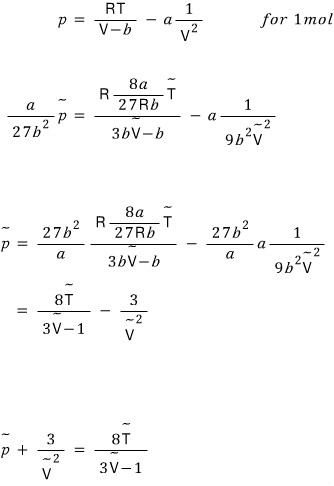
It turns into this. hehehe In the equation, $a$ and $b$ both fly away. Instead, the ranges of the variables change a bit. In other words, I think you can think of it as a kind of scaling.
Superheated and supercooled
Alright, anyway, so here comes the explanation. This part’s going to be fun.
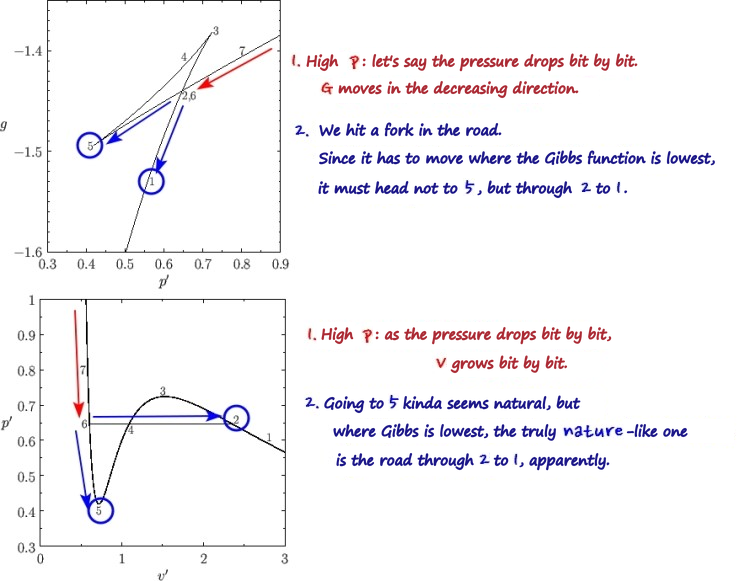
So, on the “truly nature-like” path 2, the volume suddenly jumps way up.
What on earth does this mean?!
It’s exactly a “phase transition,” right?! Yup, that’s right. Press really hard and it becomes a liquid; ease the pressure off gently and at some moment the liquid becomes a gas….
The “phase transition” that the ideal gas can’t explain, the van der Waals model can do!!!
Okay okay okay, so does that mean the path heading to 5 is completely impossible?!
Nope. It’s not impossible. Well then, let’s think about it.
Look closely: we learned that when the slope of $G$ changes at the fork, a phase transition happens. But if at the fork it heads straight~~~ on to 5, that would mean no phase transition happened. In other words, the liquid’s pressure keeps~ dropping and it should have gone poof!!! into a gas, but it’s still a liquid. We call a liquid like this superheated.
Now the other way: let’s go up. Up!
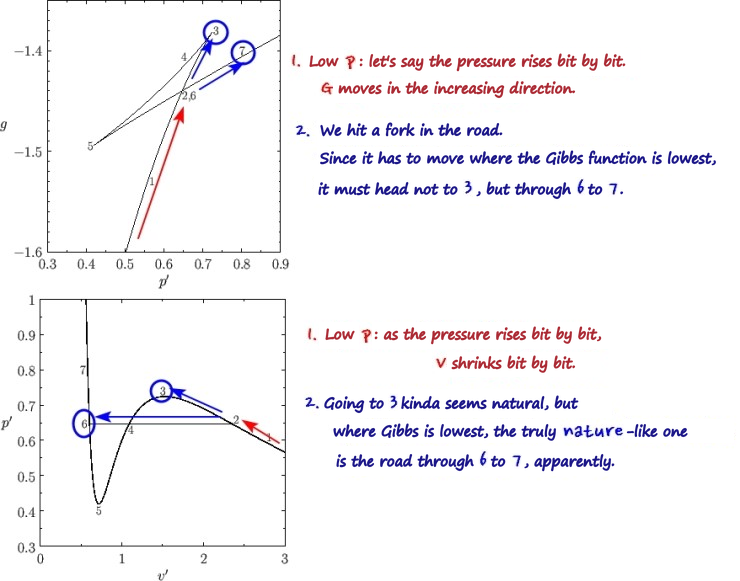
Then here too, the gas that stays on the metastable branch toward 3!!!! As you put on more and more pressure, somewhere along the way it should go poof!!! and, being a gas, turn into a liquid, but it’s a gas that hasn’t done that yet. A state like this is called supercooled, apparently.
Want to see supercooled water with your own eyes?!
Supercooled wadur is water that’s still liquid at a temperature where it should be ice. When it’s in this supercooled state, if you leave it alone~~~~ nice and quiet, it stays water for a long time, apparently. (Since it isn’t the state where the Gibbs function is at its lowest, it’s definitely not the stable state.)
But!!! If you give this water a little shock, that’s when the phase transition happens all at once, apparently!!! Whoa!!! See it with your own eyes!!!
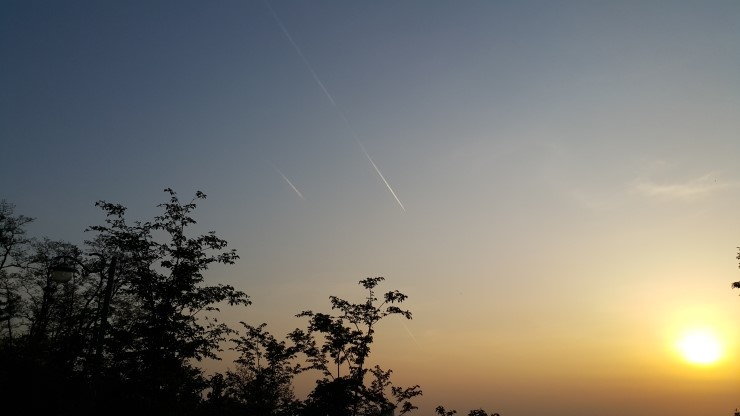
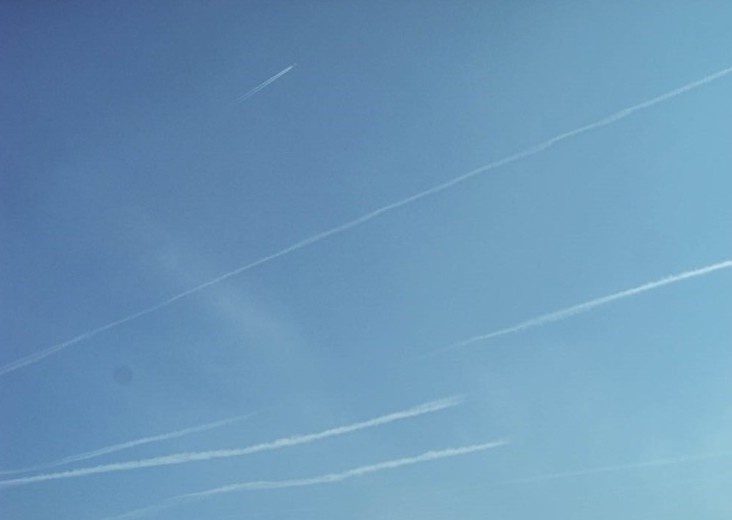
Turning into ice like this when a shock hits: we can see it above our heads too. When an airplane passes over your head, a white line appears, right?????
Those ordinary long white contrails form when hot, moist engine exhaust mixes with very cold air. Water condenses onto tiny particles, then freezes into ice crystals. How long the trail lasts depends on the surrounding humidity. So cool!!! That is different from a pressure jolt freezing a bottle of supercooled liquid water.
From here on, just read it for fun.
※Caution: fun※
Now let’s look at what happens when no shock is applied.
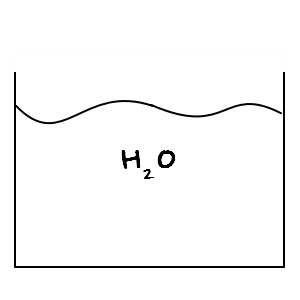
There’s water here, and if we keep lowering its temperature, it should become ice, right???? But when we take some water and lower its temperature, ice often starts forming around impurities or at the container wall, because these can make nucleation easier.
In other words, super super super super pure water apparently doesn’t go through the phase transition easily!!!
So!!! When it just won’t rain, a plane goes up into the sky, or a hot-air balloon goes up, or rockets get shot up, and up in the sky they spread dry ice  or silver iodide
  , apparently. In suitable supercooled clouds, silver iodide helps ice crystals nucleate; dry ice chills the air enough to create ice crystals too. These are ways to seed ice, rather than simply to condense water vapor hehehehe.
Then hold on, even for super super super super super pure water with absolutely no impurities, really nothing in it but H₂O, if the temperature drops way, way down, a phase transition has to happen, right?
But with no impurities around, which water molecule on earth goes through the phase transition first…..?
Okay okay okay
Let me zoom in on this part of the beaker and draw it. No matter how precisely a beaker is made, when you look at it under a microscope
it can’t avoid a shape like this.
One of those bumps acts “as if it were an impurity,” apparently!!!!
Ice can start growing next to a spot like that!!!! And if no effective surface or impurity gets it started, sufficiently cold pure water can still freeze by homogeneous nucleation in the liquid itself.
Heads-up. The figures here are the original notes, slips and all. A few things to watch for:
- In the free-energy pictures, the attraction term is $-\frac{a}{V_m}$ per mole, not $-\frac{a}{V_m^2}$: $F = -RT\ln(V_m - b) - \frac{a}{V_m} + f(T)$, which gives back $p = -\left(\frac{\partial F}{\partial V_m}\right)_T = \frac{RT}{V_m - b} - \frac{a}{V_m^2}$.
Comments
Discussion happens via GitHub Discussions. You'll need a GitHub account to comment.