Joule Coefficient and Joule Expansion of an Ideal Gas
Starting from the age-old puzzle of how to make things cold, we dig into Joule expansion: ideal gases keep their temperature, while attraction-dominated gases can cool!
Suppose you’ve been given an assignment to heat something up. You need to make some object hot. Then how would you make it hot??
You’d head straight for a lighter or a gas stove without hesitation, right? And if you don’t even have those, you’d do it like the first humans did: rub wood against wood and start a fire with the heat of friction. It was like that in the old days and it’s like that now: (unless we’re talking ultra-high temperatures) you use fire to heat up whatever you want to make hot.
Now then, back in modern times, what if you wanted to make some object “cold”???
How are you going to do it?? Leave it outside?? That just means you’ll let it come into thermal equilibrium at room temperature, 25°C, so what are you going to do when you want to cool it below 25°C?? You’ll use a refrigerator?!?!
Hmm… the refrigerator is probably the product of the question “how do we make things cold?” That is, to the question we’re asking now, “how are we going to make things cold?”, the right answer would be “I’ll build this thing called a refrigerator, blah blah blah!”
Is it starting to click now??? Since olden times, making an object hot (unless it’s ultra-high temperature) was never hard. But making something cold wasn’t easy back then and isn’t easy now. So the topic of this post is “cooling.”
Alright, first we’ll look at the Joule expansion of a gas. Not the Joule expansion of an ideal gas, but the Joule expansion of a real gas, because unlike the ideal-gas case, the Joule expansion of a real gas has to do with ‘cooling.’ First, then, let’s look at Joule expansion.
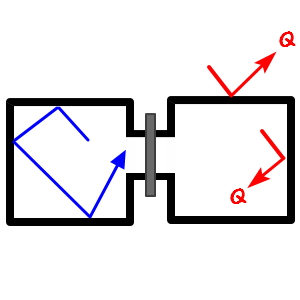
For starters, another name for Joule expansion was ‘free expansion.’ And no energy of any kind going into or out of the system is an assumption that’s already built in. Letting the gas freely (‘irreversibly’) expand into the connected space on the other side, which is a vacuum, is what we called Joule expansion, and we covered it a while back: Free Expansion (Joule Expansion) and Entropy of Mixing (Thermal & Statistical Mechanics I Studied #24). Last time we talked about entropy; today we’re talking about temperature. Here we go.
In the figure above, some particle, the one marked with the blue arrow lol, was moving with velocity $v$, and even if the pin thingy splitting the two spaces opens and it crosses over to the other side,
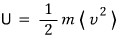
is there any room for its velocity to suddenly change from $v$ to $v'$?!?! There’s no such room anywhere. That is, 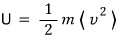 , and $U$ doesn’t change.
But the internal energy $U$ of an ideal gas (per molecule, for a monatomic gas) is  , so it depends only on the temperature $T$.
That is!!! When an ideal gas undergoes Joule expansion, its temperature doesn’t change.
But real gases are different.
Take a particle that was moving with $v$ in the closed-off space  : once the pin opens and it crosses over and sails around on the other side, there IS room for its velocity to change from $v$ to $v'$!!! Why?!?! Because real gases take into account the potential energy that we ignored for the ideal gas.
Alright, alright, alright!

Since we’re thinking inside an insulated container like this, the internal energy $U$ still doesn’t change.
(You can also think of it as ‘Joule expansion is changing $V$ while keeping $U$ fixed.’)
But in
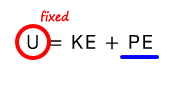
since
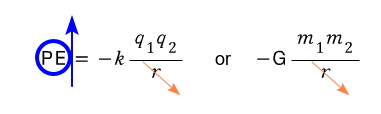
we get
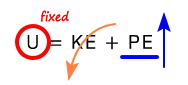
KE ↓ means the temperature goes ↓, so an attraction-dominated gas like this can get colder when it Joule-expands!!! That is not a universal rule for every real gas or every state.
So Joule expansion can indeed give us cooling when the interactions make the Joule coefficient negative.
Now let’s tidy this up in a more physics-y way. We’re going to define something called the Joule coefficient, $\mu_J$.
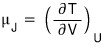
That’s the definition, and you can read its meaning like this.

Now, how are we going to analyze this?
We’re going to use the ‘math’ we used way, way back. Do you remember the “reciprocity theorem”? The reason we’re allowed to use it is right here: Reciprocal Theorem and Reciprocity Theorem (Thermal & Statistical Mechanics I Studied #23). Then let’s get into the analysis.
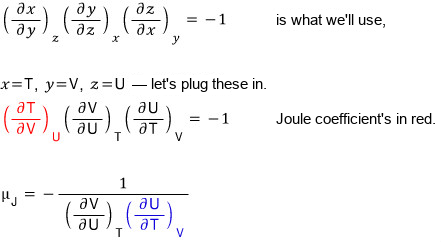
For anyone who forgot why the blue part is $C_V$: $(\partial U/\partial T)_V$ is exactly the heat capacity at constant volume, $C_V$.
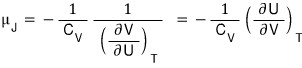
That’s as far as we’ve got. Now I’d like that one remaining derivative to be written in terms of state functions we use all the time.
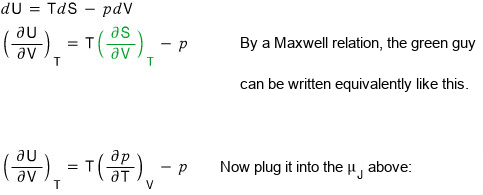
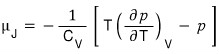
Let’s see what value $\mu_J$ takes for an ideal gas. To keep it simple, let’s say we have 1 mol of an ideal gas.
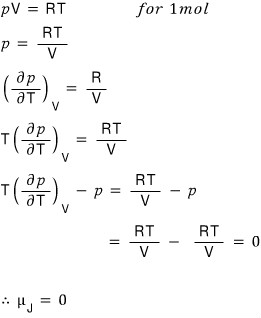
A very obvious conclusion has come out. The Joule coefficient being 0 means
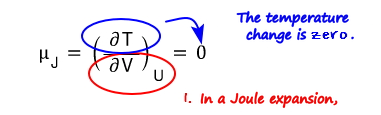
It’s the same conclusion we guessed by intuition way~ back at the start, so that feels good.
Then now, setting the ideal gas aside, let’s look at what value the Joule coefficient takes for a van der Waals gas, which is a bit closer to a real gas.
For 1 mol of a van der Waals gas,
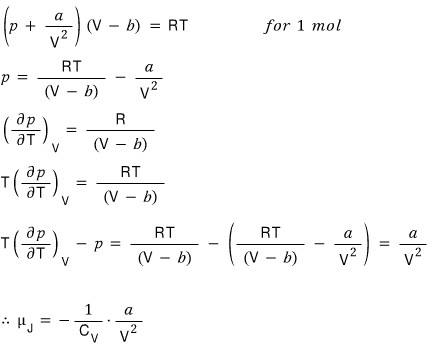
I’ll show this in a practice problem later, but the heat capacity of a van der Waals gas (a monatomic one) is
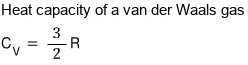
so the Joule coefficient is
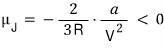
The Joule coefficient is negative!!!?!? So it really does cool down @_@
Then how much does it cool?!?!

If we write it like this, I think we can state the temperature change due to Joule expansion!!!
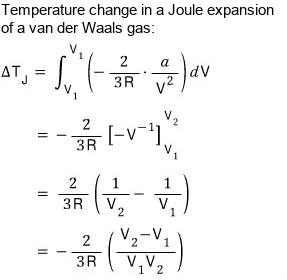
Since $V_2 \gt V_1$, I wrote it that way on purpose. The quantitative amount of temperature change depends on ‘$a$’, which is to say, it depends on the nature of the particles. Meaning it’s different for each species: H, He, Na, N₂ ······.
<It depends on the attraction between the gas molecules!!! - for a van der Waals gas> lol
Heads-up. The figures here are the original notes, slips and all. A few things to watch for:
- In the potential-energy picture, the Coulomb energy of two charges is $\frac{kq_1q_2}{r}$; the minus sign there describes an attracting pair of opposite charges, $-\frac{k|q_1q_2|}{r}$.
- $C_V = \frac{3}{2}R$ is the molar heat capacity of a monatomic gas; in general $\mu_J = -\frac{a}{C_VV^2}$ (a van der Waals gas has the $C_V$ of the ideal gas of its molecules, about $\frac{5}{2}R$ for N₂), so $\mu_J = -\frac{2a}{3RV^2}$ and the $\Delta T_J$ below are for a monatomic gas.
- Both temperature-change integrals run from $V_1$ to $V_2$ (the pictures write $V_1$ to $V_1$), and the factor $a$ belongs in every line after the first: $\Delta T_J = \frac{2a}{3R}\left(\frac{1}{V_2} - \frac{1}{V_1}\right) = -\frac{2a}{3R}\,\frac{V_2 - V_1}{V_1V_2}$.
Comments
Discussion happens via GitHub Discussions. You'll need a GitHub account to comment.