Trouton's Rule
A casual dive into Trouton's Rule, unpacking why phase transitions happen and how latent heat ties into entropy — because stability is literally everything.
The phase transition I kept foreshadowing in the earlier posts — here we go. A phase transition just means… well, the state of matter changes…. solid to liquid, liquid to gas, that sort of thing.
Why do phase transitions happen in nature??!?!
Everything seeks to be in a stable state, you know…. Which means:
The state it has transitioned into is the more stable state (at that temperature and at that pressure).
At about 1 atm, for example: at 150 °C,  is more stable as water vapor (gas) than in any other state; at 50 °C, is more stable as water (liquid) than in any other state; and at −50 °C, is more stable as ice (solid) than in any other state.
We learned this almost as an ‘axiom’ in middle and high school and accepted it without any problem, but now it’s time to look at it a little more rigorously, from a thermodynamic point of view.
The first step will be latent heat.
When the state of matter changes, there’s an extra bit of thermal energy needed, and we learned to call that ’latent heat’. I think we should understand it as a physical quantity you can figure out experimentally or phenomenologically. Aaaaand we also learned it as energy related to binding energy, right?!?!
So let me slap down the wiki definition of ’latent heat’:
Latent heat means hidden heat. It’s the heat released or absorbed when an object’s state changes without a change in temperature. As the heat that goes with evaporation and condensation, it shows up as thermal energy going into the water vapor when water evaporates from a water surface or from the surface of moist soil.
latent heat : $L$ — heat absorbed or released in the equilibrium transition from phase 1 to phase 2 at constant temperature ($T_c$, in kelvin). Here we use dS = δQ_rev/T for a reversible transition.
So this latent heat thing we’re studying is about $dQ$, the ‘heat’?!?! Then, with the help of entropy — the physical quantity tied to heat — let’s try to turn it into the other state functions we usually use.

If we call the latent heat $L$, then the latent heat $L$ is
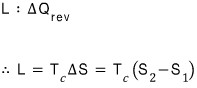
So latent heat turned out to be tied to the difference in entropy between the two phases at the transition temperature.
Since latent heat can only be discussed at the specific temperature where the phase transition happens, $T$ isn’t a variable — we plug in the specific temperature $T_c$, the transition temperature (careful: not the critical temperature, where the latent heat actually drops to zero).
Now let’s look at the $T$-$S$ graph for water.
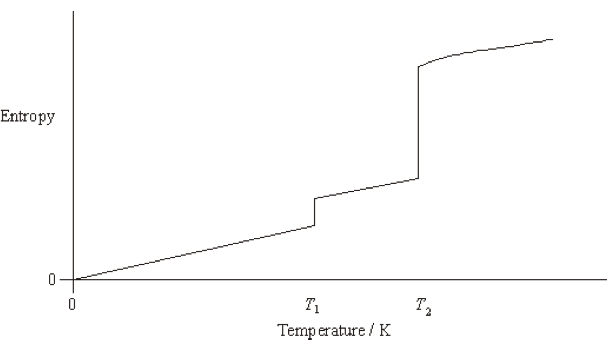
(source: A2 Chemistry (AQA) answers on satgamsat.blogspot.kr — looks like it was an A-level chemistry problem lol)
You’ve seen this kind of graph a lot, right? You probably saw one back in middle/high school, under the theme “water has a large specific heat”. But it’ll be a bit different from that one. This graph has temperature $T$ on the x-axis and $S$ on the y-axis (if you’d learned entropy back in middle/high school, you might’ve gotten hit with nuclear-grade chaos, right?), and the graph you saw in middle/high school was probably this one:
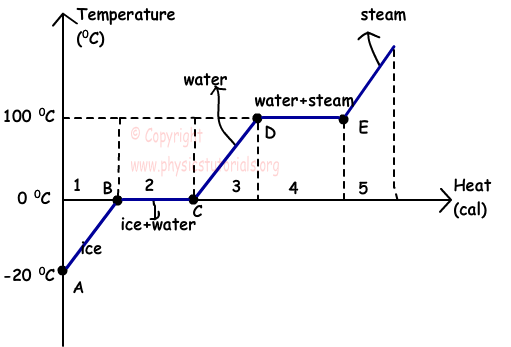
This was it, right?!?!@@@ Well, whatever: this one or that one, it’s the same story, hahaha hehe.
Alright, let’s push on.
The entropy needed when a phase transition happens (to make the transition) is~~~??!?!!
I’ll just answer this question and move on.
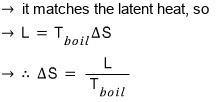
Okay okay okay, so what’s that, what IS that?
Let’s express our $\Delta S$ — at least roughly — in terms of physical quantities we already have!!!!! We’re going to infer $\Delta S$ very roughly, but I wouldn’t say it’s completely meaningless. Why??~?~?~?? That comes at the very end!!!
How exactly is it very rough??!?!?
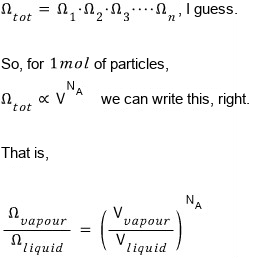
Well,  , right???? So it’s related to microstates. Can we say this physical quantity $\Omega$, the number of microstates, is proportional to the volume $V$:
  ?
?
For a very rough position-counting estimate, let’s treat the particles as independent and ignore liquid correlations. But what if there’s more than one, several of them? Particle 1:  . Particle 2 as well:
  . Particle 3 as well:
  . Particle 4 as well:
  . Particle 5 as well:
  . . . .
That is,
Now I’ll go into the equation trickery.
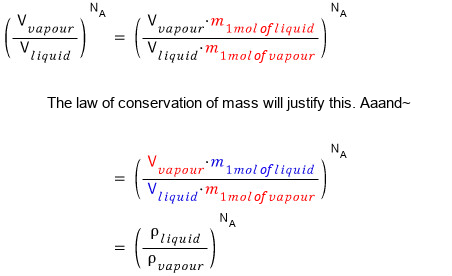
That is,
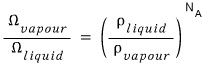
And among the commonly known facts, there’s this one: “the density of water is about 1000 times the density of water vapor”. Therefore
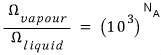
Got it up to here??? But why did we do all this??? The goal was to express the change in entropy during a phase transition in physical quantities that are easy for us to handle.
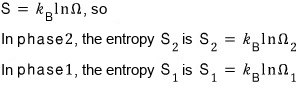
So the entropy change when going through a phase transition from phase 1 to phase 2 is
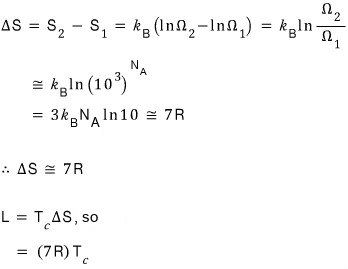
This is what’s called Trouton’s rule!! (Well, a rough version of it. The real Trouton’s rule is the measured fact that, at the normal boiling point, $L/(T_cR)$ comes out around 10 for lots of liquids ($\Delta S$ ≈ 85-88 J/(mol·K)); our rough count gives 7, which is in the right ballpark.)

So with this, can we say we’ve found some kind of universal law?
No, no, saying that would be too extreme. It’s more like a very rough guess (?), but as a ballpark estimate, it does hold.
 |
 |
 |
 |
 |
|
 |
 |
|
|---|---|---|---|---|---|---|---|---|
 |
 |
 |
 |
 |
 |
 |
 |
 |
So for lots of substances, we can roughly say this. Rou~ghly it all fits, but there are ones that clearly deviate!!! For instance, or deviate a lot.
Why, why, where, what is different about them that makes them deviate from Trouton’s rule??!??!
For helium (He), they say it’s quantum effects, and is down to none other than its polarity (hydrogen bonding, to be exact)~~
Heads-up. The figures here are the original notes, slips and all. A few things to watch for:
- In the last picture, $T_c$ is the boiling (transition) temperature, the $T_{boil}$ of the first picture, not the critical temperature of the van der Waals posts.
Comments
Discussion happens via GitHub Discussions. You'll need a GitHub account to comment.