The Clausius-Clapeyron Equation
We revisit phase transitions using Gibbs free energy and chemical potential to derive the phase coexistence condition and work toward the Clausius-Clapeyron equation hehehe.
We looked at phase transitions from the perspective of ’latent heat’. This time let’s look at them from the perspective of free energy too.
(Actually, we’ve seen it before…. back with the van der Waals gas hehehehehehe)
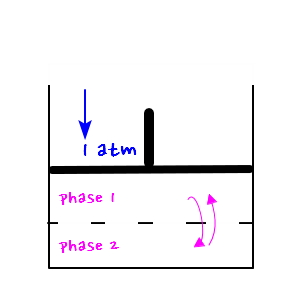
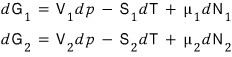
Since we’re considering two phases exchanging particles at fixed temperature and pressure, I’ll draw the picture like this. Gibbs free energy is the convenient potential here, rather than minimizing Helmholtz free energy at fixed volume hehehe. So I’m going to write it like this.

I’ll be using this kind of expression hehehe Now then,
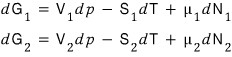
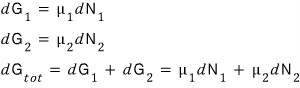
But, as you can see from the chemistry experiment above, $p$ has no choice but to stay constant at atmospheric pressure, and since we’re discussing a phase transition, we’ll take the temperature as fixed at the transition temperature $T_c$. Therefore
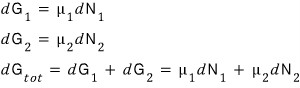
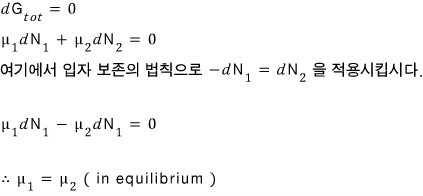
And let’s suppose we’ve reached equilibrium. Equilibrium is the state of having reached the minimum Gibbs energy! So it’ll be a state that stays put at the minimum value of the Gibbs function. That is,
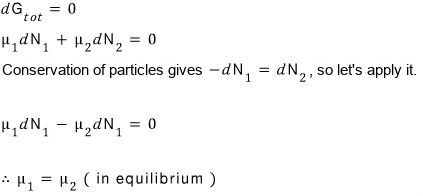
Actually this is the kind of conclusion we’ve already drawn earlier:
“On the way to equilibrium, ‘particles’ move from where the chemical potential is high to where it’s low, and they keep moving until the chemical potentials become equal.”
Now then, let me bring back the ‘phase coexistence line’ again.
(The part we’re studying now is ‘phase transitions’, and the phase coexistence line is the set of all the moments ‘when the phase coexistence condition holds’, where the phase transition takes place… so we can’t skip the discussion on the phase coexistence line.)
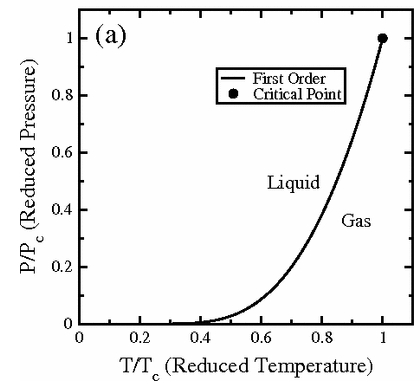
In #57,

(source: ResearchGate: van der Waals phase diagram)
I showed this graph as the phase coexistence line for the van der Waals gas, but this time I guess I’ll just draw it myself. First, I’m changing the x and y axes: no reduced variables this time. Then it’ll be drawn like this.
And I’ve tried marking two points; each of them represents a situation like this.
&&&
Both are conditions that let the two phases coexist, and in both cases the reaction would have run until the two chemical potentials became equal. The chemical potential depends on pressure and temperature. Here is a familiar ideal-gas example in molar units (the RT version); for chemical potential per particle, replace R with k_B. We won’t apply this gas formula to the liquid.
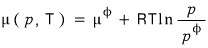
That is, for the left one in the figure above it would be

and for the figure on the right it would be this:

Now then,
let’s think about changing from point A to point B (from the $(p, T)$ situation to the $(p+dp, T+dT)$ situation). If $p$ and $T$ change, then $\mu$, the dependent variable made from them, will also change.
But!!!!  was the situation, and since we’re letting it change ‘along the phase coexistence line’,

And $G = \mu N$, right??!? Let’s read $\mu$ as the ‘Gibbs function per particle’. In the next differentiation, take a fixed representative amount of each phase; then dμ = dG/N = v dp − s dT. That is, a change in $\mu$ can be read as a change in the Gibbs function per particle. So
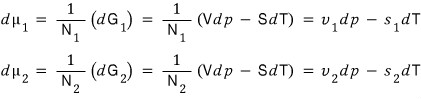
these two are what’s the saaaame now~~~~~~~ Now then, since we said the two changes are equal,

Let’s tidy up the equation a bit.
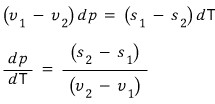

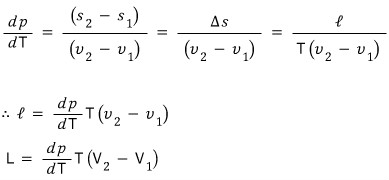
So the “(per particle) latent heat” is determined by the gradient of the $p$-$T$ phase coexistence line, the temperature at that point, and the difference between the (per particle) volumes of the two phases :)
And~~~~~~~~~~~~~
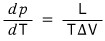
This is the exact Clapeyron equation, often discussed under the Clausius-Clapeyron heading. L and ΔV refer to transforming the same amount from phase 1 to phase 2, not the different total sizes of the two portions in the container. From now on, we’ll keep pulling it out for phase coexistence :))))))hehehehe
Sooo, what am I going to get up to in the very next post?
I’m going to derive the phase coexistence line again using the Clausius-Clapeyron equation hehehe So see you in the next post~:)))))))))
Heads-up. The figures here are the original notes, slips and all. A few things to watch for:
- The hand-drawn $p$–$T$ line flattens as $T$ rises, but a real liquid–gas coexistence line gets steeper, like the graph just above it; nothing in the derivation depends on that shape.
- Along the coexistence line, $\mu_1$ and $\mu_2$ change by the same amount, $d\mu_1 = d\mu_2$; the red arrows only mark that change (going up the liquid–gas line, both actually decrease).
- In the derivation, the brackets carry the phase index: $(V_1dp - S_1dT)$ and $(V_2dp - S_2dT)$.
Comments
Discussion happens via GitHub Discussions. You'll need a GitHub account to comment.