Phase Coexistence Curves of Water
We draw out phase coexistence curves using the Clausius-Clapeyron equation and figure out why water's solid-liquid line has a negative slope — spoiler: hydrogen bonding!!
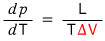
Alright alright alright, anyways, so the takeaway from what we’ve been discussing up to now is “the equation for the phase coexistence line = the Clausius-Clapeyron equation”. And yeah.
Now let’s draw it!!!! hehehehe
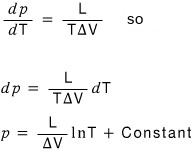
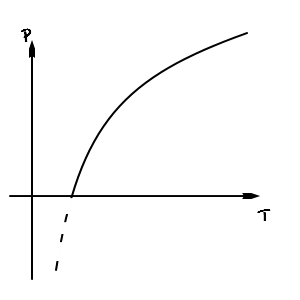
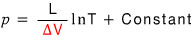
Let’s just draw it roughly like a log function (that’s what you get if $L$ and $\Delta V$ stay constant). Then it would look like this.
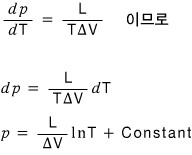
Something like this, right?
(Strictly speaking, only the solid-liquid line keeps $\Delta V$ roughly constant. For vapour $\Delta V \approx RT/p$, and the Clausius-Clapeyron equation really gives last post’s $p = e^{-L/RT + C}$, which gets steeper as $T$ rises instead of flattening out. For comparing the two lines, though, this rough sketch does the job.)
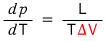
Okay, so let’s think of this picture as the phase coexistence line between vapour and liquid that comes from the Clausius-Clapeyron equation, and let’s derive the phase coexistence line between solid and liquid. The equation here will be the same as above too, but this part will be different.
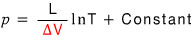
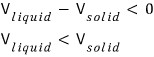
Forget about L, let’s look at V. This delta value will differ depending on the substance, but ΔV has something in common.

This point right here….hehehe So then the log function between liquid and solid will be steeper than the log function between vapour and liquid. Then I guess we can just overlay it like this and draw it.
Ah, that crossing suggests where to look for a triple point! To establish it, all three phases must have the same chemical potential; these rough curves alone are not a proof.
(it’s a pretty qualitative analysis though;;; hehehe)
This post was actually all for the sake of what comes below.
Actually, for the case of water you also learn this in middle/high school, but the phase coexistence line looks like this hehehe
It’s like this. The point is that the gradient of the phase coexistence line between solid and liquid is (-). What it being negative means is
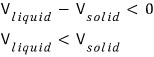
that’s what it means. That’s really weird, isn’t it?
If we represent solid, liquid, gas simply,
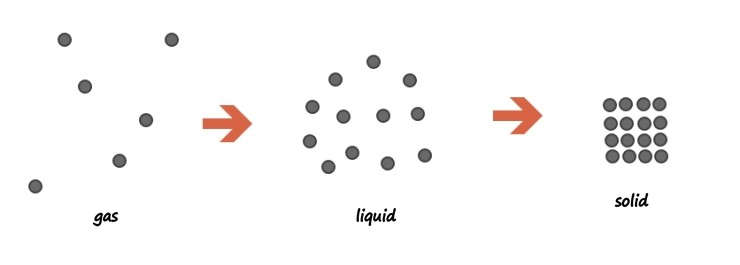
this seems reasonable, right?!?! But in the case of  it ends up saying
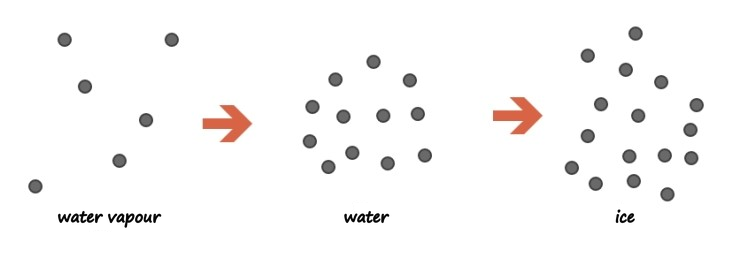
So why does have this kind of property?????
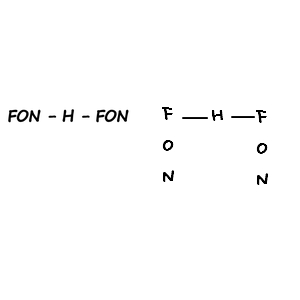
We learned this in high school chemistry, right?!?! It’s hydrogen bonding!!! FON-H-FON-H ~~~~~~ that’s how I memorized it lolol
Let me try interpreting “low temperature” as “low contained energy” (what counts as contained energy: translational kinetic energy, rotation, vibration, etc.)
Water molecules at high temperature, i.e. water vapour, have so much contained energy that, as in the picture above, you could say they’re thrashing around like hell. Then at low temperatures:
Since the contained energy is low, they don’t move, don’t rotate, don’t vibrate, right?????
Not quite! In ice they stay near lattice sites instead of roaming freely, but they still vibrate. Cooling reduces thermal motion; it does not make the molecules completely motionless. These guys settle into an ordered, open structure.
Because the difference in electronegativity between H and O is super big — ummm~~~~ the electronegativity of O is so big that it pulls in the (-) influence of H — water molecules end up with polarity. So it’s not that they’re huddled together haphazardly like above: they line up in rows and columns.
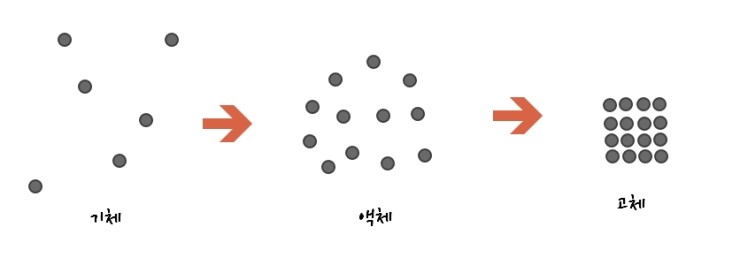
They end up lined up in rows and columns like this, and if the temperature gets juuuust a little bit higher than this,

rather than the thermal energy dissociating the water molecules like this,
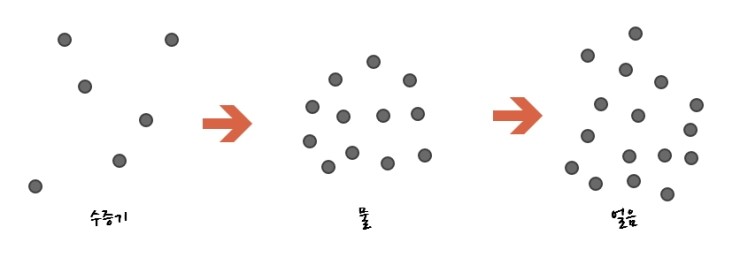
the thermal energy is used to break the hydrogen bonds like this.
So compared to when it was ice, the liquid ends up juuust a little~ more packed together hehehehe
This isn’t chemistry class, so I won’t get into stuff like how liquid near atmospheric pressure has its maximum density around 4℃, and so on.
Just get that this hydrogen bonding makes water behave differently from ordinary particles: icebergs float on water, the Han River freezes from the surface down, stuff like that…heh.hehehehe
Pleeease look forward to the next post hehehe It’s gonna be really fun heh
Comments
Discussion happens via GitHub Discussions. You'll need a GitHub account to comment.