Kelvin's Formula and Why Water Boils
We dig into why water boils by layering surface tension on top of phase-transition theory, then crank through the math to land on Kelvin's formula.
Alright, this time we’re going to analyze another phenomenon.
Why does water bubble away when it boils!!!!!
Let’s get started. Earlier, you see, we drew the Gibbs function for a phase transition (the van der Waals gas) like this.
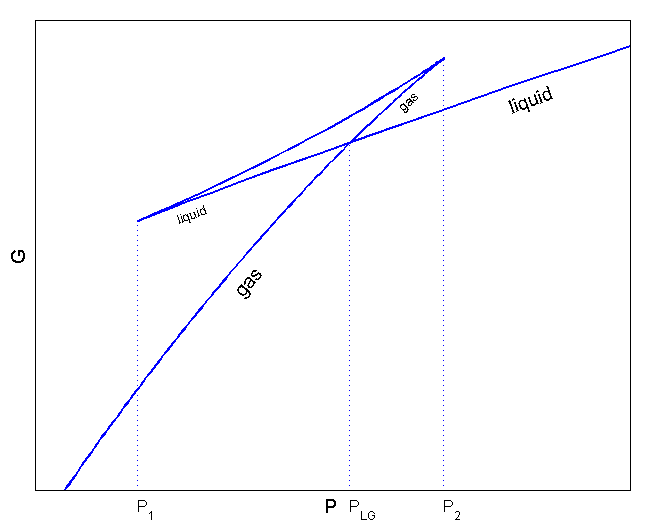
(source: Wikimedia Commons, Van der Waals GibbsP.png)

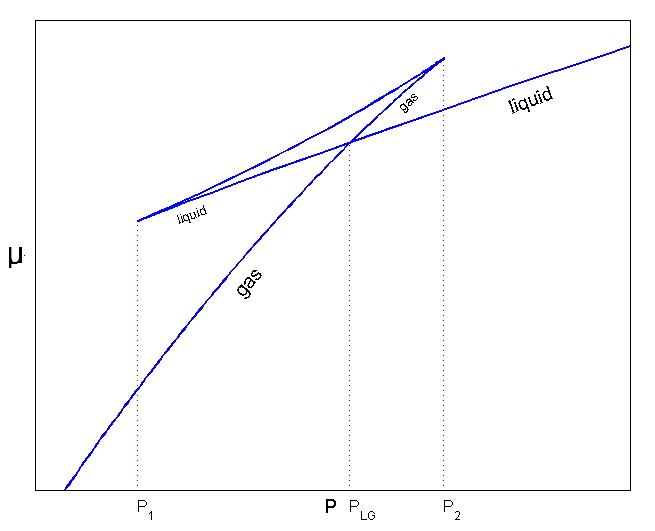
Now, between the chemical potential $\mu$ and $G$ there’s the relation

so if we now switch the graph above to a ‘per particle’ basis, we can draw it like this.
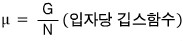
I just swapped the y-axis for the chemical potential $\mu$. We’ve covered this before: this graph hints that superheated liquid and supercooled vapour can exist, and we used it to explain those real-life phenomena!!!! (That was #56.)
But here’s the thing. This time I want to go one step further. What am I adding this time? “Surface tension”. So let me quickly go over surface tension.
If you put liquid in a piston shaped like this, a drop of liquid will form, like in this picture. What makes the liquid gather into a drop is the attraction between the molecules that make up the liquid, right?
Let’s say the drop’s surface area is $A$. Surface tension is the cost of creating more interface, not an extra force to add on top of the same molecular attraction. At fixed volume it favors a smaller area, which is why a free drop tends toward a sphere.
Let’s call the reversible work done on the interface to increase its area $dW$, and write it like this:  . $\gamma$ is the surface tension. It depends on the substance and temperature; here we hold the temperature fixed~~~
Now, let’s rewrite  with things that are handy for us. For the sphere’s mechanical balance, the pressure work uses the pressure difference Δp = p_inside − p_outside. The next pictures call that difference p, so
  .
.
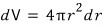
And if we think of the drop as a ‘sphere’,  , so
, so 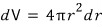 . Then
  , so
, so  .
.
Wheee, then we can rebuild the surface tension equation:
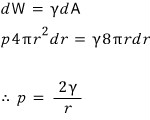
Back to phase transitions
So now, back to the main topic, phase transitions:

let’s say we’re in equilibrium right now. If we read “equilibrium” as “it keeps reacting until the $\mu$’s are equal”, then since we’re in equilibrium, we can say this is the state we’re in: 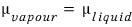 .
.
And let’s say the current equilibrium is

the state where the chemical potentials are equal at this point. Right now vapour and liquid are coexisting, right?!?!?!
In this situation, sud.den.ly!!! let’s say we take the surface tension $\gamma$ into account. Then the liquid’s pressure will change ever so slightly. It was that $p$, and it shifts ever so slightly, by $dp_{liquid}$, so let’s say the pressure became $p + dp_{liquid}$.

Whoa??!?! Then what happens to the reaction?!?!??! The reaction keeps going until the $\mu$’s are equal, remember??!?!!
Aha~~~ $\mu_{vapour}$ changes too!!!
It’ll keep reacting until it matches the liquid’s new chemical potential. So how much does the vapour change? It’ll be this much.

Aha~~~~ $\mu_{vapour}$ changes too!!!! is matched up again!!!
But look at the graph: $p_{vapour}$ changes, but not by $dp_{liquid}$, so  , and how big
  is, I’ve marked in the picture above.
Now let’s go full graph-reading mode.
Right now the two  are equal to each other:
  . They’re the same size, but let’s write $d\mu$ ‘differently’.

We can write this equation, and the principle behind it is just
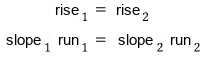
And if we call the piston’s pressure $p$, then  , so I’ll write the equation above again like this:
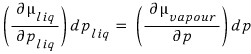
Now, we had $dG = -S\,dT + V\,dp$. So  , right? But $\mu$ is the “Gibbs function per particle”, so
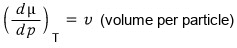
(Not the volume of a particle itself, but the volume each particle takes up in the gas, liquid or solid.)
So the equation above becomes
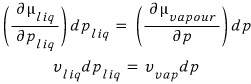
And if we multiply both sides by Avogadro’s number $N_A$,

Now the volumes are the volume taken up by 1 mol of particles. Now, let’s assume the vapour is an ideal gas. (We’re only treating the gas as ideal, that’s all.) Then, since 1 mol of ideal gas takes up $RT/p$,
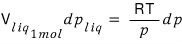
Now we integrate both sides.
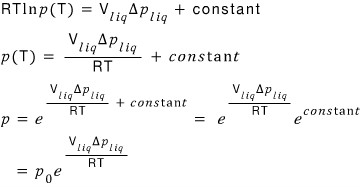
What was the $dp_{liquid}$ we started from?!??!!
It was the liquid-pressure shift from the flat-interface reference. With an incompressible liquid and ideal vapor, and neglecting the much smaller vapor-pressure contribution to that liquid shift, we use the Laplace jump — the  we found before. We sud.den.ly switched on exactly this much, after all:
  . That’s the gist, so let me put it like this.
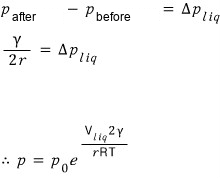
Got it? This equation is called Kelvin’s formula~~~ hehe
What the formula says
Now let’s try to understand that equation. So far we’ve understood it with
this picture, but since we’re going to understand a natural phenomenon, let me tweak the picture just a little.
I was going to say “let’s tweak it like this”, but I failed to pull it off in MS Paint. For this one at least, a hand drawing will do better.

I want to draw it like this~~~ think of it as the picture rotated all the way around. It’s all the same thing anyway, right???? So right now,
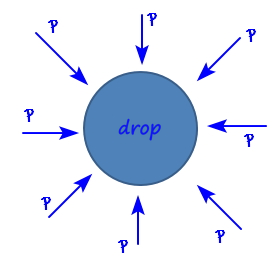
what I’m saying is: think of it as a water drop. And Kelvin’s formula was
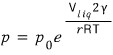
this, and $p$ is the vapour pressure, the pressure of the vapour outside.
So what this equation says is that the smaller $r$ gets, the bigger $p$ gets. In other words, a bigger $p$ means a stronger urge to evaporate.
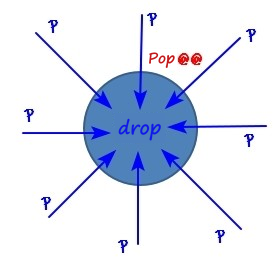
Read the “Pop@@@” as the droplet shrinking away by evaporation, not literally bursting. At a given ambient vapor pressure, a smaller drop needs a higher saturation pressure to survive.
(The inward arrows represent the outside vapor pressure. Reversing those arrows would represent a different force; surface tension itself favors shrinking the surface.)
This says that, because of this urge to evaporate, supercooled vapour can exist. That is, you can say the value of $\gamma$, which is set by the substance, decides how small a drop has to be to go pop@@@, and you could also say that even when it’s cold enough up in the atmosphere for drops to form, the urge of small drops to evaporate lets the water stay as vapour!!!!
Anyway, okey-dokey?!?!?
So then, what does it take for water to condense up in the sky?!?!
Very small pure-water droplets can evaporate before they grow. Suitable particles can make nucleation easier!!~~ In cold cloud seeding, silver iodide promotes ice nucleation and dry ice chills the air enough to produce ice crystals; that is more than simply making a bigger liquid drop.
The little speech bubble is a cartoon of how a surface can help a new phase get started. Actual cloud seeding needs suitable existing clouds and conditions.
The opposite case: bubbles
We can also think about the opposite case. A moment ago we were thinking like this, right?!?!?!?
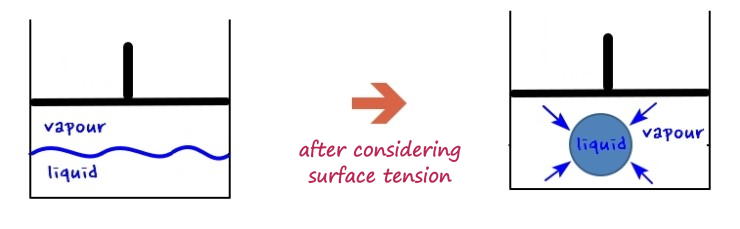
The opposite case is
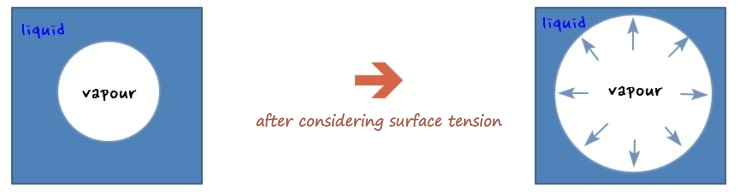
Here the curvature is reversed, but surface tension still tends to shrink the interface. The vapor pressure inside a spherical bubble must exceed the surrounding liquid pressure by 2γ/r; the outward arrows are not an outward surface-tension force. That is,  is what we’re ‘adding’ this time. Therefore
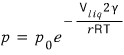
So now, a water vapour bubble that forms inside the liquid!!! If its radius is small, $p$ now gets smaller than before. That means that even at a temperature high enough for it to be a gas, the water can hang on as a superheated liquid.
In this situation, what does it take for a bubble to form?!?!?!?
The bubble has to be big enough for its vapor-pressure driving force to beat 2γ/r. In the usual approximation, it grows when p_sat(T) − p_liquid > 2γ/r.
That is, of all the bubbles that pop up inside the liquid, the small ones all croak, and only the big ones survive and keep growing and growing, and that’s what our eyes see as “water bubbling away at a boil”!!!!!
(Why they keep growing and growing comes out in the next post. Growing and growing is the natural thing to do, as in nature’s own way, apparently.)
And here’s one from the kitchen. Drop ramen soup powder into water that’s bubbling away, and it goes quiet and only bubbles again once it’s a bit hotter.
The powder isn’t killing the bubbles, though: each grain is a ‘nucleus’, a spot where a bubble gets to start out big enough instead of as one of those “small bubbles” that croak, which is why bubbles stream up from specks and scratches!!!!! The quiet spell and the “bit hotter” come from the soup itself: the powder cools the water a little, and the stuff dissolved in it raises the boiling point.
Ah….. that’s “boiling point elevation”……hehe
Heads-up. The figures here are the original notes, slips and all. A few things to watch for:
- In the integration, the second line keeps the logarithm: $\ln p(T) = \frac{V_{liq}\,\Delta p_{liq}}{RT} + \text{constant}$.
- For a droplet, the extra pressure is $\Delta p_{liq} = \frac{2\gamma}{r}$; the second line writes $\frac{\gamma}{2r}$.
- In the bubble drawing, surface tension squeezes a bubble rather than inflating it: the vapour inside sits $\frac{2\gamma}{r}$ above the liquid around it, and the outward arrows stand for the liquid’s pressure being $\frac{2\gamma}{r}$ lower ($\Delta p = -\frac{2\gamma}{r}$), not for the bubble swelling.
Comments
Discussion happens via GitHub Discussions. You'll need a GitHub account to comment.