Gibbs Free Energy of a Water Droplet and Bubble Nucleation
Walk through calculating the Gibbs free energy of a liquid droplet in vapor equilibrium, factoring in surface tension to set up the physics behind bubble nucleation.
Example 28.6. Calculate the Gibbs function of a liquid droplet of radius $r$ that is in equilibrium with vapour. Assume the temperature is one where the liquid is the thermodynamically stable phase.
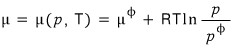
Since it says “in equilibrium”, let’s say everything is constant. Then $p$ and $T$ are constant too, and so $\mu$ is constant as well.
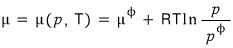
So, since $G = \mu N$, we can write $dG = \mu\,dN$, and since we’re dealing with both vapour and liquid,

let’s write it like this.
But we’re also going to take surface tension into account, so we add a surface-tension term onto the Gibbs function above. Since $dW = \gamma\,dA$,

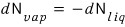
And then there’s the conservation of particle number, 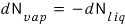 , so
, so

It’s totally fiiine to do it like this~
Let’s also throw in the relation we used before,  , too.
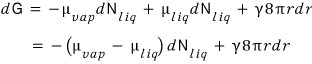
Now we’re going to write $dN$ in terms of $r$, so let’s think about it like this.
If the droplet’s radius grows by $dr$, the volume grows by  this much, right?
How many liquid water molecules are in this extra volume???
The liquid in a volume of has a mass of 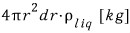 . And if we divide that by $m$, the mass of one liquid molecule, out comes the number!!! That is,
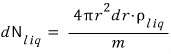
So
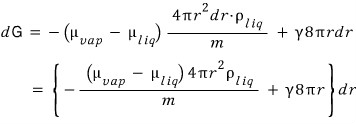
Now if we slap an integral on both sides,
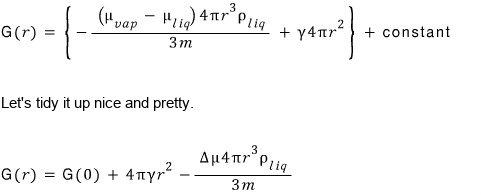
We’ve derived the Gibbs function of a droplet of radius $r$.
Shall we plot it? Aaaaah, right!
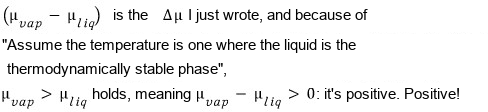
Now shall we really plot it? I’ll just copy the one in the book.
(It’s coming up a little further down, with my circles drawn on it.)
So then. Let’s compute the extremum of that graph, the point where $dG = 0$.
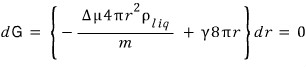
Since that’s what we’re looking for,
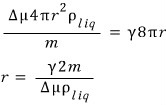
That means right at that $r$, the droplet is in equilibrium. Let’s call that $r$ “r star”.
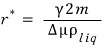
Now, when droplets form, one that comes out smaller than this reacts in the direction that minimizes the Gibbs function, so

$r \to 0$: it “disappears."
And a droplet that comes out bigger than $r^*$ also reacts in the direction that minimizes the Gibbs function, so
$r \to \infty$: “the droplet grows without limit."
So the thing from the previous post, the bubbles that keep growing when water bubbles away at a boil, can be explained by the principle of Gibbs function minimization, I guess~ hehe hahaha
(It’s the same story with liquid and vapour swapped: a vapour bubble inside the liquid.)
Comments
Discussion happens via GitHub Discussions. You'll need a GitHub account to comment.