Fluctuations
Can wild, chaotic fluctuations actually be tamed by state functions like S, T, and V? Turns out entropy and probability density are more buddy-buddy than you'd think.
Earlier we looked at Brownian motion, this unknowable random motion. So this time, here’s what we’re going to do. That Brownian motion thing — actually, not just Brownian motion, but fluctuation in general:
Can’t we express it using the state functions we’ve been dealing with all along, $T$, $V$, $p$, $S$….????
Let’s try to find the answer to that question.
First off, this thing called fluctuation, this absolute trainwreck of a physical phenomenon, feels like it’s somehow related to ’entropy’, right?? Entropy $S$ is  , so we’re going to focus on omega, the number of microstates!!!
$\Omega$ in terms of $U$? $\Omega$ in terms of $T$? $\Omega$ in terms of $p$? Stuff like that. So let’s leave the variable of $\Omega$ open and call it $x$. Just to be clear: take an isolated combined system with fixed total energy E, and let x describe an internal quantity that can fluctuate. Ω(x,E) counts the combined system’s microstates for a given x.
$\Omega$: number of microstates associated with a system characterized by parameter $x$ & energy $E$
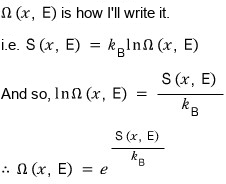
Oh…. but, the number of possible microstates… this is somehow related to the states the microstates occupy, i.e., the probability density function $p(x)$ must be related to $\Omega(x,E)$. Is it hooked in as a square? A cube? A square root? Nope, it’s the simplest one, plain ‘proportional’ (linear): every microstate is equally likely, so a macrostate with twice the microstates turns up twice as often.
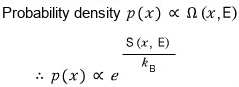
Written out like this, it doesn’t look like nonsense. The point where the entropy is maximum would be equilibrium, and the point of maximum entropy is the biggest (highest) part of the probability density function, after all???!?
Alriiight— so let’s look at equilibrium, the point where the entropy is maximum. Say the entropy is maximum at $x = x_0$, and let’s write an approximation of $S(x,E)$ around $x \sim x_0$.

(at equilibrium)
But hey, there’s a term that flies away, right?!?!?!
The first derivative will be 0, since this is the maximum point, by the logic that it’s an extremum!!!

And it goes liiike this.
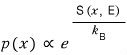
I’m going to rewrite this proportionality as below.
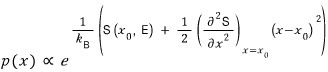
Now let’s play with it.

The red part will be a constant, so
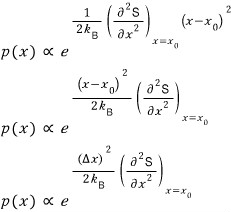
Now here’s where we guess that $p(x)$ is a Gaussian function~~~
(It’s not such a wrong claim anyway, so, well;; heh; hehe)
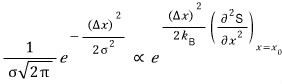
OK, so
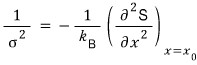
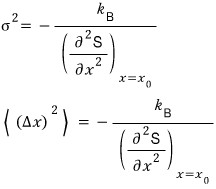
We found the fluctuation term near equilibrium.
And this equation is even more fun, because the conclusion it gives predicts real phenomena.
We left x open, right???? Now let U be the energy of a subsystem exchanging heat with a large reservoir, at fixed volume and particle number. The entropy being maximized is S_sub(U) + S_res(E − U). The reservoir supplies the first-order term that cancels at equilibrium; in the large-reservoir limit the curvature is −1/(T²C_V). Then
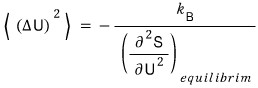
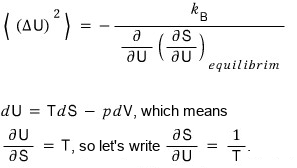
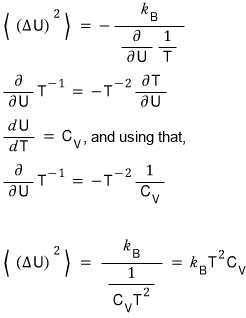
Near some continuous phase transitions, C_V can become very large and may diverge in the thermodynamic limit. That is not true of every transition, and a finite sample does not literally have infinite fluctuations.
So large C_V means large absolute energy fluctuations. The infinity in the original picture 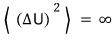 refers to an idealized limit, not every finite phase transition.
Totally
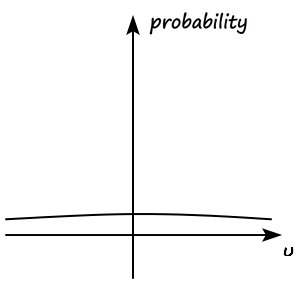
it’s in this kind of ‘pandemonium’ state, right?????
And in actual phase transitions, the fluctuations really are pandemonium, aren’t they??
And also,
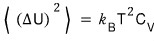
this equation tells us something. $U$ is an extensive variable, so it’s proportional to $N$, and $C_V$ is also an extensive variable, so it’s proportional to $N$ too. So we can also say the root-mean-square of the fluctuation scales like this: 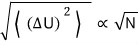 ($\because C_V \propto N$).
That is, the ‘percentage change’ of the fluctuation is
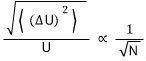
that’s what it iiis :) And this is telling us thiiis:
If the number of particles is enormous, the percentage change of the fluctuation term converges to 0!!!!!
Near a critical point, the simple C_V ∝ N scaling and the quadratic Gaussian approximation can break down. We have to check how C_V and U scale together before claiming anything about the relative fluctuation — it does not automatically go to infinity!!!~~ Urk!
Fun lol
Heads-up. The figures here are the original notes, slips and all. A few things to watch for:
- The infinite-variance picture is an idealized critical-limit sketch. Not every phase transition has divergent C_V, finite samples have finite fluctuations, and a flat Gaussian over the entire real line would not be normalizable. Near a critical point, higher entropy terms can matter.
Comments
Discussion happens via GitHub Discussions. You'll need a GitHub account to comment.