Practice Problems: Chapters 26 & 27
Chapters 26 & 27 practice problems worked by hand: the van der Waals gas's isothermal compressibility and isobaric expansivity, which both blow up at the critical point; a gas with p(V − b) = RT whose internal energy depends on T alone; U = (3/2)RT − a/V from the partition function; and which expansion (Joule, adiabatic, Joule-Kelvin) each temperature coefficient describes, checked on an ideal gas. 27.2 was already derived with the concepts, so it's skipped here~
Prob 26.1
For the Chapter 26 calculations, we’ll use one mole and write the van der Waals equation as $p=RT/(V-b)-a/V^2$. Here $a$ measures the attractive correction and $b$ is the molar excluded-volume scale. The more general $n_m$-mole equation has $n_mRT$ on the right, even though the first handwritten line drops that $n_m$.
Show that at  the isothermal compressibility of a van der Waals gas can be written as
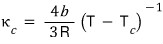
Sketch the temperature dependence of  and explain what happens to the properties of the gas as the temperature is lowered through the critical temperature.
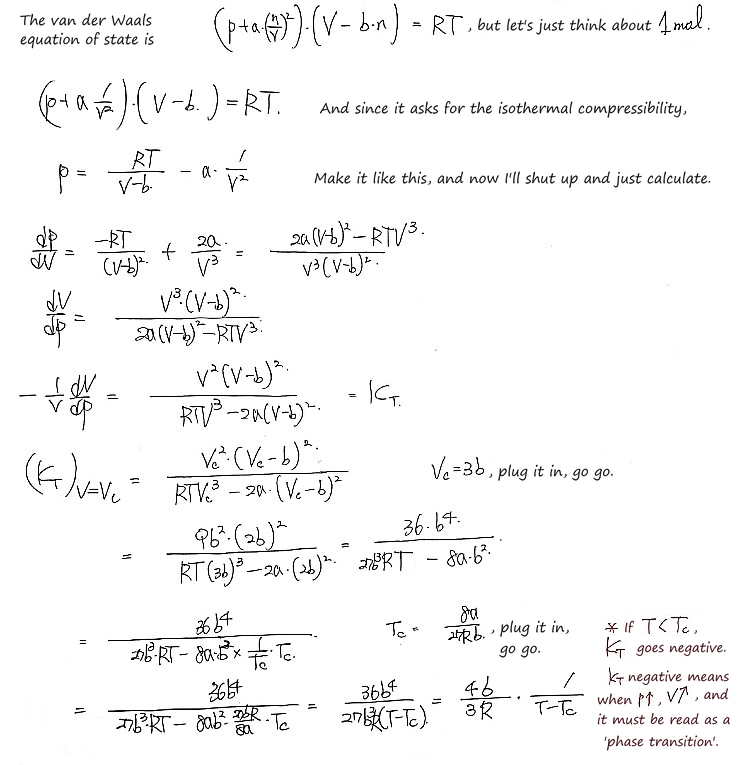
Compressibility asks how much the volume changes when we change pressure at fixed temperature. Inverting the slope of the isotherm gives
$$ \kappa_T=-\frac{1}{V(\partial p/\partial V)_T},\qquad \left(\frac{\partial p}{\partial V}\right)_T =-\frac{RT}{(V-b)^2}+\frac{2a}{V^3}. $$Substitute $V_c=3b$ and $T_c=8a/(27Rb)$, and the expression reduces to $\kappa_T=4b/[3R(T-T_c)]$. Approaching $T_c$ from above at $V_c$, the isotherm becomes flat and the response grows without bound in this model. The negative continuation below $T_c$ is mechanically unstable; a stable equilibrium separates into phases instead of behaving as a uniform gas with negative compressibility.
Prob 26.2
The equation of state of a certain gas is  , where $b$ is a constant. What order of magnitude do you expect for $b$? Show that the internal energy of this gas is a function of temperature only.
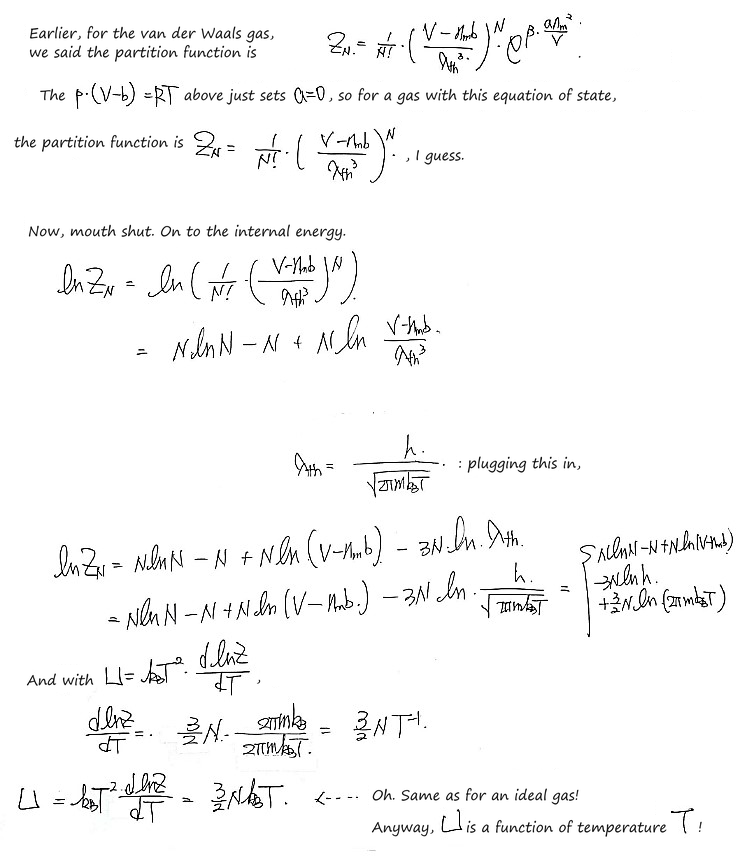
The excluded volume should scale with molecular volume: for molecular size $d$, the molar $b$ is of order $N_A d^3$. To answer the energy question without assuming a microscopic model, use
$$ \left(\frac{\partial U}{\partial V}\right)_T =T\left(\frac{\partial p}{\partial T}\right)_V-p =\frac{RT}{V-b}-p=0. $$So changing $V$ at fixed $T$ doesn’t change $U$: $U$ is a function of $T$ alone. The partition function on the sheet makes an additional assumption, a classical gas with translational motion only. That model gives $U=3Nk_BT/2$; the equation of state alone doesn’t fix that particular function of $T$. Here $N$ counts particles, while $n_m$ counts moles.
Prob 26.4
Show that the isobaric expansivity of a van der Waals gas,  , is given by
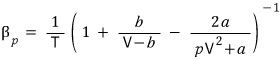
What happens to this quantity near the critical point?
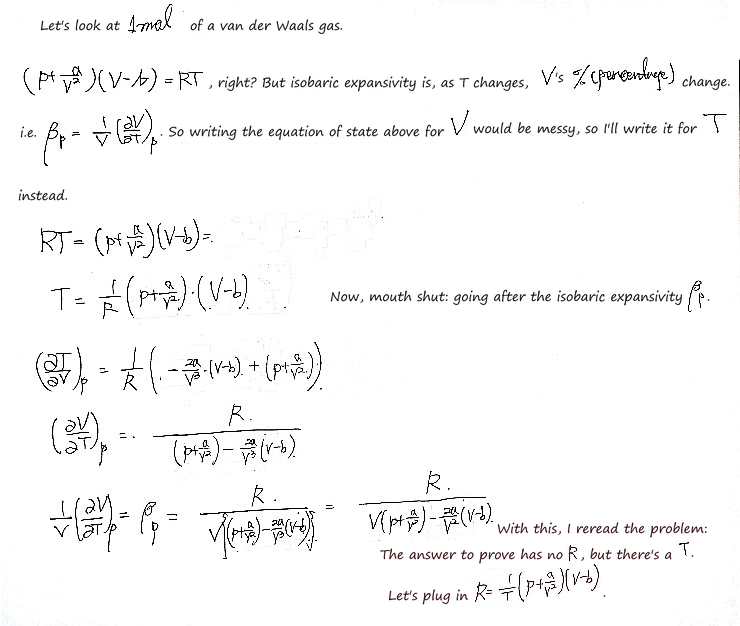
This time hold pressure fixed. Along an isobar, $0=p_T\,dT+p_V\,dV$, where the subscripts mean partial derivatives. Hence
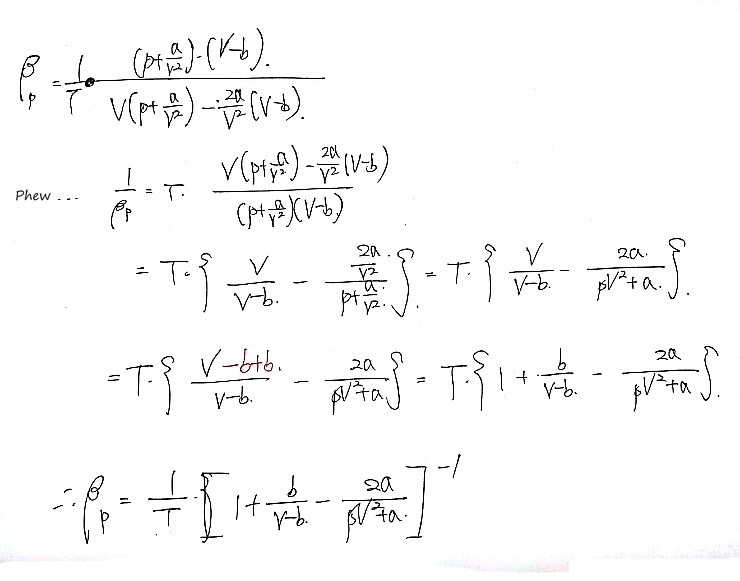
$$ \beta_p=-\frac{p_T}{Vp_V} =\frac{R}{V(p+a/V^2)-2a(V-b)/V^2}. $$Putting $R=(p+a/V^2)(V-b)/T$ into this expression gives the requested form above. This $\beta_p$ has units of inverse temperature; it isn’t the statistical-mechanics $\beta=1/(k_BT)$.
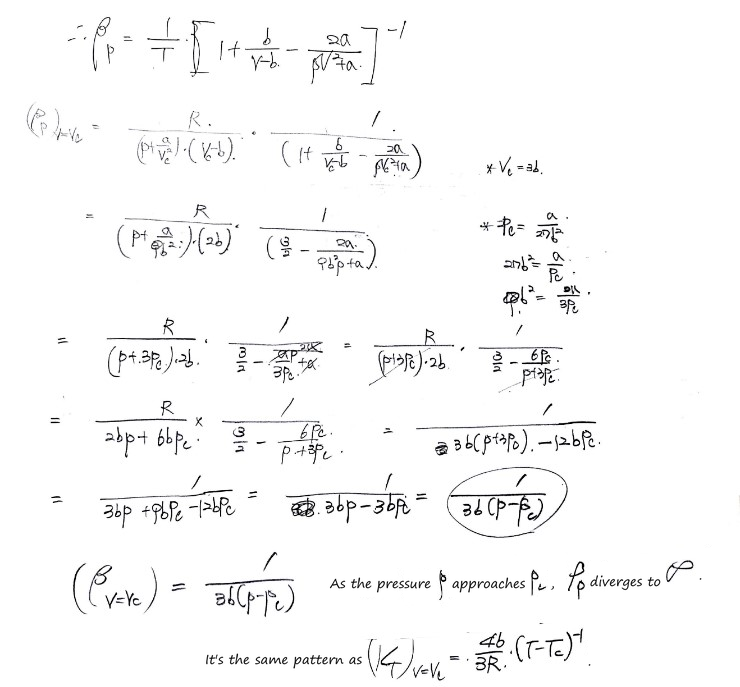
At $V=3b$, the result simplifies to
$$ \beta_p=\frac{R}{3b(p-p_c)},\qquad p_c=\frac{a}{27b^2}. $$Keep the $R$ in the numerator; it is missing from the last line on the sheet. Just as with compressibility, the vanishing isotherm slope explains the large response near the critical point.
Prob 26.5
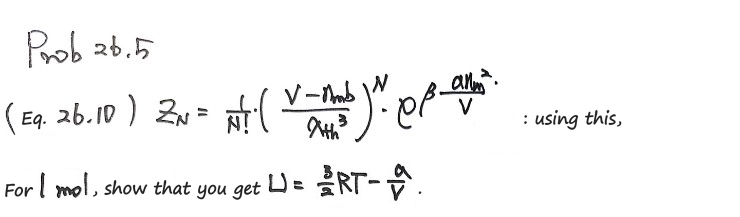
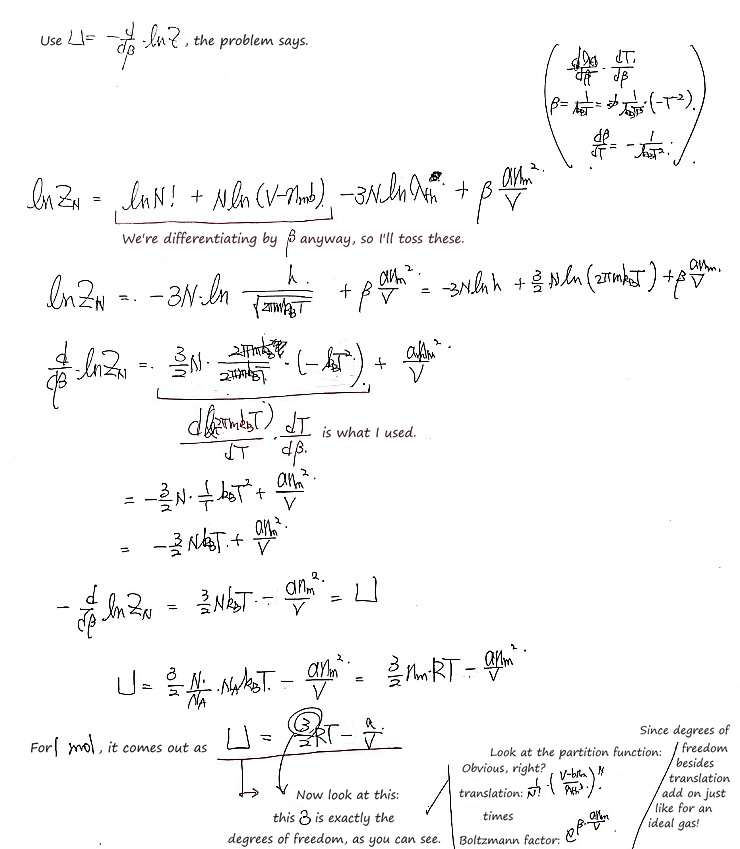
Take the logarithm before differentiating, keeping $N$, $V$, $a$ and $b$ fixed:
$$ \ln Z_N=-\ln N! +N\ln\!\left(\frac{V-n_mb}{\lambda_{th}^3}\right) +\frac{\beta a n_m^2}{V}. $$The factorial term has a minus sign. It drops out of $U=-\partial_\beta\ln Z_N$ because it is temperature independent, as is the free-volume factor. Since $\lambda_{th}\propto\beta^{1/2}$, the wavelength contributes $3N/(2\beta)$, while the last term contributes $-an_m^2/V$. Thus
$$ U=\frac32Nk_BT-\frac{an_m^2}{V}. $$For one mole this is $3RT/2-a/V$. The negative term is the attractive potential-energy correction. Excluding volume changes the number of available positions, but in this model it doesn’t add a temperature-dependent energy term.
Prob 27.1
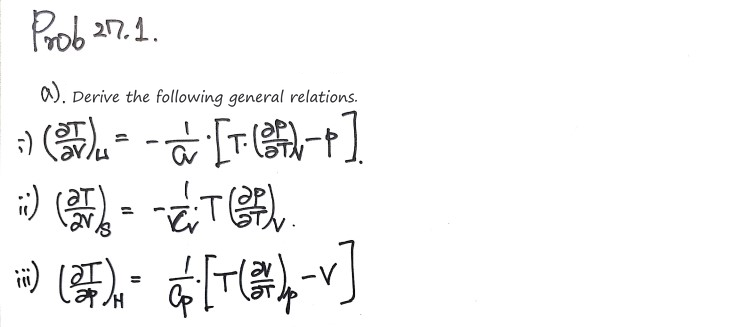
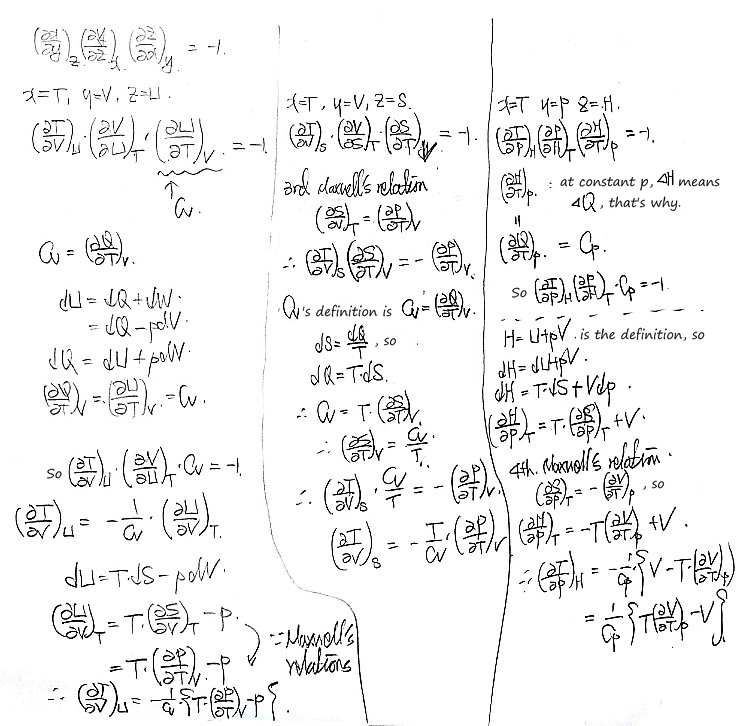
The common thread is to choose the right variables before setting a differential to zero. For a fixed amount of a simple compressible gas, the first law and Maxwell relations give
$$ dU=C_V\,dT+ \left[T\left(\frac{\partial p}{\partial T}\right)_V-p\right]dV, $$$$ dS=\frac{C_V}{T}\,dT+ \left(\frac{\partial p}{\partial T}\right)_VdV, $$$$ dH=C_p\,dT+ \left[V-T\left(\frac{\partial V}{\partial T}\right)_p\right]dp. $$Set $dU$, $dS$ or $dH$ to zero in the corresponding line and solve for the temperature slope. That’s where the three coefficients on the problem sheet come from. In the heat-transfer step, use $\delta Q_{rev}=T\,dS$; that equality refers to reversible heat transfer.
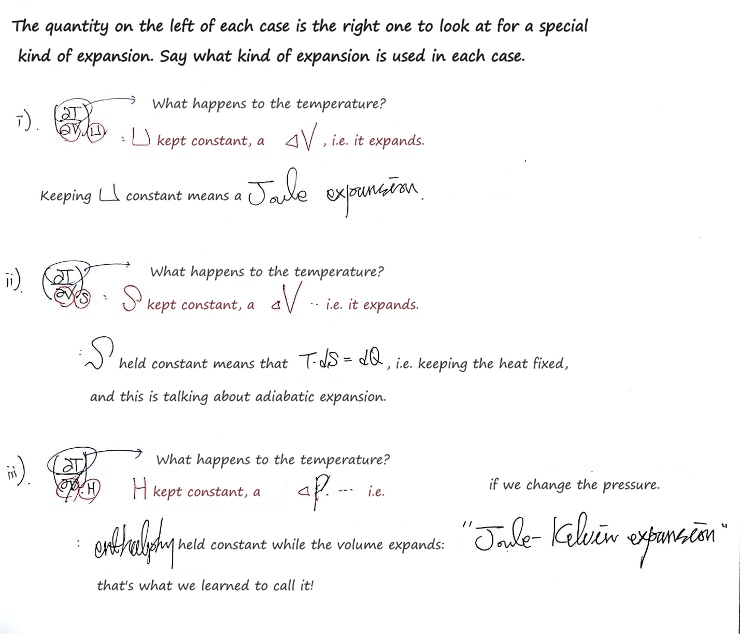
The restrictions identify three different experiments. Free expansion into a vacuum in an insulated container has no heat input or external work, so $U$ stays fixed. A reversible adiabatic expansion has $S$ fixed, and it can cool by doing work. In steady insulated throttling, with negligible kinetic and potential-energy changes, $H$ stays fixed: this is the Joule-Kelvin, or Joule-Thomson, case. An irreversible adiabatic process needn’t keep entropy constant.
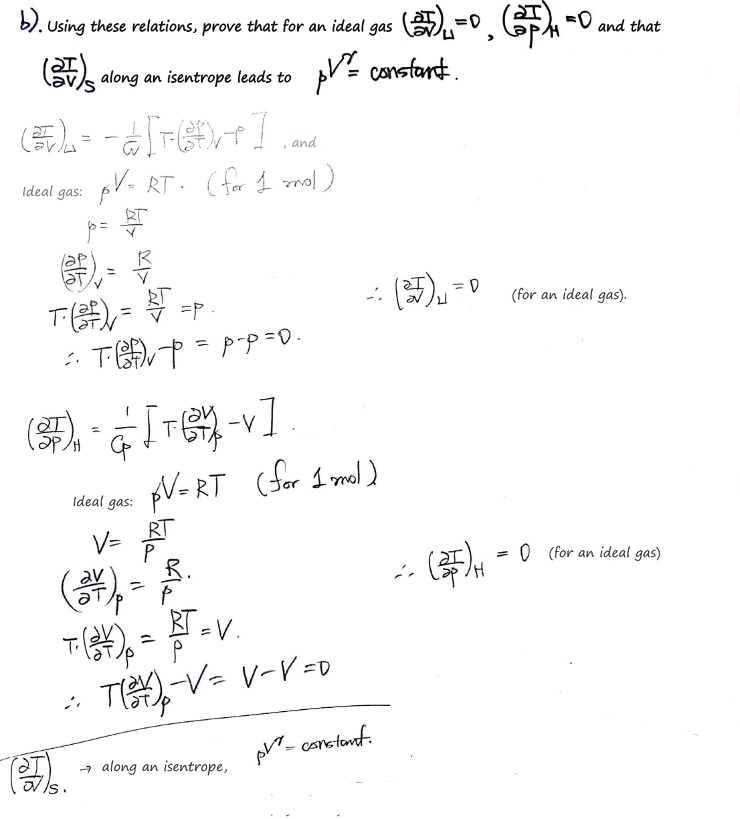
For one mole of ideal gas, $p=RT/V$. Then $T(\partial p/\partial T)_V=p$ and $T(\partial V/\partial T)_p=V$, so the fixed-$U$ and fixed-$H$ temperature coefficients vanish.
The fixed-$S$ coefficient does not vanish: it is $-RT/(VC_V)$. If the heat capacities are constant, integrating gives $TV^{R/C_V}=\text{constant}$. With $C_p-C_V=R$ and $\gamma=C_p/C_V$, this becomes $pV^\gamma=\text{constant}$. The difference is the work done during the reversible expansion; the three paths shouldn’t be treated as interchangeable.
27.2 was something I naturally derived when covering the concepts, so it’s recorded already~
Heads-up. The figures here are the original notes, slips and all. A few things to watch for:
- For $n$ moles, the van der Waals equation reads $\left(p + a\frac{n^2}{V^2}\right)(V - nb) = nRT$, with $nRT$ on the right; the sheet then sets $n = 1$, so the rest is right.
- At $V = V_c = 3b$, the isobaric expansivity keeps its $R$: $\beta_p = \frac{R}{3b(p - p_c)}$, not $\frac{1}{3b(p - p_c)}$. It still diverges as $p \to p_c$, so the conclusion stands.
- The $\frac{1}{N!}$ in $Z_N$ gives $\ln Z_N$ a $-\ln N! \approx -N\ln N + N$, not $+N\ln N - N$ (or $+\ln N!$); it depends on neither $T$ nor $\beta$, so $U$ is unaffected. And the Boltzmann factor in the margin note is $e^{\beta a n_m^2/V}$, with $n_m$ squared, as in Eq. 26.10.
- The negative-compressibility continuation below T_c is mechanically unstable. A stable equilibrium undergoes phase separation instead of following that branch as a uniform gas.
- The equation of state alone gives $(\partial U/\partial V)_T=T(\partial p/\partial T)_V-p=0$, so U depends only on T. The specific $U=3Nk_BT/2$ also assumes the classical translational model used in the partition function. Here b is a molar excluded-volume scale, of order $N_A d^3$ for molecular size d.
- Use $dS=\delta Q_{rev}/T$ for a reversible heat transfer. The constant-S expansion is reversible adiabatic; an irreversible adiabatic expansion can increase entropy. The ideal-gas relation $pV^\gamma=\mathrm{constant}$ also assumes constant heat capacities.
Comments
Discussion happens via GitHub Discussions. You'll need a GitHub account to comment.