Chapter 4 Practice Problems
Comparing marginal utility per dollar, checking tangencies against corners, and working through a kinked borrowing-and-saving budget using the original Chapter 4 problems.
Prob 4.5 — which purchase gives more utility per dollar?
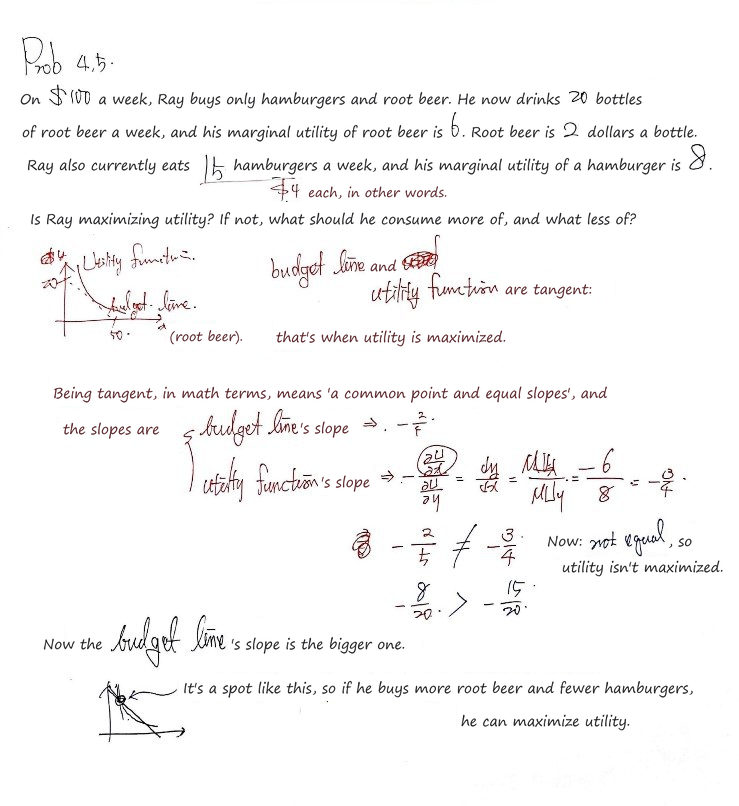
First recover the hamburger price from the actual basket: root beer costs $2\times20=40$ dollars, leaving 60 for 15 hamburgers, so each hamburger costs 4 dollars. The sheet’s later use of 5 is a slip.
Now compare the next dollar spent: root beer gives $MU_R/P_R=6/2=3$ utility units per dollar, while hamburgers give $MU_H/P_H=8/4=2$. Ray can improve his basket by shifting spending towards root beer and away from hamburgers. With root beer horizontal, the budget slope is $-2/4=-1/2$, while the indifference slope at this basket is $-6/8=-3/4$. Those slopes aren’t equal yet.
Prob 4.6 — the same comparison, reversed
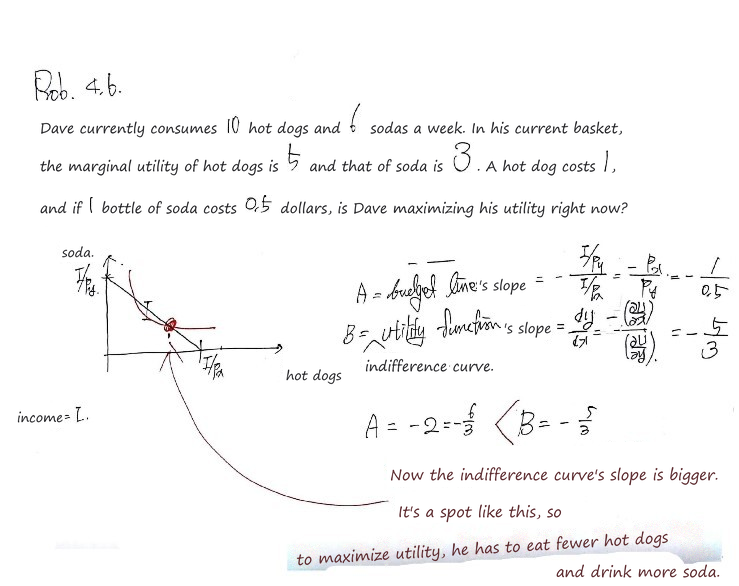
Dave’s hot dogs give $5/1=5$ utility units per dollar; soda gives $3/0.5=6$. So he should shift towards more soda and fewer hot dogs. The same answer comes from the slopes: the budget line is $-1/0.5=-2$, and the indifference curve is $-5/3$. We can identify an improving direction from the current marginal utilities, but not the exact final basket without more of his utility function.
Prob 4.8 — equal slopes can still be the wrong answer
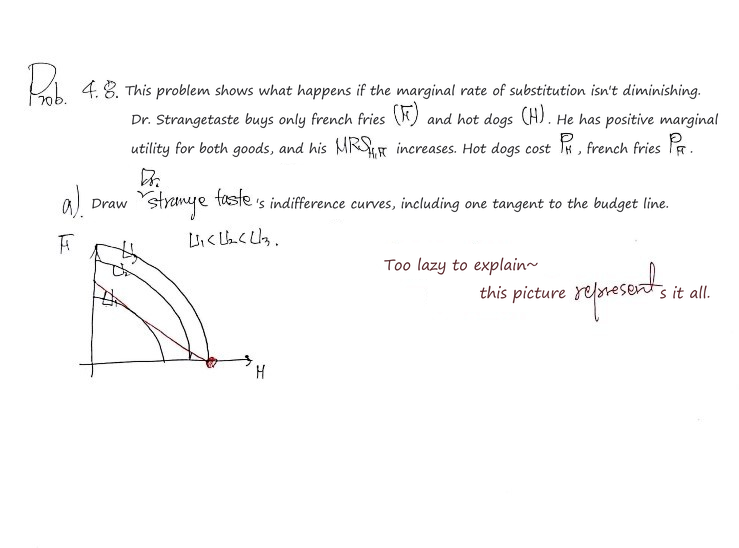
The temptation is to find a tangency and stop. Here that’s exactly the trap. An increasing MRS makes the indifference curves bow outward, so the familiar interior tangency is not a utility maximum. Moving towards a corner can reach a higher curve; the drawing shows this at the all-hot-dog end. In a particular numerical problem we would compare the two corner utilities rather than assume which good wins. Equal slopes are not a sufficient test on their own.
Prob 4.12 — recover the missing price
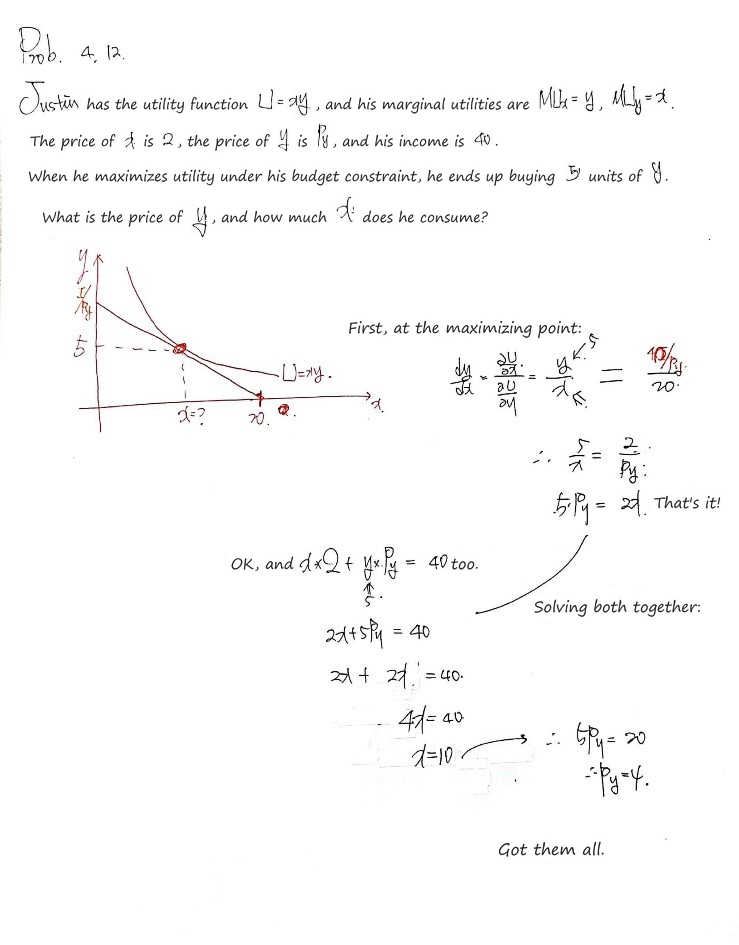
For $U=xy$, the marginal utilities are $MU_x=y$ and $MU_y=x$. At an interior optimum, the positive ratios satisfy $y/x=P_x/P_y$. We know $y=5$ and $P_x=2$, so $5/x=2/P_y$, or $5P_y=2x$.
Put that into the budget: $2x+5P_y=40$ becomes $4x=40$. Thus x = 10 and Pᵧ = 4. Check: $2(10)+4(5)=40$, and both goods give 2.5 marginal utility units per dollar. The curve slopes themselves carry minus signs; the tangency equation above compares their positive magnitudes.
Prob 4.11 — square roots, slopes and the budget
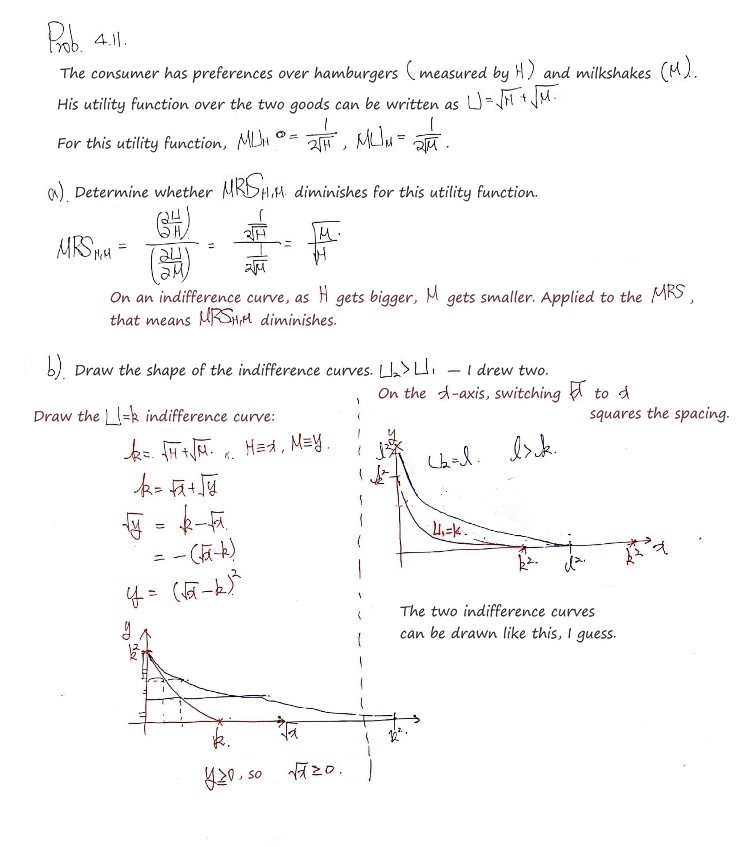
Here $U=\sqrt H+\sqrt M$ gives $MU_H=1/(2\sqrt H)$ and $MU_M=1/(2\sqrt M)$. Therefore $MRS_{H,M}=\sqrt{M/H}$. Along an indifference curve, more H means less M, making that ratio smaller.
For utility k, $\sqrt M=k-\sqrt H$ and $M=(k-\sqrt H)^2$. Keep only $0\le H\le k^2$: squaring does not permit a negative right-hand side for $\sqrt M$. The valid curve meets both axes at $k^2$.
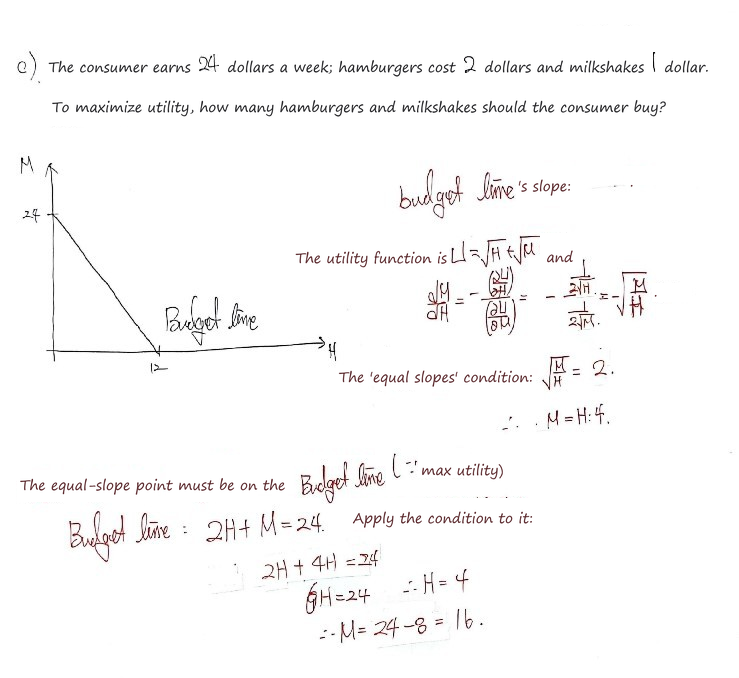
With income 24, the budget is $2H+M=24$, with slope −2. An interior optimum has $\sqrt{M/H}=2$, so $M=4H$. Substitute into the budget: $6H=24$, giving H = 4 and M = 16. The spending check is $2(4)+16=24$; the utility-per-dollar check is $[1/(2\sqrt4)]/2=[1/(2\sqrt{16})]/1=1/8$. Same answer, checked two ways.
Prob 4.17 — Meg’s kinked budget line
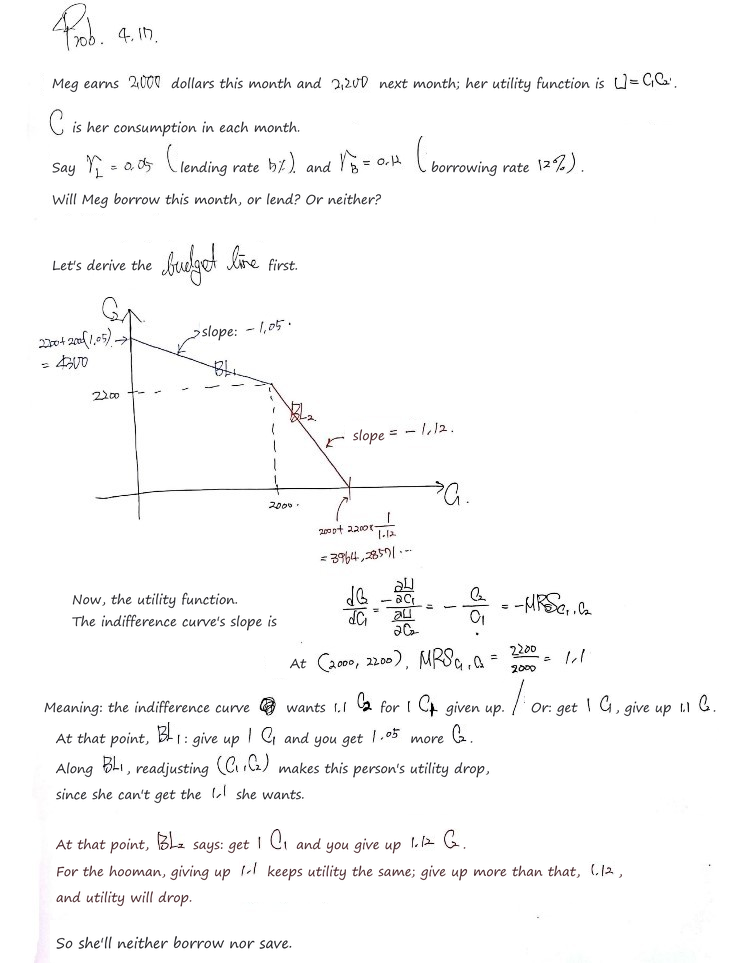
Meg starts with consumption $(C_1,C_2)=(2000,2200)$ if she neither borrows nor saves. Giving up one unit today produces 1.05 next month when she saves; getting an extra unit today costs 1.12 next month when she borrows. Those different exchange rates make the budget kink.
For $U=C_1C_2$, her MRS at the endowment is $C_2/C_1=1.1$. Saving offers less than the 1.1 she requires, while borrowing costs more than the 1.1 she is willing to give up. Since 1.05 < 1.10 < 1.12, neither direction improves utility: she stays at the kink. We don’t need to force a smooth tangency onto a point where the budget isn’t smooth.
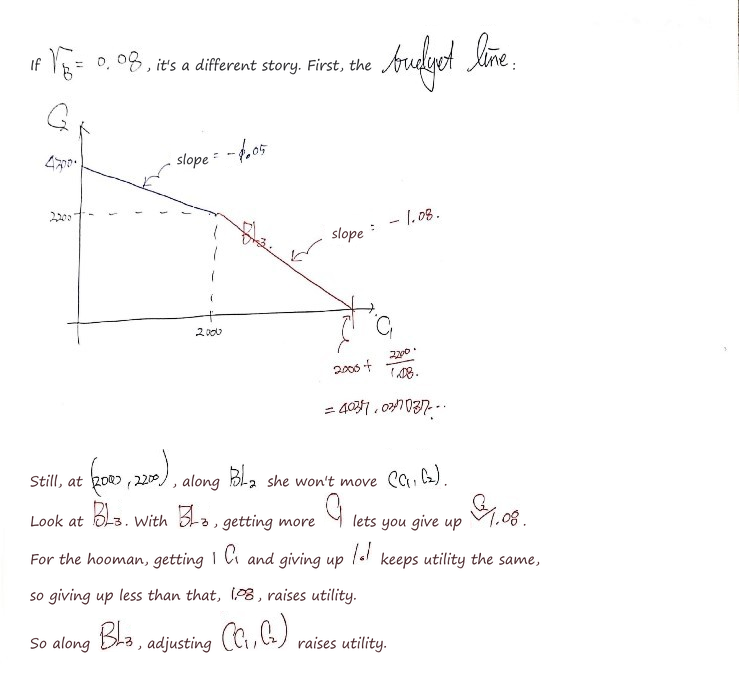
Lower the borrowing rate to 8%, and the cost of an extra unit today falls to 1.08 next month. Now it is below her MRS of 1.1, so a little borrowing improves utility. The lending side stays at 5%; the new borrowing line replaces the old 12% line.
On that borrowing segment, $C_2=2200-1.08(C_1-2000)$. Setting $C_2/C_1=1.08$ gives $C_1\approx2018.52$ and $C_2=2180$. In other words, she borrows about 18.52 now and repays 20 next month. That’s a small move to the right of the kink, exactly the direction the picture suggests.
Heads-up. The figures here are the original notes, slips and all. A few things to watch for:
- In Prob 4.5, a hamburger costs $\frac{100 - 2\cdot 20}{15} = 4$ dollars, as the red note says, so the budget line’s slope is $-\frac{2}{4} = -\frac{10}{20}$, not $-\frac{2}{5} = -\frac{8}{20}$ (and it meets the hamburger axis at 25, not 20); the indifference curve’s slope is $\frac{dy}{dx} = -\frac{MU_x}{MU_y}$, with the minus sign the middle step drops. The conclusion stands: $-\frac{10}{20} \gt -\frac{15}{20}$, so more root beer and fewer hamburgers.
- In Prob 4.11 b), only the falling half of $y = (\sqrt{x} - k)^2$ is the indifference curve: $\sqrt{y} = k - \sqrt{x} \ge 0$ means $\sqrt{x} \le k$.
- In Prob 4.11 c), the blank for the budget line’s slope is $-\frac{P_H}{P_M} = -2$.
- In Prob 4.17 with $r_B = 0.08$, the line along which Meg still won’t move from (2000, 2200) is the lending line $BL_1$ (slope $-1.05$); the 12% borrowing line $BL_2$ is gone, replaced by $BL_3$.
- For the slopes in Prob 4.12 and 4.11 c), keep dy/dx = −MU_x/MU_y. The positive MU ratio equals the positive price ratio at tangency; both actual curve slopes are negative. The final allocations shown are unchanged.
Comments
Discussion happens via GitHub Discussions. You'll need a GitHub account to comment.