Practice Problems: Chapter 19
Working through Chapter 19 practice problems on average energy, the equipartition theorem, and potential wells — plus one I got stuck on and would love feedback on!
Prob 19.1
He atom, Xe atom, Ar atom, Kr atom: what is the average energy of the gas at room temperature, in eV?
Hint: do we even have to calculate all four?
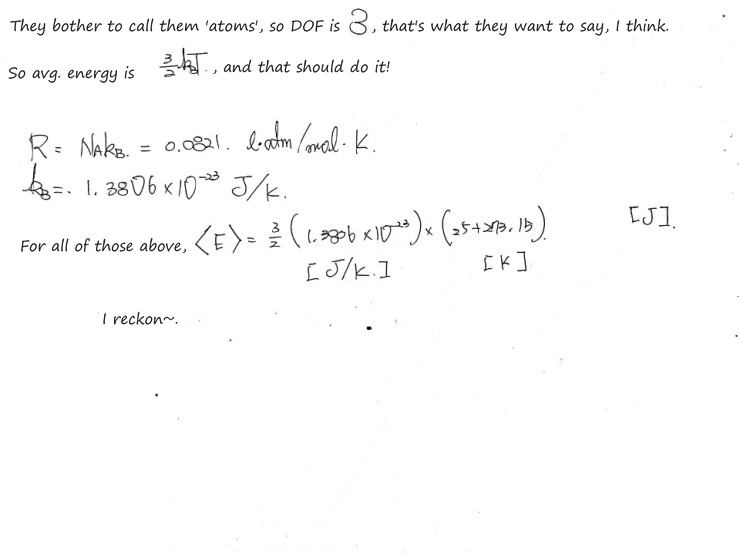
At 25°C, that is about $0.0385\,\mathrm{eV}$ per atom for all four.
Prob 19.3
A particle at position $r$ is inside the following potential well $V(r)$.

Here $A$ and $B$ are positive constants and $n \gt 2$. Show that the bottom of the well can be approximated by a quadratic term. So, assuming the equipartition theorem is valid in this situation, find the average energy of the particle above the bottom of the well at temperature $T$.
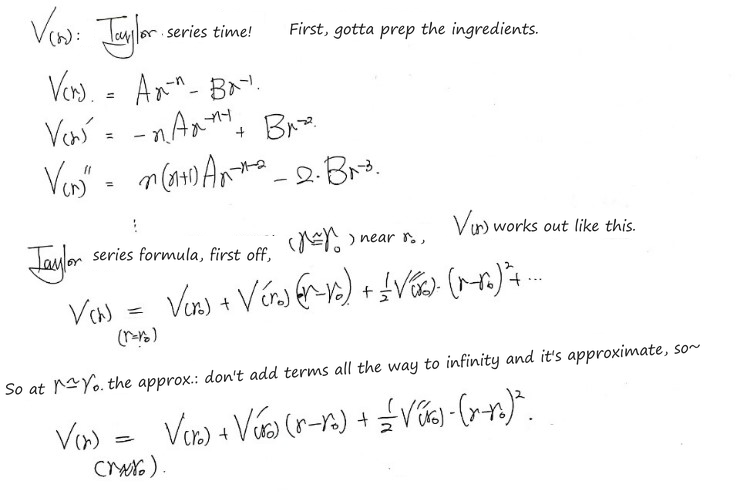
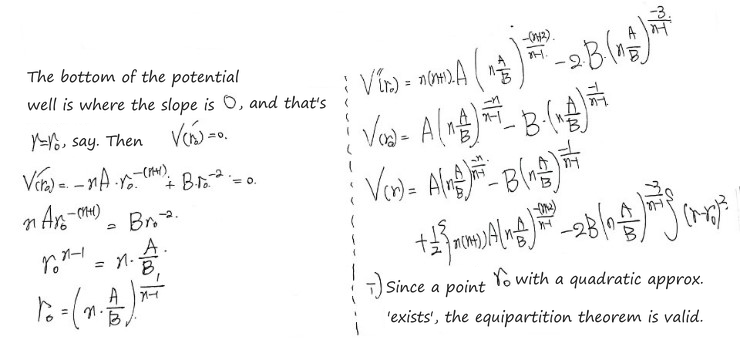
In the local classical approximation, the mean potential energy above the minimum is $k_BT/2$. If r is the single coordinate of a one-dimensional oscillator and we include its kinetic energy too, the total mean energy above the bottom is $k_BT$.
Prob 19.4
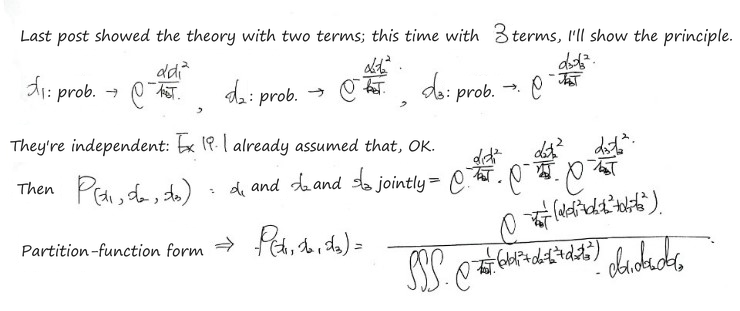
In Example 19.1, show the following:


Prob 19.5
If the energy $E$ of the system is not a quadratic term but is given like  , show that the average energy is
 .

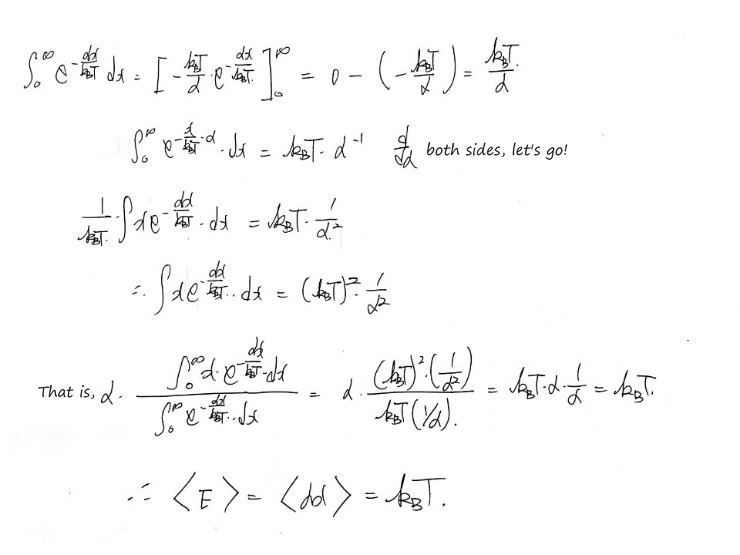

(For the very last problem, I got this far but I can’t get to the conclusion. I’m putting it up here because I’d love for someone to point out what I’m missing.)
Heads-up. The figures here are the original notes, slips and all. A few things to watch for:
- In the last line of the general case $E = \alpha|x|^n$, the minus sign of the line above stays: $\langle E\rangle = -\alpha k_BT\,\frac{\frac{d}{d\alpha}\int e^{-\alpha x^n/k_BT}dx}{\int e^{-\alpha x^n/k_BT}dx}$. The integral is proportional to $\alpha^{-1/n}$, so this finishes at $\langle E\rangle = \frac{k_BT}{n}$ ($\frac{1}{2}k_BT$ for $n = 2$, as equipartition says, and $k_BT$ for $n = 1$, as in the problem before).
- A quadratic approximation does not by itself guarantee classical equipartition: the thermal motion must stay near the minimum and quantum level spacing must be negligible on the temperature scale.
Comments
Discussion happens via GitHub Discussions. You'll need a GitHub account to comment.