Practice Problems: Chapter 23
Working through Chapter 23 practice problems on photons by hand: where u_ν and u_λ peak (x = 2.821 and 4.965), why a photon gas has s = 4p/T, G = 0, C_V/V = 3s and a special constant-pressure limit, ln Z, F, S, U and p from the partition function, and 2.701 k_BT of energy and 3.602 k_B of entropy per photon, which is not an ideal gas's (3/2)k_BT.
Prob 23.2
These two spectra describe the same radiation, but they count energy per frequency interval and per wavelength interval. That’s why their peaks needn’t correspond to the same photon energy. We’ll use $\beta=1/(k_BT)$ below.
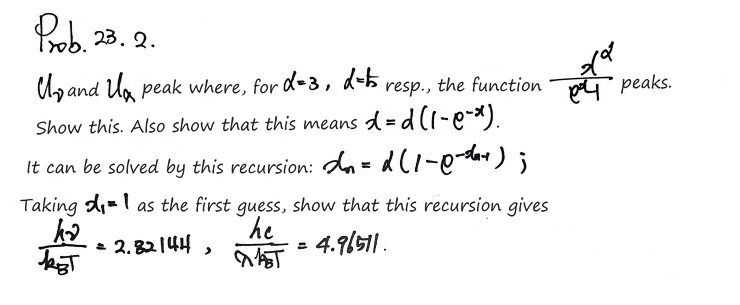
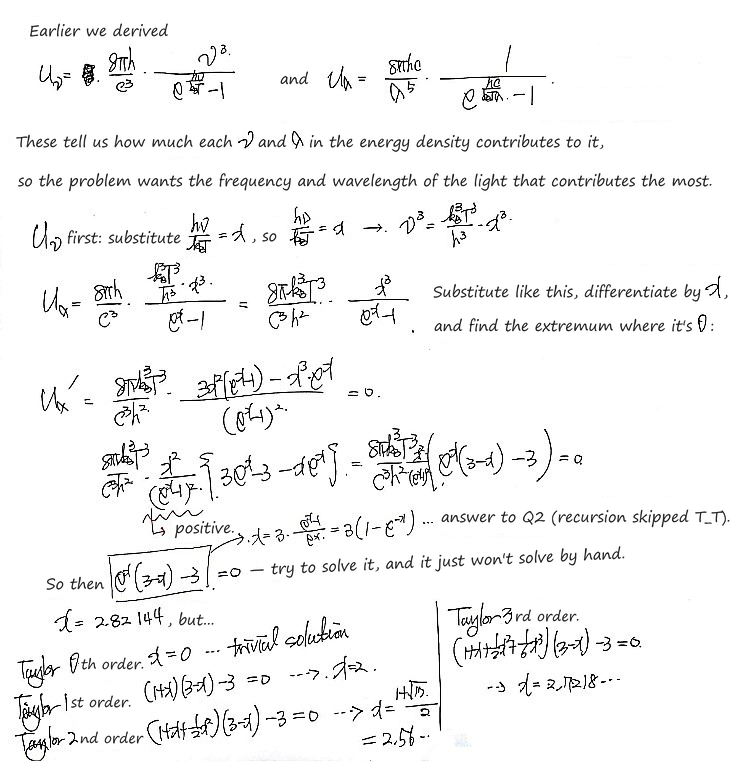
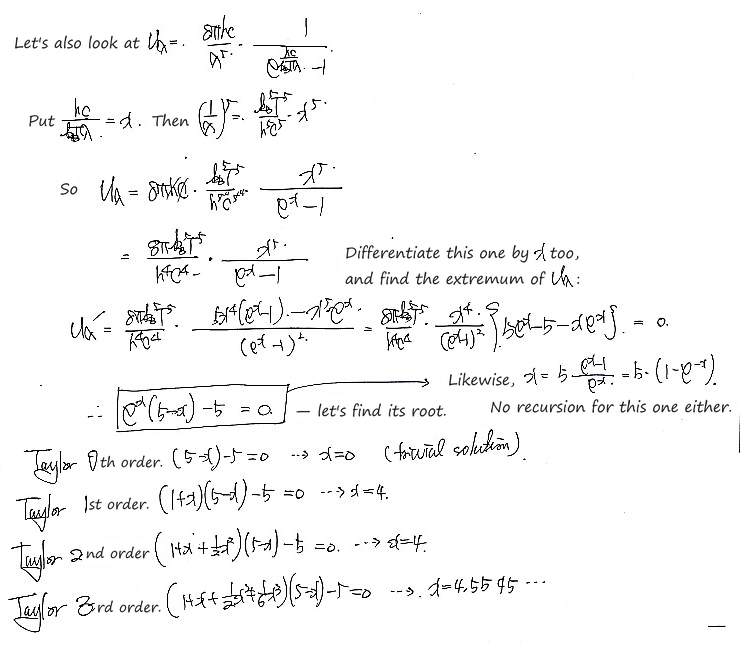
After the substitutions on the sheets, both peak problems reduce to $f(x)=x^\alpha/(e^x-1)$. Differentiating for $x>0$ gives
$$ f'(x)=\frac{x^{\alpha-1}[\alpha(e^x-1)-xe^x]} {(e^x-1)^2},\qquad x=\alpha(1-e^{-x}). $$Starting with $x_1=1$ and repeatedly evaluating the right-hand side gives the nonzero roots $2.82144$ for $\alpha=3$ and $4.96511$ for $\alpha=5$. The root $x=0$ is the endpoint, not the spectral peak. The low-order Taylor attempts in the notes are rough approximations; the wavelength case gives about $4.70$ and $4.86$ at second and third order, rather than the values written there.
To compare the two spectra, remember the interval conversion:
$$ u_\lambda=u_\nu\left|\frac{d\nu}{d\lambda}\right| =u_\nu\frac{c}{\lambda^2},\qquad \nu=\frac{c}{\lambda}. $$That extra factor changes the shape. So we shouldn’t take the frequency peak and simply call $c/\nu_{peak}$ the wavelength peak.
Prob 23.5
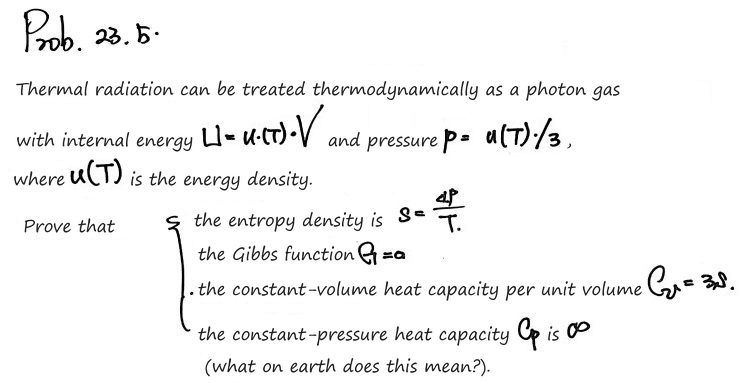
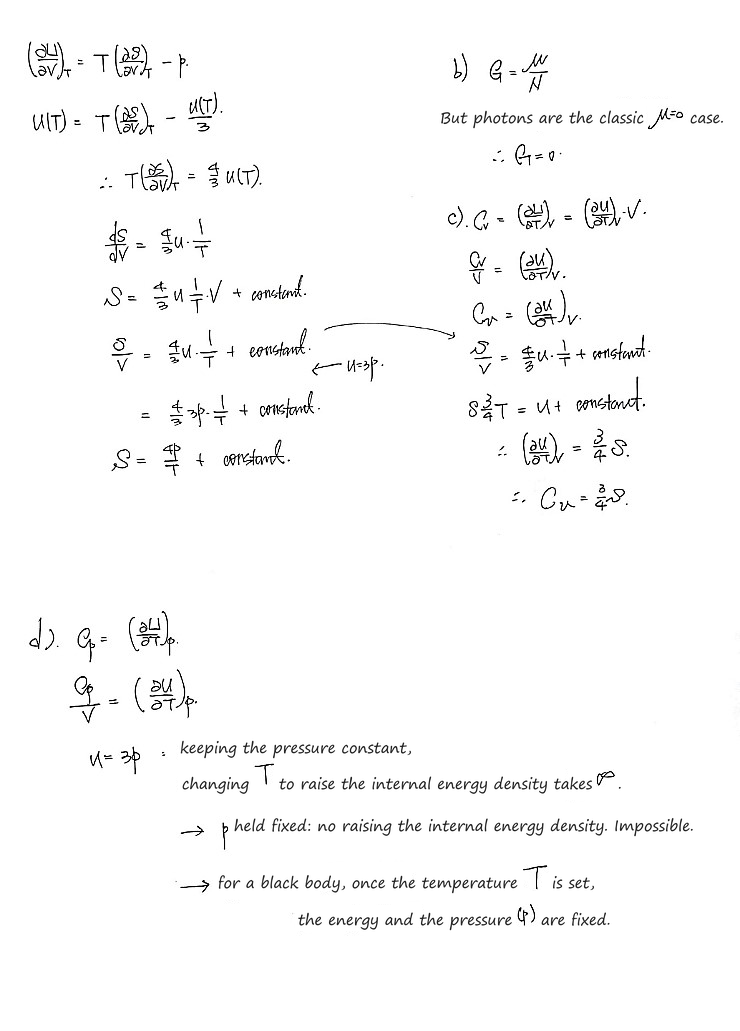
Let’s separate totals from densities: $u=U/V$ and $s=S/V$. Write the radiation energy density as $u=aT^4$, where $a=4\sigma/c$; 23.6 below gets this temperature dependence from the partition function. For equilibrium photons $\mu=0$, so $U=TS-pV$. Together with $p=u/3$, this gives
$$ s=\frac{u+p}{T}=\frac{4p}{T} =\frac43aT^3,\qquad G=U+pV-TS=0. $$Now the heat-capacity check is straightforward:
$$ \frac{C_V}{V}=\frac{du}{dT}=4aT^3=3s, \qquad C_V=3S. $$The $3s/4$ at the end of the handwritten calculation is a slip. Also, the statement’s “infinite $C_p$” needs care: fixing $p=aT^4/3$ already fixes $T$. Radiation can absorb heat and expand while staying at that temperature. There is no ordinary finite heat-capacity derivative with $T$ and $p$ independently variable here; it isn’t a claim that the energy density itself becomes infinite.
Prob 23.6
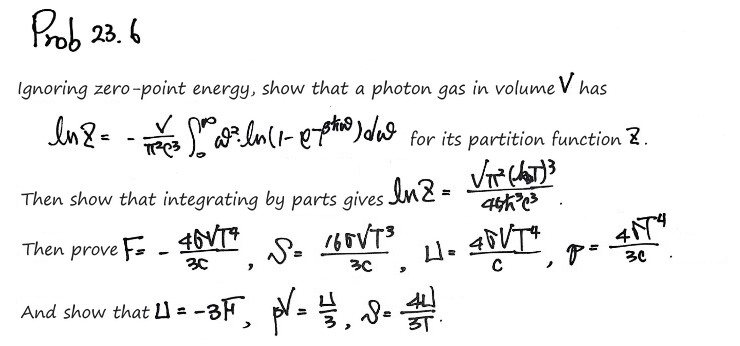
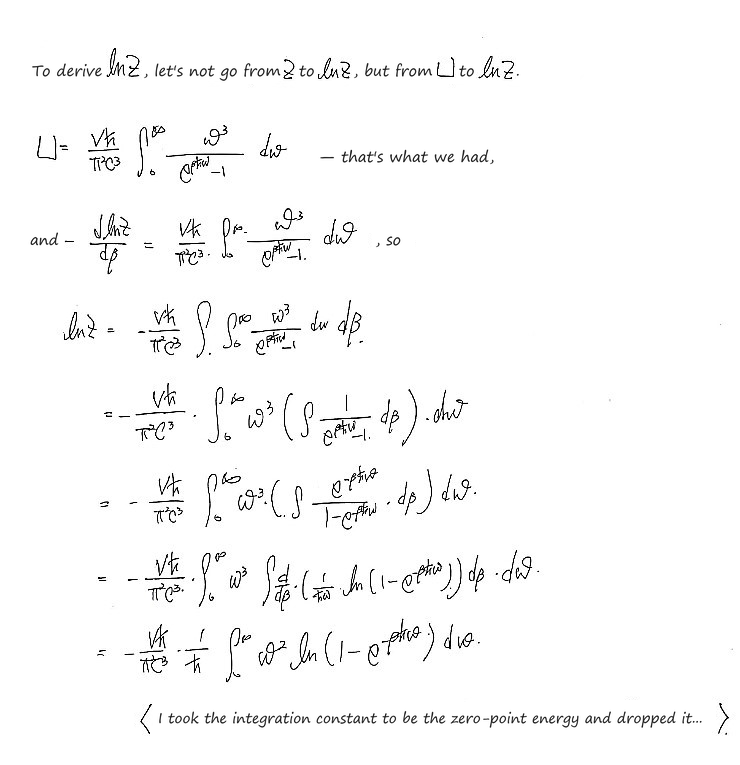
The energy formula lets us integrate $U=-\partial_\beta\ln Z$ with respect to $\beta$. For the integral over modes, the derivative
$$ \frac{\partial}{\partial\beta}\ln(1-e^{-\beta\hbar\omega}) =\frac{\hbar\omega}{e^{\beta\hbar\omega}-1} $$is the useful step. Integration leaves a $\beta$-independent constant in $\ln Z$. Here we fix it by $Z\to1$ as $T\to0$, with a unique vacuum and zero-point energy omitted. An energy-reference shift would instead add a term proportional to $\beta$; it isn’t that integration constant.
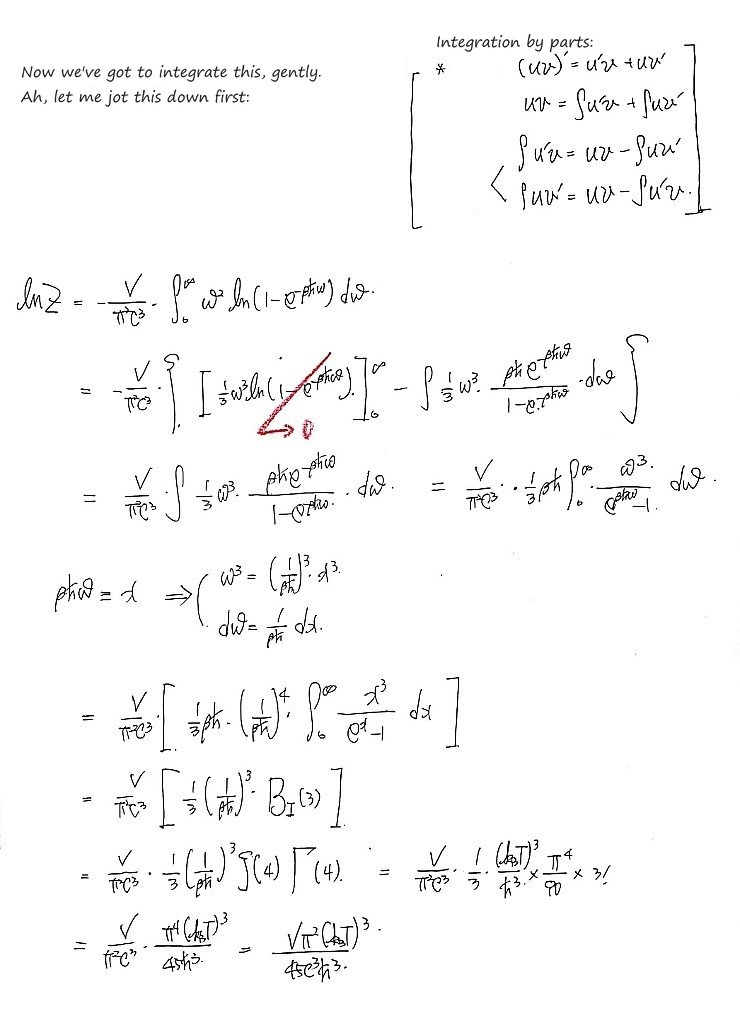
For integration by parts, the endpoint term $\omega^3\ln(1-e^{-\beta\hbar\omega})$ vanishes at both ends. Set $x=\beta\hbar\omega$ in the remaining integral and use
$$ \int_0^\infty\frac{x^3\,dx}{e^x-1} =\Gamma(4)\zeta(4)=\frac{\pi^4}{15}. $$That leaves $\ln Z=V\pi^2/[45\hbar^3c^3\beta^3]$. The power $\beta^{-3}$ is worth keeping visible, because differentiating it gives the fourth power of temperature in $U$.
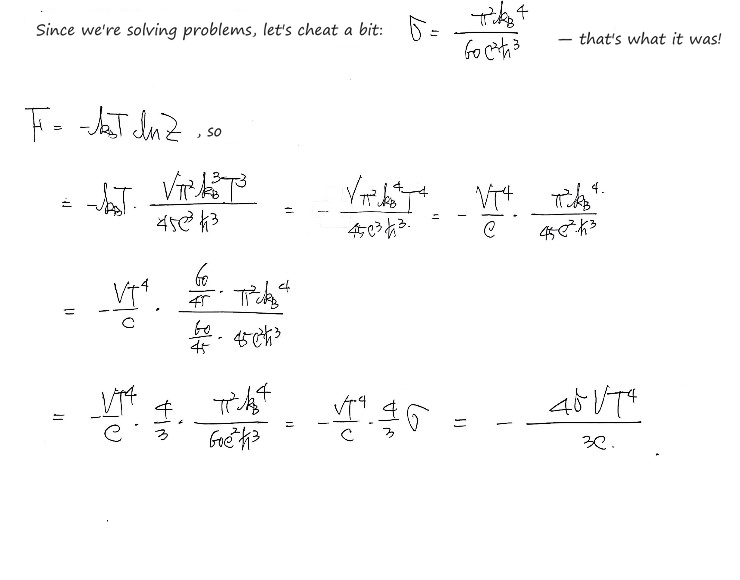
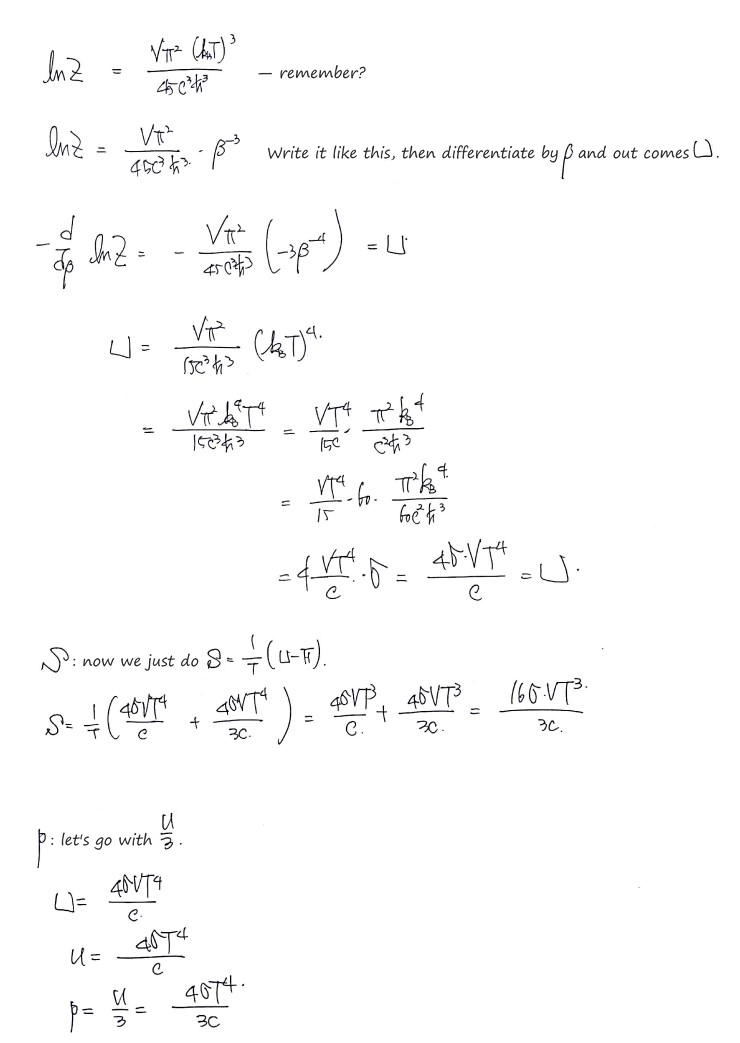
We can check all four results from the same $F$, rather than treating them as separate formulas:
$$ F=-\frac{aVT^4}{3},\quad S=-\left(\frac{\partial F}{\partial T}\right)_V =\frac{4aVT^3}{3},\quad p=-\left(\frac{\partial F}{\partial V}\right)_T =\frac{aT^4}{3}. $$Then $U=F+TS=aVT^4$. So the requested relations $U=-3F$, $pV=U/3$ and $S=4U/(3T)$ agree with one another. Substituting $a=4\sigma/c$ gives the forms on the problem sheet.
Prob 23.7
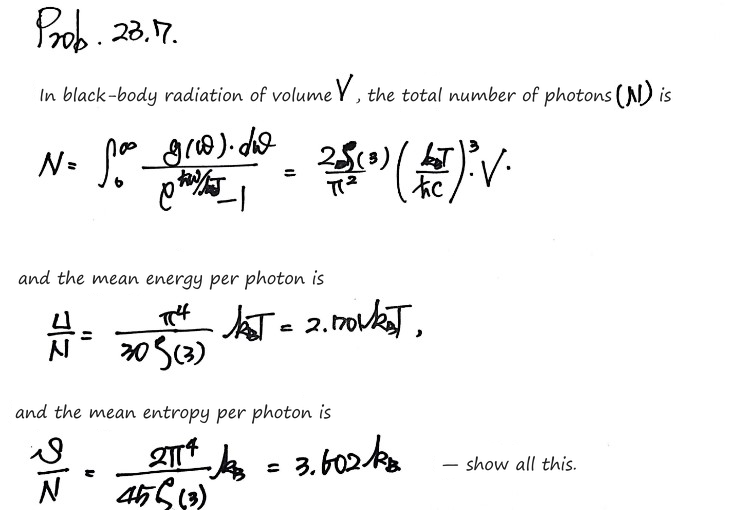
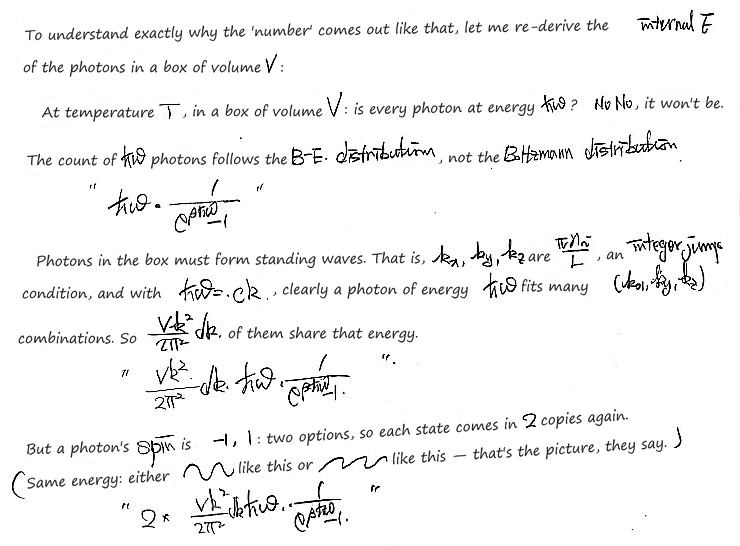
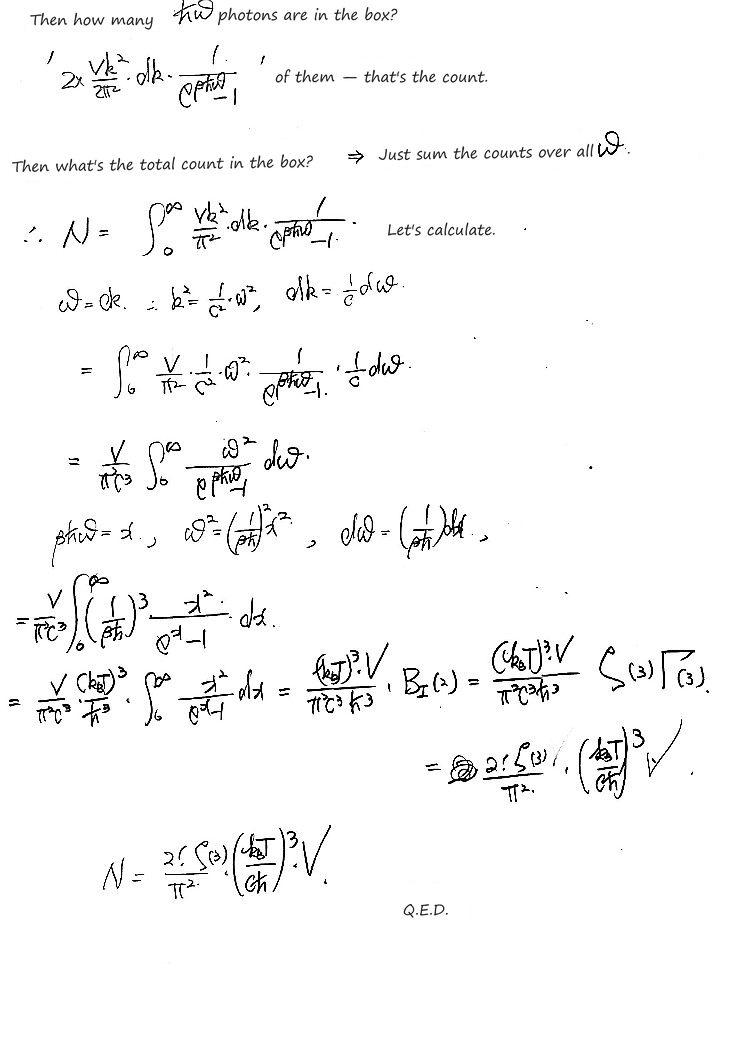
Here’s the counting distinction that matters. The number of modes in $d\omega$, including the two photon polarizations, is $V\omega^2d\omega/(\pi^2c^3)$. Each mode has mean occupation $1/(e^{\beta\hbar\omega}-1)$, since $\mu=0$. Multiply those to count photons; multiply once more by $\hbar\omega$ to count their energy. We use $\omega=ck$, so the photon energy is $\hbar\omega=\hbar ck$.
For the number integral, $x=\beta\hbar\omega$ gives $\int_0^\infty x^2/(e^x-1)\,dx=\Gamma(3)\zeta(3)=2\zeta(3)$. Hence
$$ N=\frac{2\zeta(3)V}{\pi^2} \left(\frac{k_BT}{\hbar c}\right)^3. $$This is an occupation-weighted count, not a partition function. The last sheet labels a count of this kind $Z$; keep that distinction in mind.
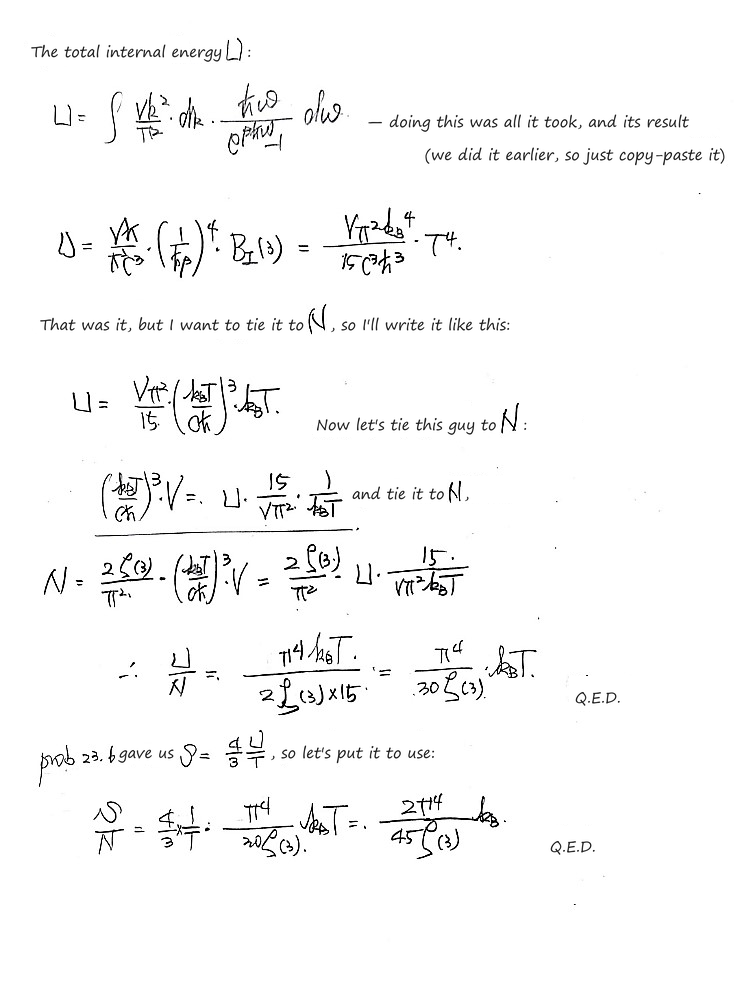
Dividing the energy by the number cancels $V$ and three powers of temperature:
$$ \frac{U}{N}=\frac{\pi^4}{30\zeta(3)}k_BT \approx2.70118\,k_BT. $$Using $S=4U/(3T)$ immediately gives $S/N\approx3.60157\,k_B$. The extra $V$ in an intermediate rearrangement on the sheet isn’t needed: both totals were already proportional to the same volume.
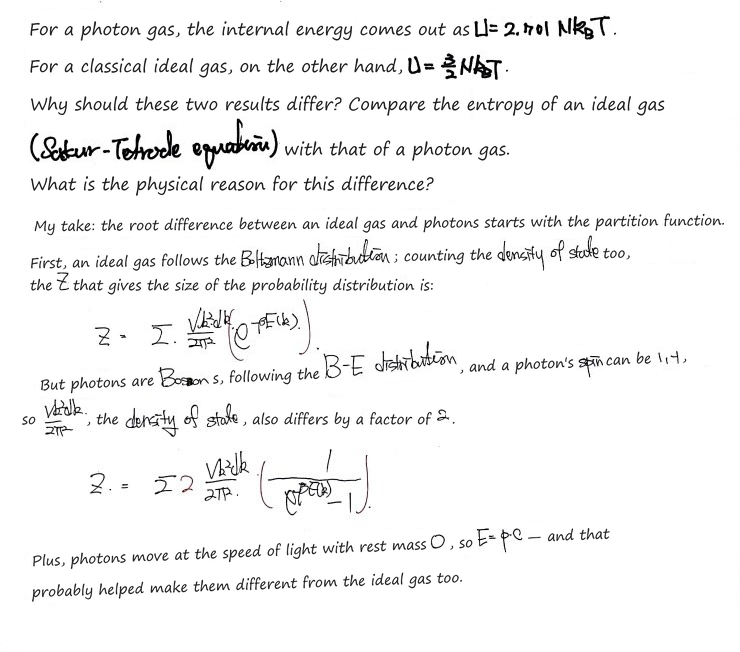
Why doesn’t this give the familiar $3k_BT/2$? That classical result uses quadratic translational energy and Boltzmann statistics for a fixed number of massive particles. Here the energy is linear in momentum, $E=pc$, and the occupation is Bose-Einstein with $\mu=0$. The two polarizations multiply both $U$ and $N$, so they cancel in the ratio; they don’t explain the coefficient $2.70118$ by themselves.
The entropy comparison has the same restriction: the Sackur-Tetrode formula describes a classical gas with a specified particle number. In equilibrium radiation, photons can be created or absorbed, so $N$ changes with $V$ and $T$. We should compare the two physical setups, rather than insert photons into the massive-gas formula.
Heads-up. The figures here are the original notes, slips and all. A few things to watch for:
- In Prob 23.2, for the peak of $u_\lambda$ the Taylor approximations of $e^x(5 - x) - 5 = 0$ give $x \approx 4.70$ at second order and $x \approx 4.86$ at third order (the sheet writes 4 and 4.5545); the exact root 4.965 and the roots for $u_\nu$ are right.
- In Prob 23.5 c), $C_V = \frac{du}{dT} = 4aT^3 = 3s$, as the statement says (the sheet ends with $\frac{3}{4}s$). Also $G = \mu N$, which is 0 because $\mu = 0$ for photons, and $C_p = \left(\frac{\partial H}{\partial T}\right)_p$.
- In Prob 23.7, the energy integral runs over $\omega$ only, and tying it to $N$ gives $\left(\frac{k_BT}{c\hbar}\right)^3 V = \frac{15U}{\pi^2 k_BT}$, with no second $V$; $\frac{U}{N} = \frac{\pi^4}{30\zeta(3)}k_BT$ is right. On the last sheet, the sum with $\frac{1}{e^{\beta\hbar\omega} - 1}$ counts the photons, $N$; it is not a partition function $Z$.
- Here $3s$ is the heat capacity per volume, so the total is $C_V=3S$. For equilibrium radiation $p=aT^4/3$, fixed pressure also fixes temperature. The stated “infinite $C_p$” is a formal way of saying heat can be added by expanding the radiation at constant T; there is no ordinary finite derivative with T and p independently variable.
- Integrating $U=-\partial\ln Z/\partial\beta$ leaves a β-independent constant in ln Z. It is fixed here by $Z\to1$ as $T\to0$ with a unique vacuum and zero-point energy omitted; a constant energy shift would instead add a term linear in β.
- Use $\omega=ck$ and photon energy $\hbar\omega=\hbar ck$. Number counting has the occupation factor alone; energy counting adds $\hbar\omega$. The two photon polarizations multiply both U and N, so they cancel in U/N: the mean-energy difference comes from the linear dispersion and Bose–Einstein distribution at μ=0.
Comments
Discussion happens via GitHub Discussions. You'll need a GitHub account to comment.