Practice Problems: Chapter 25
Working through Chapter 25 practice problems by hand: the volume of a D-dimensional hypersphere from two Gaussian tricks (α = 2π^(D/2)/(DΓ(D/2)), which gives πr² and (4/3)πr³), the density of states in D dimensions with spin degeneracy g, and, for a general dispersion relation E = αp^s, the density of states in energy and the single-particle partition function Z₁ = V/λ^D.
The long algebra on these sheets is doing three things: find the volume of a sphere in $D$ dimensions, use its thin shells to count states, then change the state labels from $k$ to energy. Let’s separate those steps so the factors of $2\pi$ don’t all arrive at once.
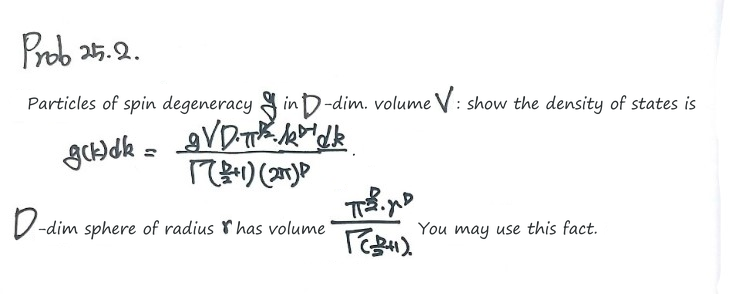
Prob 25.2 — The same Gaussian, counted two ways
First we need the volume inside a radius $r$. Its boundary satisfies $x_1^2+\cdots+x_D^2=r^2$. Call the enclosed volume $V_D(r)=C_Dr^D$; I’ll use $C_D$ here so it won’t get confused with the dispersion constant $\alpha$ in the next problem.
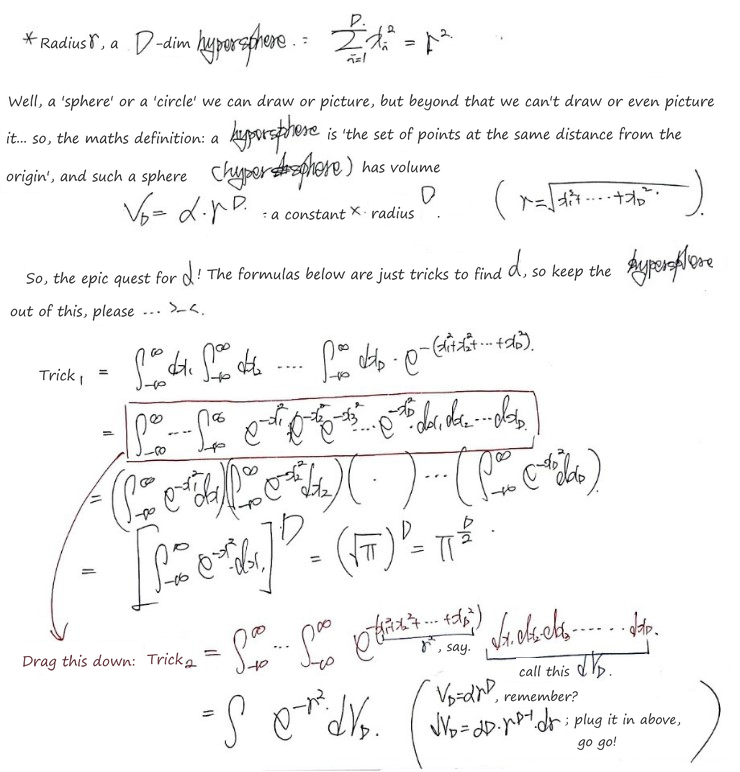
The trick is to calculate one integral twice. Integrating separately along each coordinate gives $(\sqrt\pi)^D$. Using radial shells gives
$$ \pi^{D/2}=C_DD\int_0^\infty r^{D-1}e^{-r^2}\,dr =\frac{C_DD}{2}\Gamma(D/2). $$In the last step, put $x=r^2$. The factor $1/2$ comes from $dr=dx/(2\sqrt x)$ — easy to lose that one!
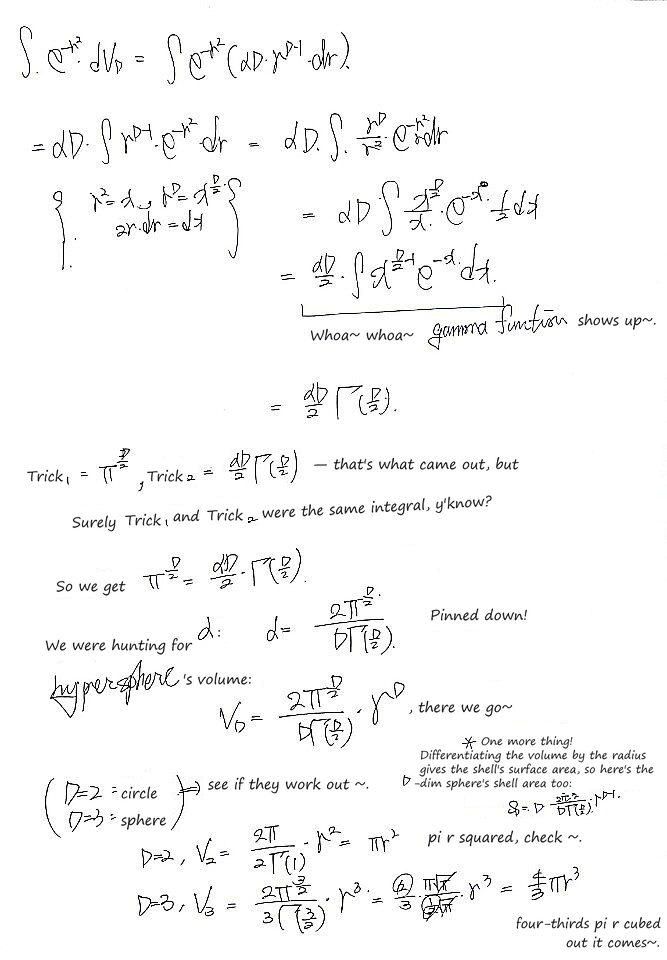
So $C_D=\pi^{D/2}/\Gamma(D/2+1)$, using $\Gamma(z+1)=z\Gamma(z)$. Check the familiar cases: $D=2$ gives $\pi r^2$, and $D=3$ gives $4\pi r^3/3$. Good. Differentiating the enclosed volume gives the thin-shell measure
$$ dV_D=\frac{2\pi^{D/2}}{\Gamma(D/2)}r^{D-1}\,dr. $$Now use that shell in $k$-space. With the periodic-box counting used on the sheet, each allowed wavevector occupies a cell $(2\pi/L)^D$, and $L^D=V$.
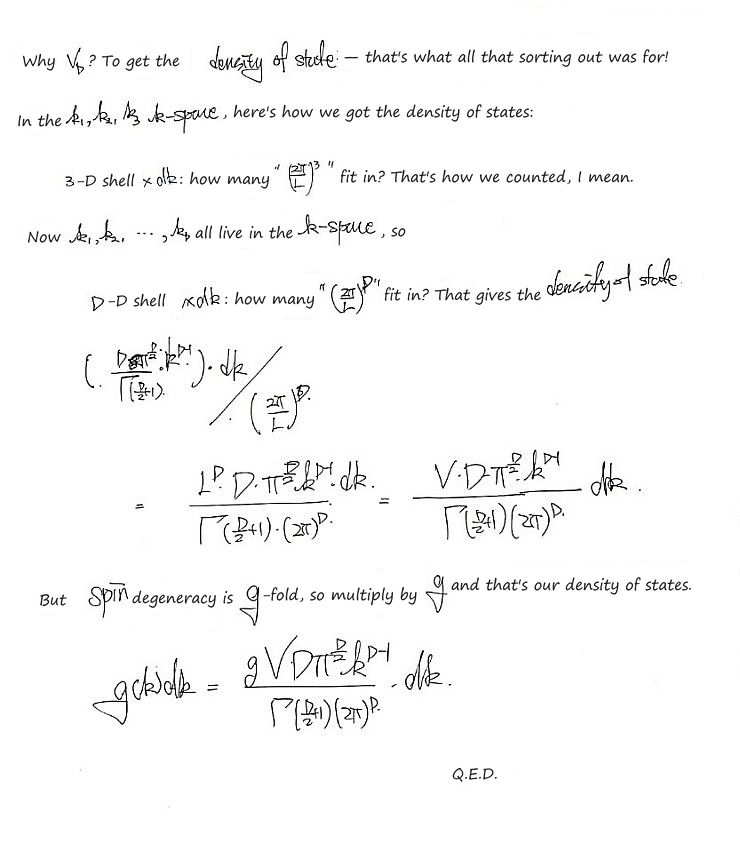
Divide the shell measure by the cell size and multiply by the $g$ degenerate spin states:
$$ g(k)\,dk=\frac{gV}{(2\pi)^D} \frac{2\pi^{D/2}}{\Gamma(D/2)}k^{D-1}\,dk. $$This is the same coefficient as the problem’s version with $D/\Gamma(D/2+1)$. The continuum approximation treats a large box’s closely spaced $k$ points as a smooth density.
Prob 25.3 — Relabel the states by energy
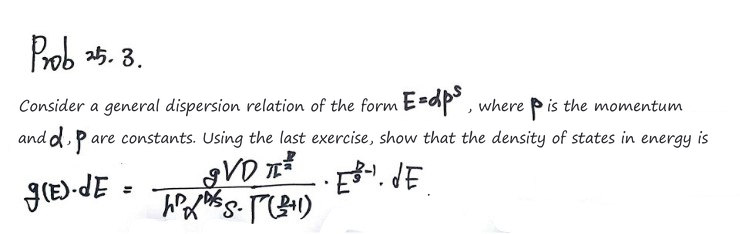
Here $E=\alpha p^s$, with $\alpha>0$ and $s>0$; $p$ is the momentum magnitude. Since $p=\hbar k$, energy increases with $k$. We are counting the same states, just putting energy labels on them now.
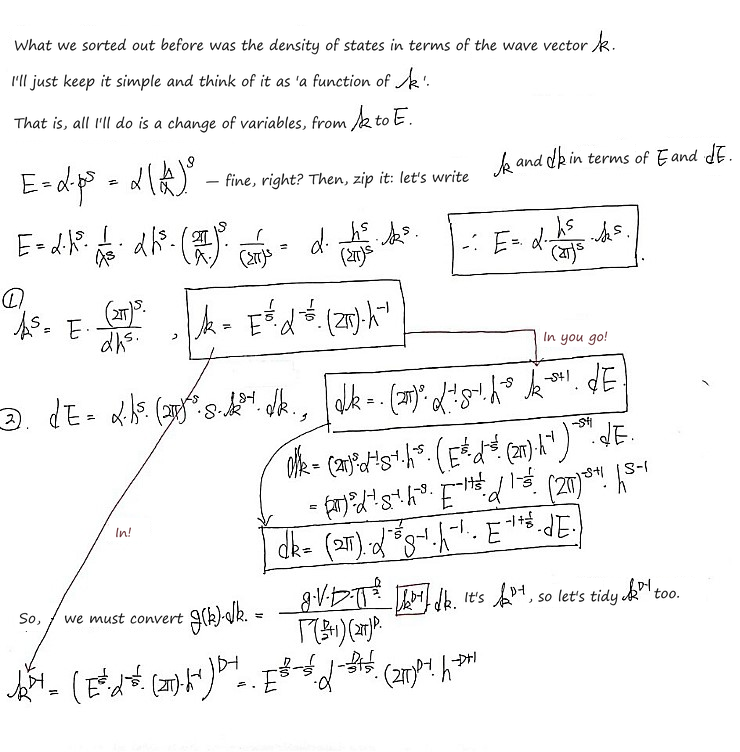
The change of variables is
$$ k=\frac{E^{1/s}}{\hbar\alpha^{1/s}}, \qquad \frac{dk}{dE}=\frac{E^{1/s-1}}{s\hbar\alpha^{1/s}}. $$Multiply that derivative by $k^{D-1}$. The energy powers combine to $D/s-1$; the $D$ factors of $\hbar$ turn the denominator $(2\pi)^D\hbar^D$ into $h^D$.
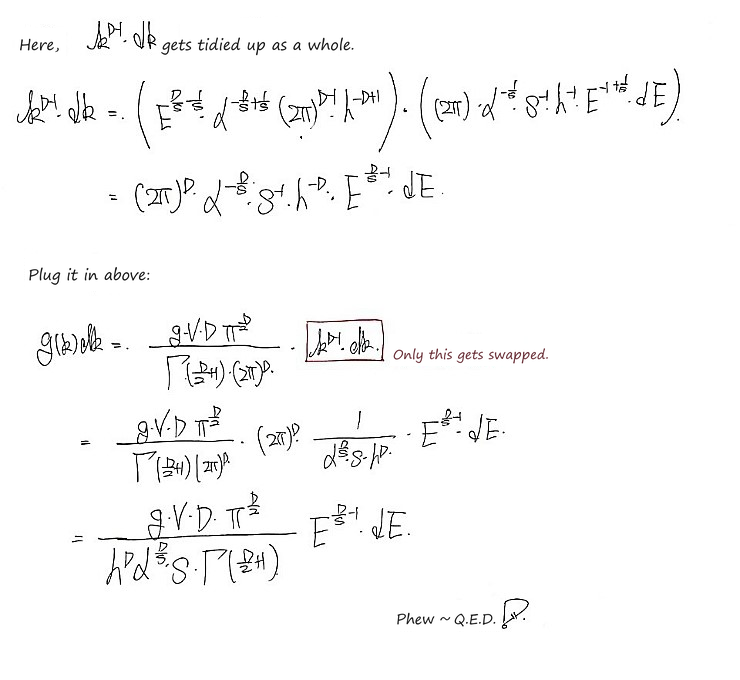
That is why $g(E)$ has the form written on the sheet, proportional to $E^{D/s-1}$. As a quick check, ordinary quadratic motion ($s=2$) gives a density proportional to $\sqrt E$ in three dimensions, and a constant density in two.
For the partition function, start from its definition: $Z_1$ sums $e^{-\beta E}$ over states. When we integrate over energy instead, the density of states supplies how many states lie in each interval $dE$:
$$ Z_1=\int_0^\infty g(E)e^{-\beta E}\,dE. $$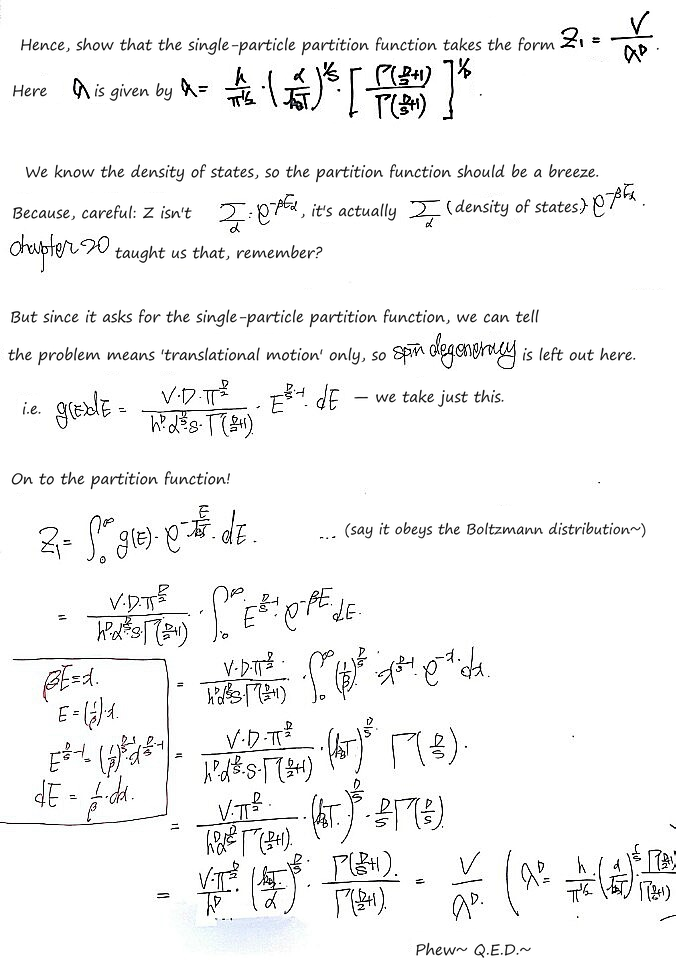
The remaining integral is $\int_0^\infty E^{D/s-1}e^{-\beta E}dE=\beta^{-D/s}\Gamma(D/s)$. With the coefficient from the previous sheet, this gives
$$ Z_1=\frac{gV\pi^{D/2}}{h^D} \frac{\Gamma(D/s+1)}{\Gamma(D/2+1)} \left(\frac{k_BT}{\alpha}\right)^{D/s} =\frac{gV}{\lambda^D}, $$where
$$ \lambda=\frac{h}{\sqrt\pi} \left(\frac{\alpha}{k_BT}\right)^{1/s} \left[\frac{\Gamma(D/2+1)}{\Gamma(D/s+1)}\right]^{1/D}. $$The notes’ $V/\lambda^D$ is the result per internal state, or with $g=1$. One particle can still have several spin states! Also, the bracket at the bottom of the sheet gives $\lambda$ itself, despite its $\lambda^D$ label.
For a last check, set $s=2$ and $\alpha=1/(2m)$. The gamma functions cancel and $\lambda=h/\sqrt{2\pi mk_BT}$ — back to the familiar thermal wavelength. Its units are length, and $gV/\lambda^D$ is dimensionless, just as a partition function should be.
Heads-up. The figures here are the original notes, slips and all. A few things to watch for:
- In the statement of Prob 25.3, the constants in $E = \alpha p^s$ are $\alpha$ and $s$; $p$ is the momentum.
- The single-particle partition function is $Z_1 = \sum e^{-\beta E}$ over all states, by definition; the density of states comes in when that sum over states is turned into an integral over energy, $Z_1 = \int_0^\infty g(E)\,e^{-\beta E}\,dE$, which is what the sheet then does. In the last bracket, the expression is $\lambda$ itself, $\lambda = \frac{h}{\sqrt{\pi}}\left(\frac{\alpha}{k_BT}\right)^{1/s}\left[\frac{\Gamma(D/2 + 1)}{\Gamma(D/s + 1)}\right]^{1/D}$ (the bracket labels it $\lambda^D$); $Z_1 = \frac{V}{\lambda^D}$ is right.
- The final $Z_1=V/\lambda^D$ is the translational partition function per internal state, or assumes $g=1$. A single particle can still have spin degeneracy: including the g states gives $Z_1=gV/\lambda^D$. The dispersion integral assumes $\alpha>0$ and $s>0$.
Comments
Discussion happens via GitHub Discussions. You'll need a GitHub account to comment.