Practice Problems: Chapter 21
Working through Chapter 21 practice problems by hand: the partition function of a 2D gas, why the Sackur-Tetrode entropy is extensive (and the distinguishable-particle one isn't), counting states below E_max, and a gas of two-level atoms.
These four problems all start with the same question: what states can the particle occupy? Once that count is in the partition function, the entropy and heat capacity follow from it. Let’s keep an eye on that connection while working through the sheets.
The gas formulas use the dilute classical limit. The box is also large enough that we can replace the closely spaced translational energy levels by an integral. Write $\beta=1/(k_BT)$.
Prob 21.1 — A gas with one less direction to move
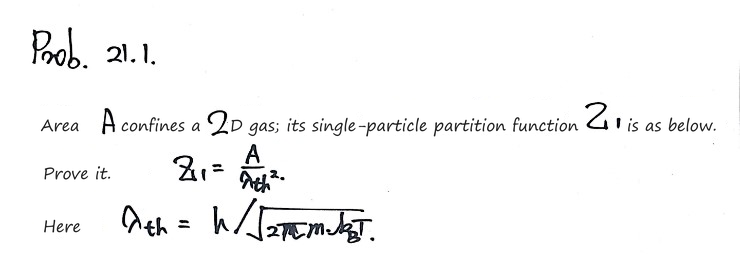
The square has side $L=\sqrt A$. Its standing waves have $k_x=n_x\pi/L$ and $k_y=n_y\pi/L$, with positive integers $n_x,n_y$. For the wavefunction, the normalized prefactor is $2/\sqrt A$; the $2/A$ in the sheet is a slip.
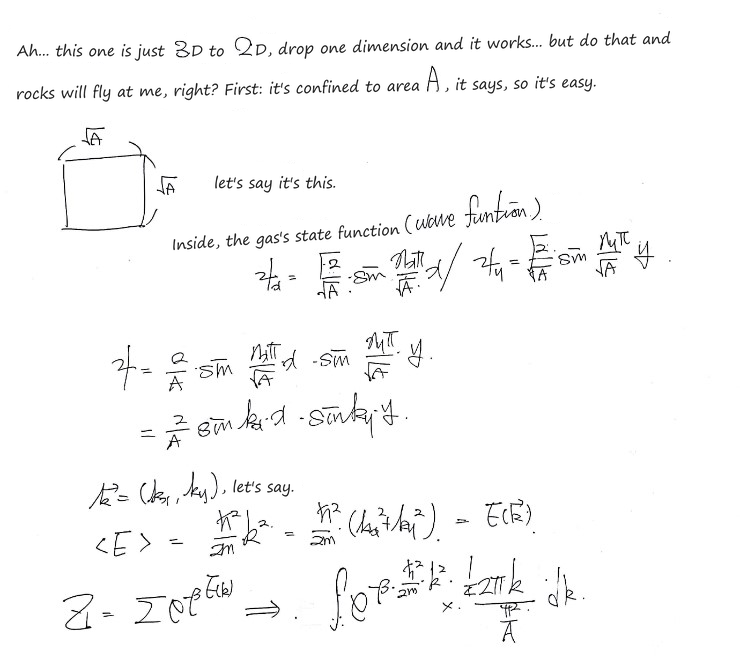
Where does that $A/(2\pi)$ in the integral come from? Each allowed state occupies a cell of area $(\pi/L)^2$ in $k$-space. We only use the positive quadrant, so the thin ring contributes $(2\pi k\,dk)/4$. Divide ring area by cell area and we get $A k\,dk/(2\pi)$. Ahh, that’s the state count!
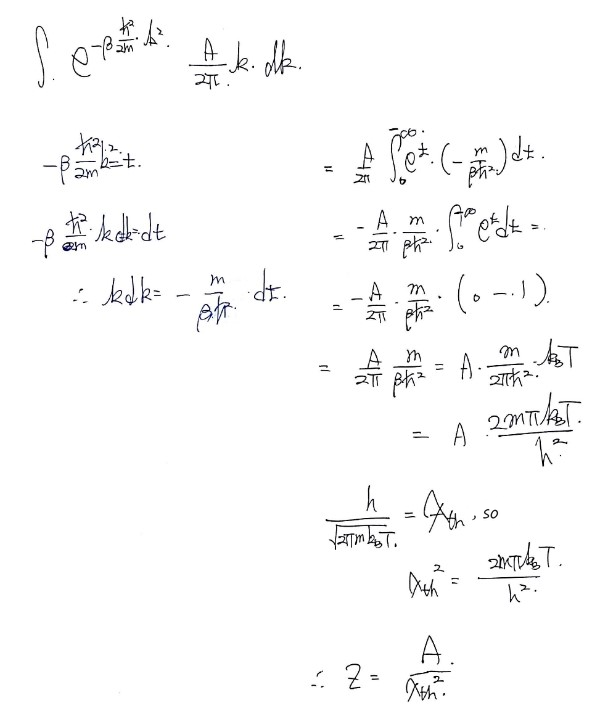
With $E=\hbar^2k^2/(2m)$, the remaining integral is just a Gaussian:
$$ Z_1=\frac{A}{2\pi}\int_0^\infty k\,e^{-\beta\hbar^2k^2/(2m)}\,dk =\frac{Am}{2\pi\beta\hbar^2} =\frac{A}{\lambda_{\rm th}^2}. $$Here $1/\lambda_{\rm th}^2=2\pi mk_BT/h^2$, not $\lambda_{\rm th}^2$. An area divided by an area gives a dimensionless $Z_1$, as it should.
Prob 21.2 — What exactly has to double?
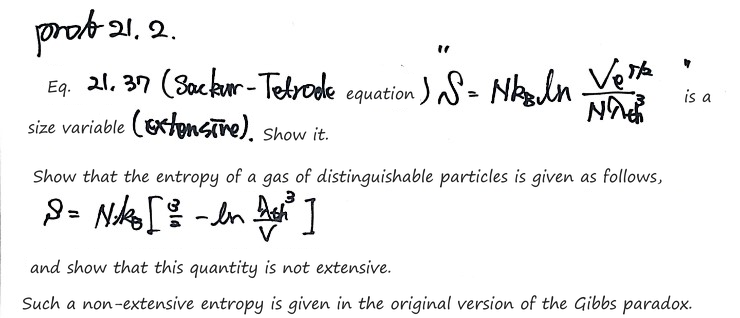
“Extensive” means that if we double the gas at the same temperature and density, its entropy doubles too. So double both $N$ and $V$. The thermal wavelength stays fixed because $T$ stays fixed.
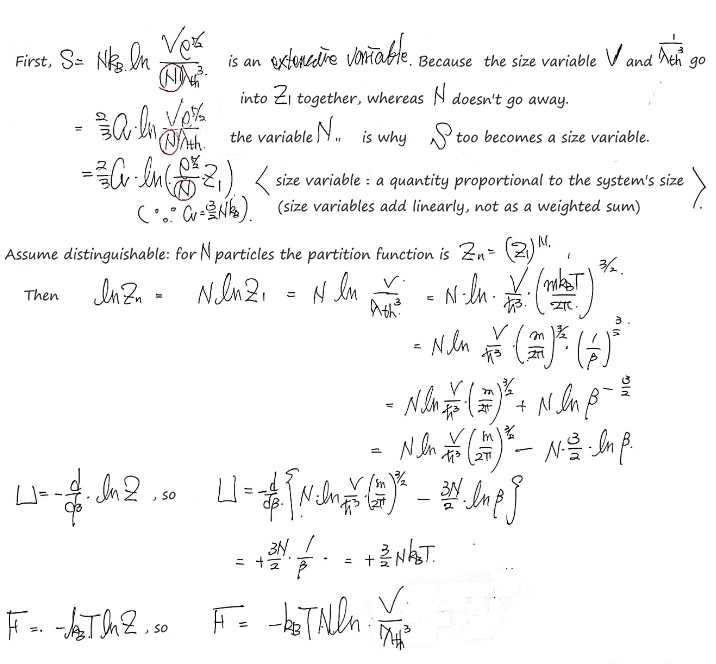
In the large-$N$ approximation used for Sackur–Tetrode,
$$ S=Nk_B\left[\frac52+\ln\frac{V}{N\lambda_{\rm th}^3}\right], $$the ratio $V/N$ inside the logarithm does not change. Only the prefactor doubles. That’s the check we wanted — saying merely that $Z_1$ contains $V$ is not enough.
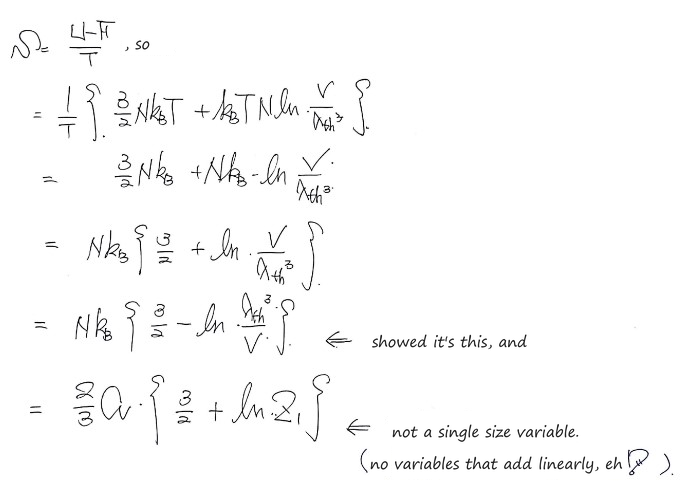
If we instead use the distinguishable-particle counting $Z_N=Z_1^N$, the result on the sheet is $S_{\rm dist}=Nk_B[3/2+\ln(V/\lambda_{\rm th}^3)]$. Now the logarithm contains $V$ alone. Under the same doubling,
$$ S_{\rm dist}(2N,2V,T)=2S_{\rm dist}(N,V,T)+2Nk_B\ln2. $$That extra term is the problem. For identical particles in this classical limit, dividing the state count by $N!$ removes the spurious labeling and gives the extensive expression above.
Prob 21.3 — Counting states up to an energy cutoff
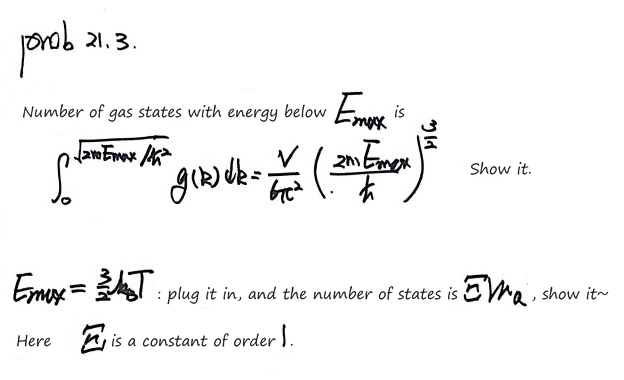
This is a count of available single-particle states, not a count of particles occupying them. The cutoff fixes $k_{\max}=\sqrt{2mE_{\max}}/\hbar$. In three dimensions the shell count is $V k^2dk/(2\pi^2)$, for one internal state.
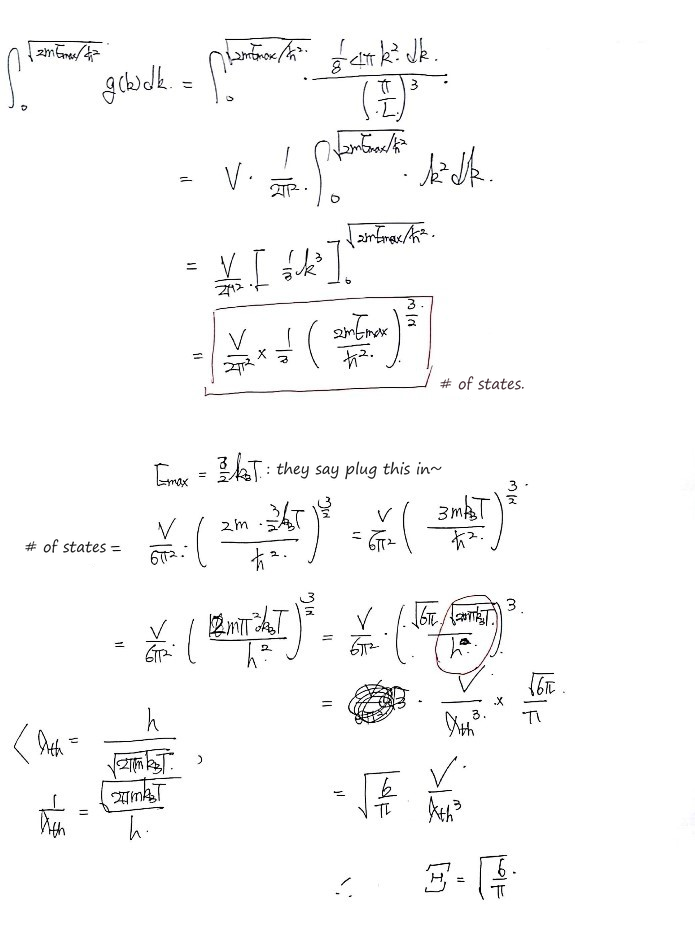
Integrating from zero to $k_{\max}$ gives
$$ \mathcal N(E_{\max})=\frac{V k_{\max}^3}{6\pi^2} =\frac{V}{6\pi^2}\left(\frac{2mE_{\max}}{\hbar^2}\right)^{3/2}. $$Put in $E_{\max}=3k_BT/2$ and compare with $V/\lambda_{\rm th}^3$. The ratio is $\xi=\sqrt{6/\pi}\approx1.382$. Nice — an ordinary number of order one, independent of the size of the box or the temperature. Here $n_Q=1/\lambda_{\rm th}^3$.
Prob 21.4 — Moving around, and getting internally excited
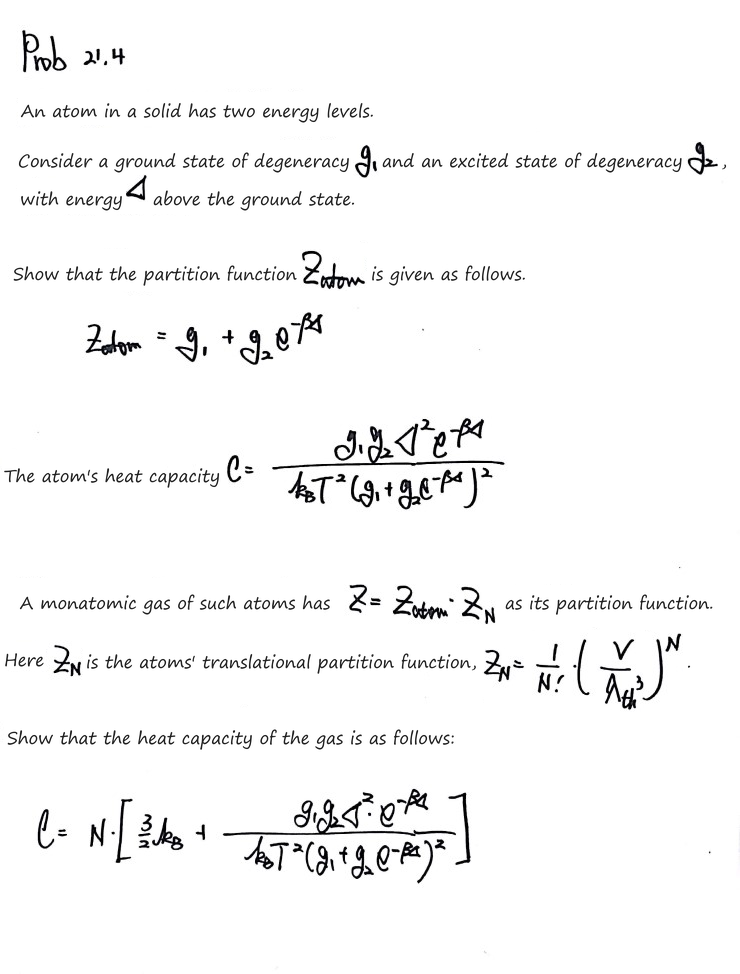
Take the ground-state energy as zero. There are $g_1$ ways to have that energy and $g_2$ ways to have energy $\Delta$. Their Boltzmann weights give $Z_{\rm atom}=g_1+g_2e^{-\beta\Delta}$. The probability of being in the excited level is therefore
$$ P_{\rm ex}=\frac{g_2e^{-\beta\Delta}}{g_1+g_2e^{-\beta\Delta}}, \qquad U_{\rm atom}=\Delta P_{\rm ex}. $$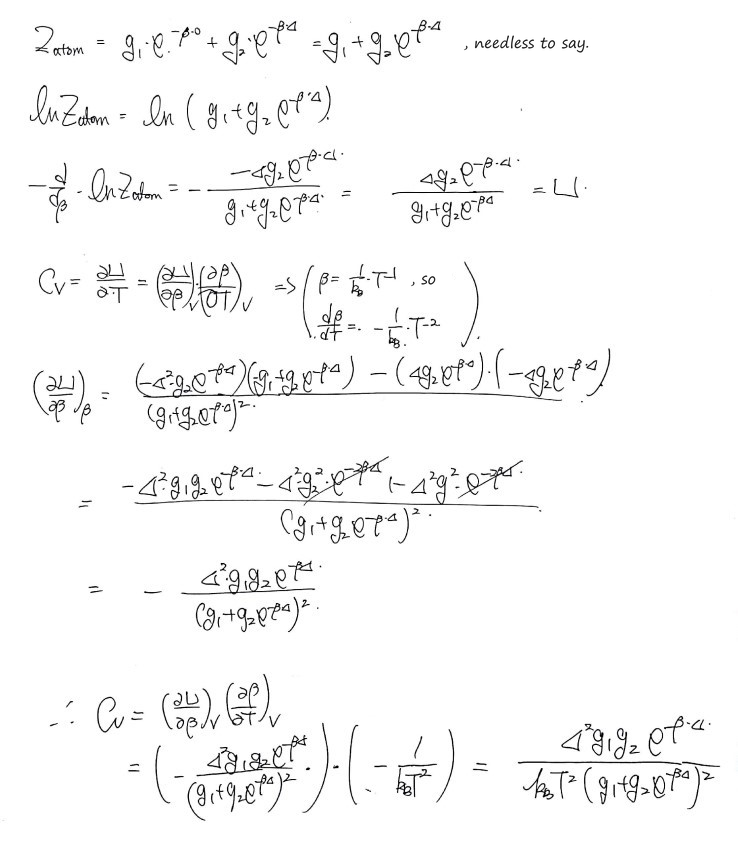
Differentiating this energy with respect to temperature gives the internal heat capacity. The two minus signs — from the Boltzmann derivative and from $d\beta/dT=-1/(k_BT^2)$ — cancel, so this contribution is positive.
For the gas, every one of the $N$ atoms has its own internal states. Multiply those factors, but divide for indistinguishability only once:
$$ Z=\frac1{N!}\left(\frac{VZ_{\rm atom}}{\lambda_{\rm th}^3}\right)^N. $$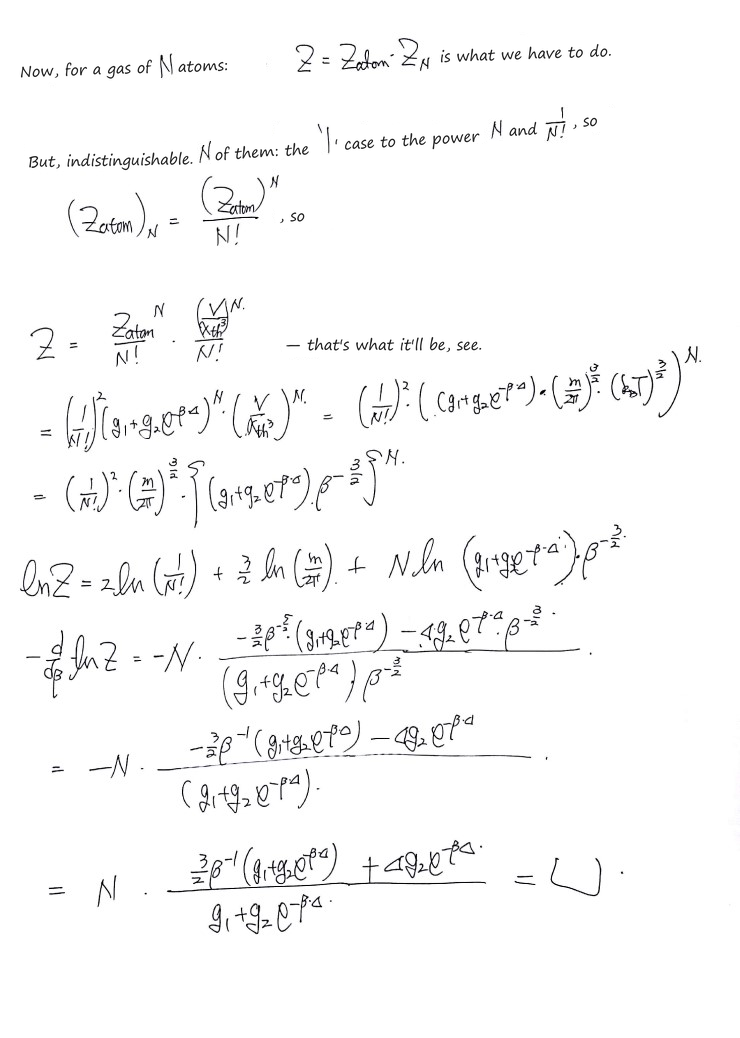
The logarithm splits into translational and internal pieces. That is why the energy is the usual $3Nk_BT/2$ plus $N\Delta P_{\rm ex}$, and the heat capacities add the same way:

The second term is the extra capacity for internal excitation. Within the two-level model it becomes small both when excitation is frozen out and when the level populations have nearly saturated. That gives us a physical check on the derivative, too.
Heads-up. The figures here are the original notes, slips and all. A few things to watch for:
- In Prob 21.1, the normalised wavefunction in the square of area $A$ is $\psi = \frac{2}{\sqrt{A}}\sin(k_xx)\sin(k_yy)$ (not $\frac{2}{A}$), and $\lambda_{th} = \frac{h}{\sqrt{2\pi mk_BT}}$ gives $\frac{1}{\lambda_{th}^2} = \frac{2\pi mk_BT}{h^2}$ (the sheet writes $\lambda_{th}^2$ on the left); $Z_1 = \frac{A}{\lambda_{th}^2}$ is right.
- In Prob 21.2, $S = Nk_B\left[\frac{3}{2} - \ln\frac{\lambda_{th}^3}{V}\right]$ is not extensive because its bracket depends on $V$ itself ($Z_1 \propto V$ is a size variable) rather than on $\frac{V}{N}$: doubling $N$ and $V$ doubles the prefactor but also adds $\ln 2$ inside the bracket. The Sackur-Tetrode bracket has $\ln\frac{V}{N\lambda_{th}^3}$ instead.
- In Prob 21.3, the result is $\frac{V}{6\pi^2}\left(\frac{2mE_{max}}{\hbar^2}\right)^{3/2}$, with $\hbar^2$, as the sheet’s own integral gives.
- In Prob 21.4, the gas’s partition function is $Z = Z_{atom}^N Z_N$ (each of the $N$ atoms brings its own $Z_{atom}$), and the $\frac{1}{N!}$ for identical atoms sits in $Z_N$ only, so the second $\frac{1}{N!}$ on $Z_{atom}^N$ goes; neither changes $U$ or $C$, which are right.
Comments
Discussion happens via GitHub Discussions. You'll need a GitHub account to comment.